
Scientific Peptide Supplies for Research in Ireland
A research designation alone does not determine whether a peptide may be supplied or used in Ireland. When assessing scientific peptide supplies, distinguish research procurement from medical use and consider the product’s intended purpose. This guide covers practical supply questions without treating a research label as a legal ruling.
Clear information about quantities, documentation and product form makes procurement easier to review. This guide explains how to interpret listed quantities and prices, assess a Certificate of Analysis, and understand peptide fragments. It also outlines the role of research-grade peptides and how Z&M Peptide Ireland supports research procurement in Ireland.
Key Takeaways
- Compare each listed price with its stated quantity and unit before assessing value.
- Use a Certificate of Analysis as supporting documentation when reviewing a peptide’s analytical details.
- Recognise peptide fragments as shorter amino-acid chains, typically consisting of fewer than 50 amino acids.
- Assess product price separately from any applicable delivery and VAT charges when estimating total procurement spend.
Table of Contents
Peptide quantities and listed prices
For research teams in Ireland, compare the quantity, unit and order total separately. Match the product code and pack size to the planned protocol.
Irish and EU suppliers can differ in catalogue range, testing records, shipping terms and customer support. Compare the documentation and order details provided for each supplier.
Available Peptide Quantities
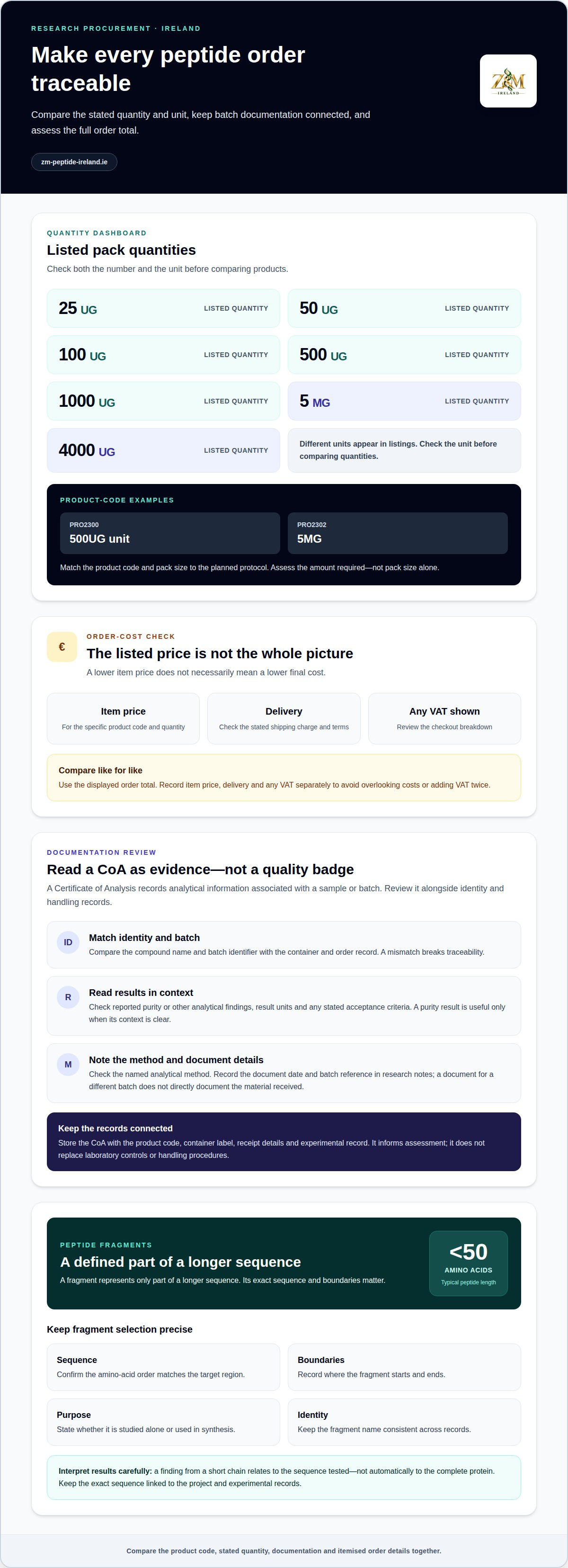
Listed quantities include 25UG, 50UG, 100UG, 500UG, and 1000UG. Other entries use 5MG or 4000UG, so check units before comparing quantities. For example, PRO2300 is listed as a 500UG unit, whilst PRO2302 is listed as 5MG. Scientific peptide supplies should be assessed against the amount your protocol requires, not pack size alone.
For safe handling, follow the product label and your laboratory’s procedures. Record the product code, quantity received and handling steps together. These records support traceability and help distinguish similar items.
Listed Prices and Total Cost
A listed price applies to a specific product code and quantity. Compare like-for-like items rather than treating different pack sizes as equivalent. For scientific peptide supplies, choose a quantity that suits both the protocol and the procurement budget. Keep the code and unit with the price in your purchasing records.
In Ireland, consider the item price alongside shipping and any VAT shown at checkout. Record each charge separately and use the displayed order total. This avoids adding VAT twice or overlooking delivery costs when comparing suppliers.
Shipping terms and support arrangements can differ between Irish and EU suppliers. Compare the stated delivery details, documentation and order information for the specific purchase. A lower listed item price does not necessarily mean a lower final cost.
Certificates of Analysis
Counterfeit, contaminated or mislabelled research peptides can undermine experimental results. Their identity or composition may differ from the label. A Certificate of Analysis (CoA) records analytical information associated with a sample or batch and can support review, but assess it alongside the material’s identity and handling records.
First, match the CoA’s product name and batch identifier to the container and order record. A mismatch breaks traceability. Check that the document identifies the tested material, reports analytical results and describes the methods used. For example, a purity result is useful only when its context and method are clear.
Review the CoA’s details together rather than treating it as a quality badge. Compare the reported identity with the supplied label, then examine the result units and any stated acceptance criteria. Record the document date and batch reference in your research notes. If the document covers a different batch, it does not directly document the material you received.
- Identity: Compare the compound name and identifier with the container.
- Results: Read reported purity or other analytical findings in context.
- Method: Record the named analytical approach and its reported result.
Keep the CoA with the relevant research records, including the product code and receipt details. This makes later reviews more precise and helps distinguish a document mismatch from a laboratory result. A CoA should inform your assessment, not replace appropriate laboratory controls or handling procedures.
For research teams assessing procurement documentation, research peptide supply information provides a relevant next step. Keep the CoA, container label, and experimental record connected throughout review.
Peptide fragments
Peptides are short amino-acid chains, typically consisting of fewer than 50 amino acids. A fragment represents only part of a longer sequence. For example, a research plan focused on one region of a protein may use a corresponding peptide fragment rather than the complete sequence. The fragment’s sequence and boundaries therefore matter.
In peptide synthesis, fragments can be research materials in their own right or components of a larger synthesis strategy. Their defined sequences let researchers focus on a selected region. A custom peptide description should state the required amino-acid order and identify the intended fragment clearly. This helps distinguish a partial sequence from a complete target.
Before selecting a fragment, compare its sequence with the research objective. Check these details in the experimental plan:
- Sequence: confirm the amino-acid order matches the target region.
- Boundaries: record where the fragment starts and ends.
- Purpose: state whether it is studied alone or used in synthesis.
- Identity: keep the fragment name consistent across records.
These steps help prevent a naming difference from becoming a material-selection error. For example, two fragments from the same protein can represent different regions. Sharing a protein name does not make their sequences equivalent. Record the exact sequence alongside the project identifier.
Fragment length also affects how you interpret results. A finding from a short chain relates to the sequence tested, not automatically to the complete protein. Keep that distinction clear in protocols, data tables and research notes. If fragments are synthesis building blocks, document each component and its intended position in the final sequence.
For procurement records, link each fragment’s sequence, label and experimental purpose. This gives researchers a practical basis for comparing materials and reviewing results. It also keeps a custom peptide request precise, without relying on an informal name or broad target description.
Research peptide costs in Ireland: shipping and VAT
For a research order in Ireland, consider the item price alongside shipping and any VAT shown. The product price alone does not establish the final payable total. Check the order summary before placing the order, and keep its itemised charges with your procurement records. This separates the peptide price from delivery and tax entries.
Shipping charges can depend on the order and the delivery terms shown at checkout. Compare the stated charge and delivery option for each order rather than assuming suppliers use identical terms. For example, record the product subtotal, shipping charge, VAT and final total separately. This makes later budget reviews clearer.
For VAT, use the treatment shown in the supplier’s transaction details. Do not calculate tax from an assumed rate. The applicable treatment can depend on the transaction, so retain the invoice or order confirmation as a record of the amount charged. If VAT is included in the displayed total, do not add it again.
- Product: record the selected item and pack quantity.
- Shipping: note the delivery charge shown for the order.
- VAT: use the tax amount and treatment recorded at checkout.
- Total: retain the final payable amount from the order summary.
This breakdown also helps when comparing quotations. Compare matching products and quantities, then assess shipping and VAT separately. A lower product subtotal may not mean a lower total once delivery charges are included. Tie each figure to its supplier and order record to avoid mistaken comparisons during purchasing reviews.
For a practical procurement next step, review research procurement options and assess the order details against your budget and laboratory requirements.
Z&M Peptide Ireland: Research Peptides
Z&M Peptide Ireland supplies research peptides for laboratory and research purposes. Its offering is relevant when your project requires research-grade compounds for scientific work, not medical consultation or personal use. The right selection depends on your study design, the material’s intended role and your laboratory’s handling procedures.
Before procurement, match the required peptide to your protocol and record its identifier, quantity and intended use. Keep the order information with relevant laboratory records to support traceability during handling and review. This is a practical next step after assessing quantities, documentation, fragments and order costs.
Research peptides are intended exclusively for laboratory and research purposes. For procurement, visit zm-peptide-ireland.ie.
Put your research requirements into practice
Make procurement part of the experimental plan, not a separate administrative task. Define the material’s research purpose, assign responsibility for reviewing supplier documentation and decide how to record the order before work begins. A consistent process helps your team connect purchasing decisions with laboratory procedures and results.
For research teams in Ireland seeking scientific peptide supplies, the next step is to match the required research peptides to the project’s documented needs. Z&M Peptide Ireland supplies Research Peptides for laboratory and research purposes. This procurement option is for teams that need research materials, not medical consultation.
Review the research peptide offering and take the next step at Z&M Peptide Ireland. A considered procurement process gives your team a clear basis for moving from planning to research.
Z&M Peptide Ireland and Scientific Peptide Supplies
Z&M Peptide Ireland offers Research Peptides. If you are looking for scientific peptide supplies for research, this is where the article’s guidance can lead you to the client’s offering.
Turn to Z&M Peptide Ireland when you are ready to explore Research Peptides.
Frequently Asked Questions
Legal & Compliance: Are Peptides Legal?
Legality depends on the specific peptide, its intended purpose and how it is supplied or used. A research label alone does not establish that a compound is suitable or permitted for every purpose. Distinguish laboratory research procurement from human or veterinary use, and do not treat research material as medicine. Assess the substance and proposed use against applicable Irish and EU requirements.
What are scientific peptides and what are they used for in research?
Scientific peptides are short chains of amino acids studied in laboratory research. Researchers may use a defined sequence to investigate a molecular question or develop an experimental method. For example, a study might compare how two sequences behave under the same assay conditions. The research purpose determines which sequence and experimental controls are relevant.
Which suppliers sell research peptides to customers in Ireland?
Z&M Peptide Ireland supplies research peptides to Ireland’s scientific community for laboratory and research purposes. Its online platform supports procurement of research-grade compounds. Research teams can consider the supplier when sourcing materials for a laboratory project and align purchasing records with their internal procedures. The offering is for research, not medical consultation or treatment.
How can I assess the purity and quality of research peptides?
Assess purity alongside identity and the analytical method used to produce the result. High-performance liquid chromatography (HPLC) can provide a purity profile, whilst mass spectrometry can support assessment of molecular mass. Interpret neither result in isolation: compare the findings with the material’s expected identity and your experimental requirements. Record the analytical details alongside the sample in your research notes.
What certificates of analysis and testing should peptide suppliers provide?
A useful Certificate of Analysis identifies the material and links its results to the relevant batch. Review the reported identity, analytical findings, test method and any stated criteria. For example, a purity value without its method gives limited context. Keep the document with procurement and laboratory records, and distinguish supplier documentation from any testing required by your research protocol.
What are the Irish and EU rules for importing and purchasing research peptides?
Irish and EU purchasing considerations depend on the compound, its intended use and whether the transaction involves cross-border supply. Before procurement, identify the substance and research purpose, then consider the relevant product classification and transaction requirements. Do not assume a research designation resolves every import or purchase question. Keep the product description and order records together for a clear audit trail.
