
Reta Peptide: UK Status, Expected Availability and Conditions Studied
In Ireland, retatrutide remains investigational and is not an approved medicine. The Health Products Regulatory Authority (HPRA), Ireland’s medicines regulator, provides the official context for medicine authorisation and availability.
It’s understandable to look for a clear timeline as clinical studies progress. Retatrutide is being studied in Phase 3 trials, but trial progress alone does not establish approval or availability in Ireland.
This article reviews the conditions studied, reported trial side effects and administration schedules used in clinical research. It also explains how to distinguish trial evidence from the regulatory status relevant to readers in Ireland.
Key Takeaways
- Retatrutide remains investigational and is not currently available as an approved medicine in Ireland; future availability depends on regulatory approval.
- Clinical studies are examining its potential across obesity and overweight, including among people with type 2 diabetes.
- Trial findings need to be read alongside reported side effects and the limits of evidence from ongoing studies.
- Clinical trial administration schedules are research protocols, not instructions for personal use; laboratory research has a separate purpose.
Table of Contents
Conditions being studied
Retatrutide is an investigational triple receptor agonist studied in clinical trials for metabolic conditions. It activates receptors for GIP, GLP-1 and glucagon. GIP is glucose-dependent insulinotropic polypeptide, also called dependent insulinotropic polypeptide. The informal label “GLP-3” is scientifically inaccurate and does not identify a separate receptor. This mechanism defines the compound’s research profile, but does not establish a clinical benefit.
Obesity and overweight are central study areas. TRIUMPH-1 examined adults with obesity or overweight who did not have diabetes. Its results were presented at the 2026 American Diabetes Association Scientific Sessions and published in The New England Journal of Medicine. The published report recorded average body-weight loss of 28.3% over 80 weeks in the 12 mg group. The trial also assessed whether participants reached substantial weight-loss thresholds. These are findings in the studied population, not predictions for individuals.
Type 2 diabetes is another study focus. TRIUMPH-2 enrolled adults with type 2 diabetes and obesity or overweight. Results were presented at the 2026 European Association for the Study of Diabetes Annual Meeting and published in The Lancet. In the 12 mg group, average body-weight loss was 20.8% over 80 weeks, and average A1C reduction was 1.5%. These endpoints measure different outcomes and should be interpreted separately.
TRIUMPH-3 examined adults with severe obesity and established heart disease. Its study population makes it relevant to research on retatrutide in a distinct clinical context. However, findings from this group should not be assumed to apply to people without established heart disease. The trial name and participant characteristics are essential when assessing the scope of any reported outcome.
When reviewing a published result, first identify the population, then the measured endpoint and study duration. A weight outcome in adults without diabetes does not answer the same question as an A1C outcome in adults with type 2 diabetes. Likewise, evidence from a clinical trial differs from in-vitro or animal findings, which use different experimental systems and cannot be treated as equivalent human evidence.
Retatrutide remains investigational, so trial findings describe research rather than established clinical use. For Irish laboratory teams, this distinction matters when using human studies to frame a hypothesis. Clinical outcomes do not directly establish an assay method, experimental concentration or result in a separate model. Keep the trial population, protocol and endpoint attached to each finding during interpretation.
Licensed medicines such as semaglutide (Wegovy®) and tirzepatide (Mounjaro®) act on one or two of the three receptors being investigated for retatrutide. This comparison helps explain why a compound acting on three receptors is being studied, while keeping receptor activity distinct from evidence of clinical outcomes.
For laboratory teams, receptor coverage can help frame a research question, but it does not establish that the medicines have equivalent effects or that results from one compound predict results from another. Interpret each finding in the context of the specific compound, participant group and endpoint studied. This makes mechanistic comparisons useful without treating them as evidence of shared clinical benefit.
What are the common and serious side effects of retatrutide?
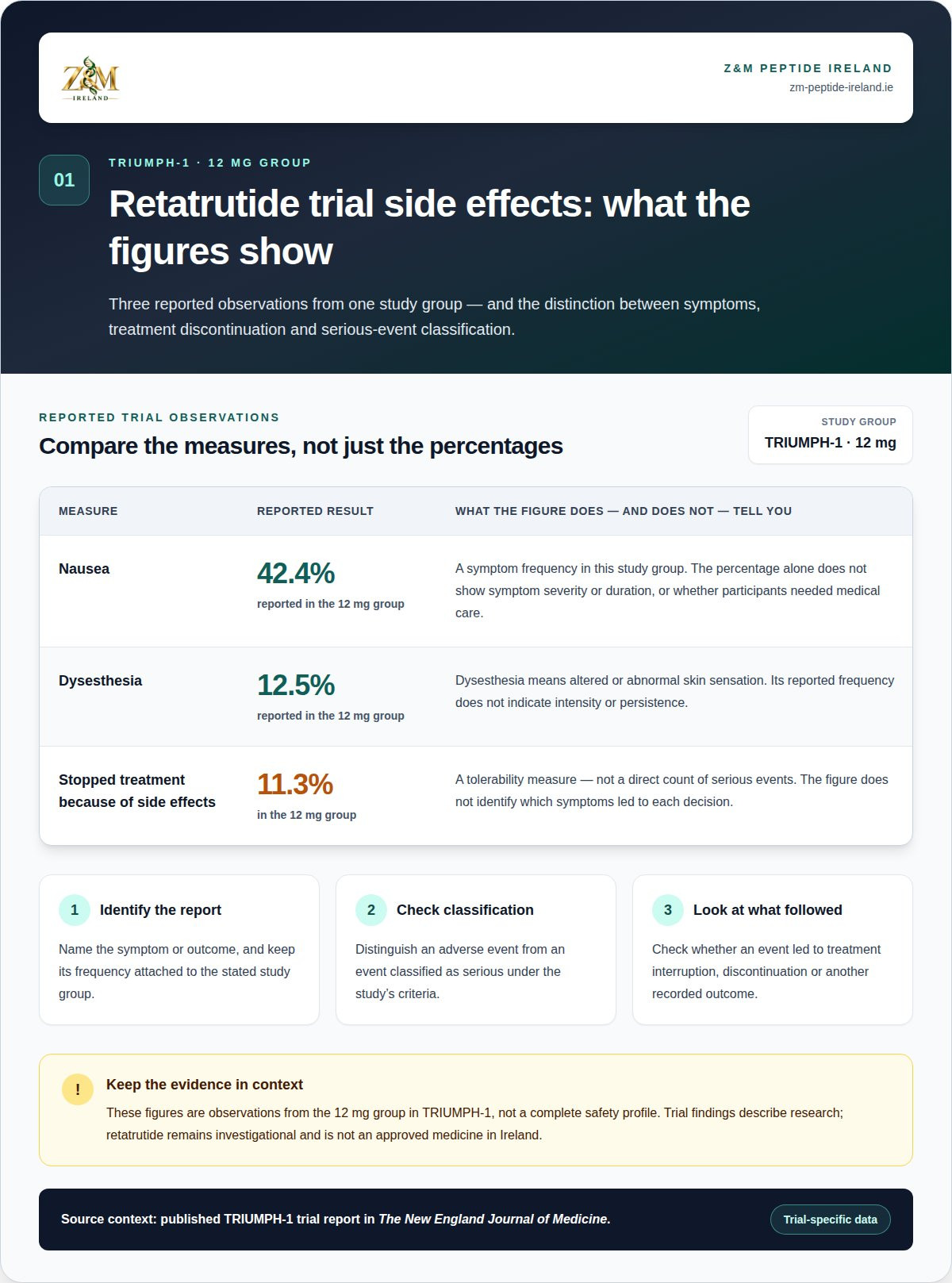
Side-effect figures from retatrutide trials describe observations in specific study groups, not a complete safety profile. In TRIUMPH-1, nausea was reported by 42.4% of participants taking 12 mg. Dysesthesia, meaning altered or abnormal skin sensation, was reported by 12.5% in that group. The TRIUMPH-1 results were published in The New England Journal of Medicine. These percentages relate to trial participants and should not be treated as predictions for every person.
It is important to distinguish a reported side effect from a serious adverse event. Nausea is a symptom recorded during a trial; its percentage alone does not show its severity or duration, or whether participants needed medical care. Dysesthesia describes a sensory symptom, but its reported rate does not indicate intensity or persistence. Those details depend on the published trial report’s full adverse-event data and definitions.
TRIUMPH-1 also reported that 11.3% of participants taking 12 mg stopped treatment because of side effects. This result is reported in the same published trial. Discontinuation is a measure of tolerability, not a direct count of serious events. Participants may stop for different reasons, and this figure does not identify which symptoms led to each decision. It should therefore be read alongside, not substituted for, the study’s separate safety findings.
For a careful reading of trial safety, separate these three questions:
- What was reported? Identify the symptom, such as nausea or dysesthesia, and its frequency in the stated group.
- How was it classified? Distinguish an adverse event from an event classed as serious under the study’s criteria.
- What happened next? Check whether the event led to treatment interruption, discontinuation or another recorded outcome.
This approach prevents a common misreading: a frequent symptom is not automatically a serious event, while a lower frequency does not by itself establish low clinical importance. The 11.3% discontinuation figure adds information about tolerability, but does not explain each participant’s experience. The published TRIUMPH-1 report is the relevant source for interpreting these trial-specific observations and their classifications.
Retatrutide remains investigational, so trial safety findings are still part of evidence being assessed. Study population, treatment duration and dose all affect how results should be interpreted. The percentages above apply to the 12 mg group in TRIUMPH-1; they should not be transferred to another dose or population without corresponding evidence. Nor do trial observations establish safety for use outside a clinical study. For Irish laboratory teams, these human data provide clinical context, but they are not a substitute for compound characterisation or evidence from a distinct experimental system.
How is retatrutide administered, and what dosing schedules have trials studied?
Clinical trials have administered retatrutide as a once-weekly subcutaneous injection. “Subcutaneous” means delivery beneath the skin, rather than into a vein or muscle. This describes clinical research protocols, not personal-use instructions. Retatrutide remains investigational, and trial administration should not be treated as an approved treatment schedule in Ireland.
The published Phase 2 study provides useful context for interpreting schedules. It randomised 338 adults and ran for 48 weeks, with once-weekly treatment arms. Different dose levels allowed investigators to assess outcomes across groups. The design does not mean that a trial dose or schedule is appropriate outside the study. Its purpose was to generate controlled evidence under a defined clinical protocol.
Phase 3 programmes, including the TRIUMPH trials, have continued to assess retatrutide in larger clinical research settings. Trial protocols can differ in their populations, dose arms, escalation procedures and observation periods. Those differences affect how results should be compared. For example, a finding from a study with adults without diabetes cannot automatically be interpreted as an equivalent result in adults with type 2 diabetes.
When reviewing a published schedule, focus on its research context rather than copying it. The key distinctions are:
- Route: the clinical-trial route reported for retatrutide is subcutaneous injection.
- Frequency: published trial arms used once-weekly administration.
- Protocol: dose selection and any changes belong to the specific study design.
- Population and duration: participant characteristics and observation period shape the meaning of outcomes.
For laboratory research, clinical administration data answer a different question from biochemical profiling. A weekly injection schedule describes how an investigational medicine was administered in a human study. It does not establish a laboratory concentration, assay condition or experimental protocol. Those parameters depend on the research question, model system and validated method, not a human trial schedule.
Retatrutide studies have examined multiple dose levels, but dose values and escalation instructions are not included here because they could be mistaken for guidance on human use. This distinction is especially important in Ireland, where retatrutide is not an approved medicine. When interpreting published evidence, researchers should record the trial name, population, route, frequency and duration separately. This preserves the protocol context without presenting clinical schedules as treatment or laboratory-handling instructions.
Researchers interpreting published evidence should record the trial population, treatment duration and dose schedule alongside outcomes, because these features define the context in which results were observed. The page states that phase 2 trials studied retatrutide doses up to 12 mg per week. The published Phase 2 retatrutide study included doses from 1 mg up to 12 mg and used once-weekly treatment arms.
Dose values describe the range studied in that research, not a recommendation or personal-use instruction. Read them alongside the study design and participant group, rather than as a schedule transferable to another setting. A reported dose range alone does not establish which dose is suitable for an individual or how treatment should change. The clinical protocol is essential context for understanding how investigators studied retatrutide.
Z&M Peptide Ireland: Research Peptides
Z&M Peptide Ireland supplies research peptides for laboratory and research purposes. For Irish research teams, this provides a procurement option for peptide materials needed for non-clinical laboratory work, not an approved medicine or treatment. Retatrutide’s clinical-trial findings do not establish that a particular compound is available or suitable for a specific experiment.
Define the experimental purpose before selecting research materials. Biochemical profiling, analytical method development and receptor studies, for example, have different requirements. Research-only labelling does not demonstrate safety, regulatory approval or permission for human use. Keep procurement decisions separate from clinical-trial evidence and medical use.
For research-peptide procurement for laboratory work, contact Z&M Peptide Ireland to discuss your requirements.
Plan the next research step
For Irish research teams, a useful next step is to turn interest in the reta peptide into a defined laboratory question. Specify the biological model, endpoint and analytical method before selecting materials. This keeps human clinical findings in their proper role: context for developing a hypothesis, not a ready-made laboratory protocol or evidence that a medicine is available.
If a project requires peptide material, align procurement with the experiment. A receptor-focused assay, for example, may have different analytical considerations from a stability or identity study. Record the intended research use and material requirements in the project plan. This makes the next decision concrete without treating trial administration schedules as instructions.
For research peptide procurement, contact Z&M Peptide Ireland and outline your laboratory requirements. A clearly defined research question is a sound basis for moving forward.
Z&M Peptide Ireland and Research Peptides
If you’re exploring reta peptide for research, Z&M Peptide Ireland supplies Research Peptides for laboratory use.
When Research Peptides are relevant to your next research step, turn to Z&M Peptide Ireland.
Frequently Asked Questions
What is retatrutide (RETA peptide) and how does it work?
Retatrutide is an investigational peptide medicine candidate; “reta peptide” is an informal name for it. Its triple-agonist design targets the GIP, GLP-1 and glucagon receptors, allowing researchers to assess one molecule’s activity across three hormone pathways. This receptor profile distinguishes it from compounds targeting fewer receptors. It does not establish that retatrutide is approved or suitable for human use.
