
Research peptides for university facilities and solid-state stability
Solid-state stability is a procurement consideration, not a guarantee of peptide performance. For research peptides used by universities, the dry form can help preserve the material during storage, but conditions and handling remain important to its integrity.
That distinction matters when a laboratory plans experiments: a product’s form and storage requirements affect how it is managed before use. A research-use-only label defines intended use; it is not proof of safety, approval or legal permission for human or veterinary use.
This article explains why solid-state stability matters, outlines peptide categories commonly considered for laboratory research and summarises how research-use-only restrictions apply. It also covers the practical role of analytical documentation, including what a Certificate of Analysis can show about identity, purity and batch details.
Key Takeaways
- Understand why a peptide’s solid form can matter for storage, and which handling factors influence its stability.
- See how commonly discussed research peptides differ, and why intended study context matters when selecting material.
- Distinguish research-use-only labelling from evidence of safety, approval or permission for human or veterinary use.
- Use analytical documentation to assess identity, purity and batch information before procurement decisions.
Table of Contents
Commonly ordered research peptides
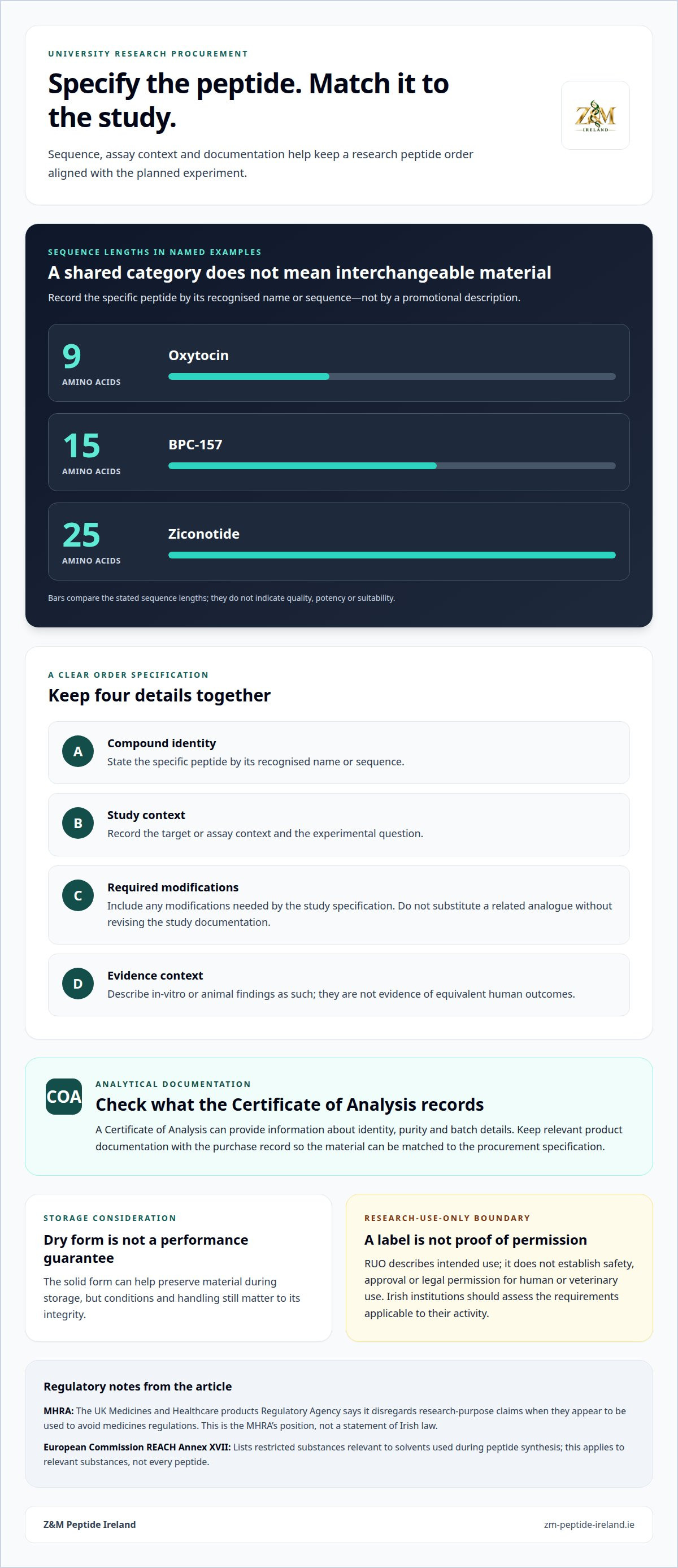
Procurement records should identify a peptide by its sequence or recognised name, not by a promotional description. BPC-157, for example, is a 15-amino-acid peptide. That concrete identifier gives researchers and purchasing teams a clearer starting point for matching a requested compound to a study specification.
Examples of other named peptides include oxytocin, a 9-amino-acid peptide, and ziconotide, a 25-amino-acid peptide. These examples differ in sequence and research context, so a shared category label does not make them interchangeable. A university request should state the specific peptide and the experimental question it is intended to address.
For research peptides for universities, selection begins with the protocol. Record the compound name or sequence, target or assay context, and any required modifications. For instance, a project examining a defined sequence should not substitute a related analogue without revising its study documentation. This keeps the order aligned with the planned experiment.
Procurement teams can organise requests by research purpose rather than broad claims about a compound. A clear specification helps distinguish material identity from proposed biological effects. Findings from in-vitro or animal studies should be described as such, not presented as evidence of human outcomes. This distinction matters when the literature describes a peptide using therapeutic language.
Solvents used during peptide synthesis can also be relevant to procurement review. The European Commission’s REACH Annex XVII lists restricted substances relevant to those solvents. This applies to relevant substances, not every peptide. Keeping the compound specification and relevant material documentation together gives the university a traceable basis for its purchasing decision.
Research-use-only disclaimers
A research-use-only (RUO) label describes intended use; it does not establish safety, approval or legal permission. Research peptides supplied for this purpose are intended for in-vitro laboratory and scientific research, not human or veterinary use. University procurement records should preserve that distinction from purchase through storage, experimental use and disposal.
The boundary is practical. A laboratory protocol might examine a peptide’s behaviour in a cell-based assay, while a proposal to administer it to a person or animal falls outside the stated research-only purpose. Marketing language cannot replace the approved study protocol, institutional review or applicable regulatory assessment. Nor does a research label show that a material is suitable for a particular assay.
Regulatory status depends on the product and its presentation, not simply a disclaimer on the packaging. The UK Medicines and Healthcare products Regulatory Agency says it disregards research-purpose claims when they appear to be used to avoid medicines regulations. That is the MHRA’s position, not a statement of Irish law; Irish institutions should assess the Irish and EU requirements applicable to their intended activity.
For a university order, record the research purpose, named investigator, compound identity and intended laboratory use. Keep the product documentation with the purchase record, and ensure the protocol, labelling and actual handling remain consistent. If a proposed activity changes from in-vitro work to human or veterinary use, the original RUO wording does not authorise that change.
Apply the disclaimer at each operational stage. Procurement staff can route an order as laboratory material; receiving staff can retain its identity and accompanying records; researchers can restrict use to the stated experimental purpose. For example, an in-vitro assay does not become a clinical study simply because its results are biologically relevant. Findings from cell or animal research also do not establish human safety or efficacy.
In Ireland, treat RUO status as an intended-use boundary, not a regulatory exemption. University approval processes and applicable requirements still govern the research activity. Clear records help prevent a mismatch between the purchase description, study protocol and peptide’s actual use.
What peptides are and how they work
Peptides are chains of amino acids linked by peptide bonds. Their sequence and shape influence interactions with biological targets. Oxytocin, for example, consists of 9 amino acids. The human body is estimated to contain about 7,000 peptides at any time, with varied roles in biological signalling.
Chain length helps define laboratory terminology. A polypeptide is described as a chain of more than 20 amino acids, while a chain exceeding 50 amino acids is described as a protein. Recording a sequence and chain description helps ensure procurement specifications refer to the intended material.
A peptide may bind to a receptor or another molecular target, influencing signalling or cellular activity. The outcome depends on its sequence, target and experimental model. For example, a response observed in a cell assay describes that model, not necessarily an equivalent response in humans. Record assay conditions when interpreting results.
Peptides can be synthesised as defined sequences, although chemical changes and enzymatic breakdown may affect their stability, half-life or membrane permeability. These characteristics shape experimental design. Researchers should align the assay, sample conditions and measurement point with the question being tested, rather than assume every sequence behaves alike.
University teams should connect a peptide sequence to a defined target and experimental model. A receptor-binding study, for instance, differs from an assay tracking downstream cellular activity. State the intended model and readout in the project documentation, then select analytical methods suited to the question. This helps teams distinguish material identity from observed behaviour. It also supports accurate reporting: findings from in-vitro, animal and human research represent different types of evidence and should not be treated as interchangeable. A clear link between sequence, model and readout makes results easier to interpret across project records and research groups.
What quality standards and certificates should universities require when purchasing research peptides?
A Certificate of Analysis (CoA) helps procurement and research teams assess a peptide batch against its documented characteristics. For research-grade material, the CoA should include HPLC purity results and the chromatogram. The chromatogram supports the reported purity figure, rather than leaving the percentage as an isolated claim.
Identity is a separate question from purity. Mass spectrometry can help verify whether the measured molecular mass corresponds to the expected peptide. A high purity result alone does not establish identity, so both analytical details matter when reviewing documentation for a named sequence.
Water content can affect how a laboratory interprets the mass of material weighed for an experiment. A CoA can report water content, ideally measured using Karl Fischer titration. The salt form, such as acetate or TFA, should also be stated because it forms part of the material’s chemical description.
Batch traceability links the received material to its records. The CoA should identify the batch number, test date and retest date. Procurement staff can retain these details alongside the order and product identity, allowing researchers to associate experimental records with the relevant batch. A retest date does not replace following the stated storage conditions.
Research-grade peptides for laboratory research differ from GMP material made under pharmaceutical quality systems for use in medicines. A research CoA does not establish GMP status, pharmaceutical suitability or sterility. Universities should match the material category and documentation to the intended laboratory study, rather than treating one certificate as evidence of every quality attribute.
For a practical procurement record, retain the CoA with the purchase documentation and study file. Align the peptide name, batch identifier and analytical results across those records. Review research peptide options in relation to your laboratory’s specified research requirements.
Compare suppliers by reviewing batch-specific HPLC purity results and chromatograms, mass-spectrometry identity checks, reported water content and salt form, and traceable batch and testing details. Match the material and documentation to the laboratory’s research requirements; this information does not support comparisons of synthesis options or delivery.
Z&M Peptide Ireland: Research Peptides
Z&M Peptide Ireland supplies research peptides for laboratory and scientific research. University teams can consider this offering when a defined research requirement calls for a peptide intended for research use, rather than human or veterinary use.
Before procurement, align the requested material with the study protocol, intended experimental model and university purchasing process. Keep the compound identity and research purpose clear in the order records. Research-use-only status describes intended use; it does not establish safety, approval or legal permission for other uses.
For research peptide procurement that fits your laboratory requirements, contact Z&M Peptide Ireland.
Put procurement criteria into practice
A sound procurement decision begins with a defined experimental purpose. The next step is to translate that purpose into a clear material specification and an approval trail that fits the university’s purchasing process. This gives researchers and procurement teams a shared basis for assessing whether a peptide is suitable for the planned work.
For research peptides for universities, consistency between the study plan, requested material and records can support clearer interpretation later. Build these requirements into the project workflow before placing an order, and retain relevant procurement information with the study documentation. A precise specification also makes it easier to identify questions that need resolution within the institution’s process.
Z&M Peptide Ireland offers Research Peptides for laboratory and scientific research. Contact Z&M Peptide Ireland to discuss research peptide procurement for your laboratory. A clearly defined requirement is a practical starting point for the next stage of your research.
Frequently Asked Questions
What are research peptides and how are they used in university research?
Research peptides are amino-acid sequences used as materials in laboratory investigations. A university team might use a defined sequence as a probe in an in-vitro assay, comparing its observed interaction with a control condition. The research question determines the assay and interpretation. Researchers should record the sequence and experimental context so results can be understood alongside the methods used.
Where can Irish universities source research-grade peptides from reputable suppliers?
Irish university teams can source research peptides from Z&M Peptide Ireland, which supplies compounds intended for laboratory and scientific research. For a purchase, align the requested material with the study specification and the university’s purchasing process. The authorised purchaser and principal investigator can coordinate the order records, linking the procurement trail to the project’s experimental documentation.
How should universities compare peptide suppliers on purity, documentation, synthesis options, and delivery?
Compare CoAs for HPLC purity with a chromatogram, mass-spectrometry identity checks, water content, salt form and batch details. Compare synthesis support for design, yield and purity requirements, solid-phase synthesis and modifications. For delivery, Limerick city orders usually arrive within one to two working days, while most wider Mid-West addresses receive deliveries within two working days.
What EU and Irish regulations apply to purchasing, importing, storing, and using research peptides in universities?
Treat RUO labelling as an intended-use boundary, not a regulatory exemption, and assess the Irish and EU requirements applicable to the planned activity. REACH Annex XVII lists restricted substances relevant to solvents used in peptide synthesis; this is not a blanket rule for every peptide.
What ethics, biosafety, and institutional approvals are needed for peptide research involving animals or human samples?
University approval processes, institutional review and applicable regulatory assessment govern research activities. RUO material is intended for in-vitro laboratory research, not human or veterinary use; the RUO label does not authorise a proposed change to such use.
What are the main safety, storage, handling, and disposal risks for research peptides?
Dry, freeze-dried peptides can last a year or more when kept cold, while a peptide in solution may last only days or weeks; follow the stated storage conditions. RUO labelling does not establish safety, and records should keep the intended laboratory use clear through storage, research and disposal.
