
Research Peptide Shop for Catalogue, Availability and Quotes
Yes. A research peptide shop lets you browse compounds and pack sizes, review lot-specific certificates, check availability and request a quotation. To get product-specific pricing, identify the compound and size you need before requesting a quote.
For laboratory procurement, a clear product record matters as much as a catalogue entry. A certificate is most useful when its lot identifier matches the material being considered. A research-only label alone does not establish safety, approval or legal permission.
This guide explains what to look for in lot-specific documentation, how to compare catalogue options and availability, and what to include in a quotation request. It also shows how Z&M Peptide Ireland supports Irish research teams seeking research peptides.
Key Takeaways
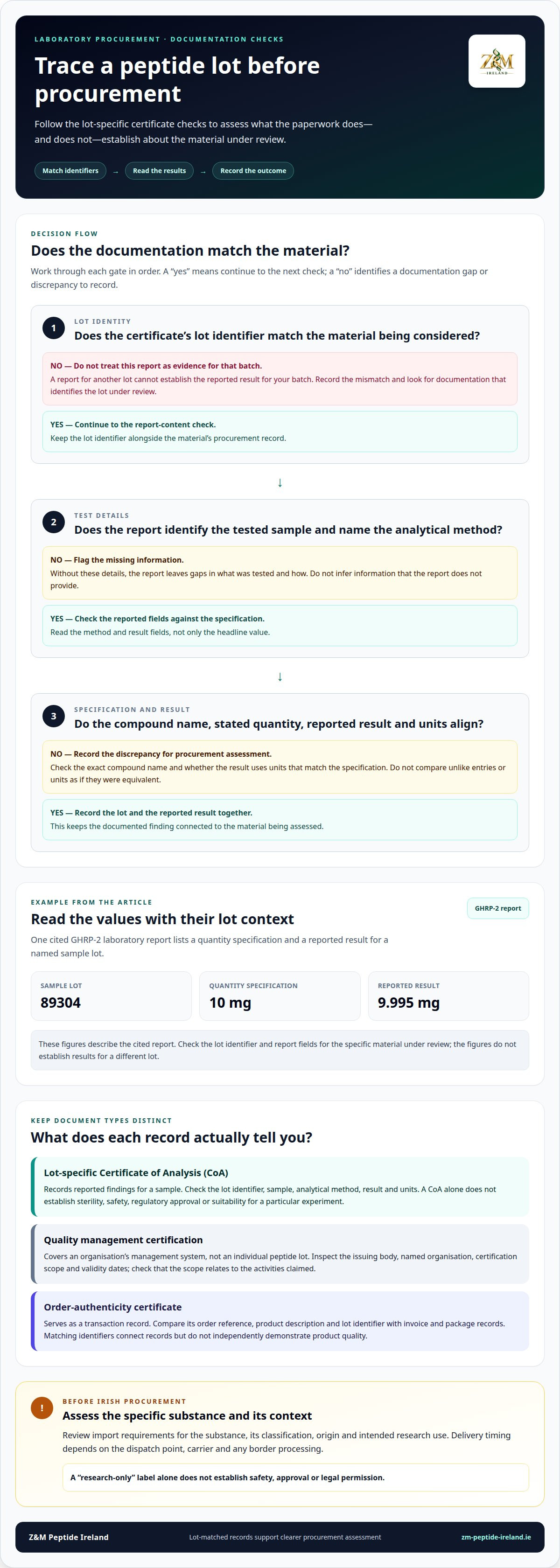
- Match a certificate’s lot identifier to the material under consideration; one cited GHRP-2 report records 10 mg specified and 9.995 mg reported for lot 89304.
- Browse catalogue entries by compound and product details so you can identify options relevant to your laboratory requirements.
- Compare available variants and sizes against your research needs before preparing a procurement request.
- For a quotation, specify the compound and size you are seeking so the request is clear and actionable.
Table of Contents
Lot-specific certificates of analysis
Begin by matching the certificate’s lot identifier to the exact material under review. A report for another lot cannot establish the reported result for your batch. One cited GHRP-2 laboratory report lists a quantity specification of 10 mg and a reported result of 9.995 mg for sample lot 89304. Compare the compound name, lot code, stated quantity and reported result, rather than relying on a certificate title alone.
Read the method and result fields, not just the headline value. Check whether the report identifies the tested sample, names the analytical method and gives units that match the specification. A Certificate of Analysis (CoA) records reported findings for a sample; on its own, it does not establish sterility, safety, regulatory approval or suitability for a particular experiment. Record any difference between the specified quantity and reported result for your procurement assessment.
Quality management certification covers an organisation’s management system, not an individual peptide lot. If a supplier presents a certificate, inspect the issuing body, named organisation, certification scope and validity dates. Check that the scope relates to the activities claimed. A valid management-system certificate is not a substitute for a lot-specific CoA or proof that a particular sample was tested.
An order-authenticity certificate serves a different purpose from analytical documentation. Treat it as a transaction record and compare its order reference, product description and lot identifier with the invoice and package records. Matching identifiers connect the purchased item to its paperwork, but do not independently demonstrate product quality.
For Ireland, assess import requirements for the specific substance, its classification, origin and intended research use before ordering. Delivery timing depends on the dispatch point, carrier and any border processing. To assess a research peptide shop’s legitimacy and product quality, compare its business identity and ordering records with a lot-matched CoA, then review the method, units and results. A research-only label alone proves none of these points.
Online peptide and amino acid derivatives catalogue
Use catalogue entries to identify compounds and compare their listed details. Treat each entry as a procurement record, not proof of suitability for your research.
Peptide and amino acid derivative listings
Research peptides are compounds studied in scientific research, including investigations of molecular structure or biological activity. They are intended for laboratory research, not as a basis for treatment advice. An online catalogue may group peptides and amino acid derivatives by compound name or category. Compare the exact identity and listed form before considering an entry.
For Irish procurement, record the compound name, listed size and accompanying documentation for each catalogue entry. Compare like with like: a peptide and an amino acid derivative are distinct entries, even if both are relevant to the same project. This gives your team a clear basis for assessing the catalogue against its research requirements.
Catalogue prices
Read any displayed price alongside the product size and unit. Without that context, a price cannot support a useful comparison between catalogue peptides. Note whether an entry shows a product price or directs procurement teams to request a quotation; these are different stages of purchasing.
For a quotation, specify the compound and listed size. The options requested and order details determine what the quote covers. Do not treat a price for one size as the price for another. Record the quoted item description with your procurement paperwork.
Which research peptide shops ship to Ireland? Delivery options depend on the seller’s destination settings and the specific item. Review the destination information during ordering, and consider import requirements for the compound and its intended research use.
Buying or handling research peptides carries risks if identity, documentation or storage information is inadequate. For example, a mismatch between a product label and its records can undermine sample traceability. Follow your institution’s risk assessment and handling procedures.
Assess catalogue quality by comparing compound identity, product details and supporting documentation. A research-only label does not establish safety, approval or legal permission. These checks help laboratories decide whether a listing is documented sufficiently for procurement.
Compound variants, sizes and availability
Compare each catalogue entry with the compound required by your research protocol. Similar names can refer to distinct molecules, so record the full listed name and any variant details. Check whether the entry identifies a sequence, modification or other distinguishing feature. These fields help procurement teams avoid treating related compounds as interchangeable.
Variants may differ in amino acid sequence or chemical modification. These differences can affect the material being studied, so match the entry to the scientific question and approved protocol. For example, do not substitute a modified peptide for an unmodified form just because both share a familiar base name. Keep the precise catalogue description in the procurement record.
Next, compare available sizes and units. A mass value describes quantity, not how many experiments it will support. That depends on the protocol, analytical plan and material-handling requirements. Record the stated unit exactly and compare like with like. Do not assume differently labelled sizes represent equivalent quantities.
Availability is a procurement status, not a compound specification. Treat the status shown while browsing as relevant to that point in the purchasing process, and record when you reviewed it. If an entry is unavailable, check whether another listed variant meets the protocol before changing the order. A substitution requires scientific approval, not merely a matching category or similar name.
Synthesis details can also distinguish materials. Review any stated description carefully, including whether it identifies a sequence or modification relevant to the intended analysis. Do not infer synthesis method, purity or performance from a compound name alone. Those properties need their own documentation; a catalogue label cannot replace analytical evidence.
Before ordering, prepare a short comparison record: compound name, variant, size, unit and displayed availability. This gives laboratory procurement and scientific staff a shared reference. It also makes discrepancies easier to spot between the selected catalogue entry, internal requisition and material received.
Ordering and quotations
A clear quotation request starts with an exact catalogue description. Copy the compound name, variant and listed size into your procurement notes. Add the quantity required and the Irish delivery destination. These details define the requested items more clearly than a broad category or approximate product name.
Before submitting, compare the request with your laboratory requisition. Confirm that the compound and size match the approved research plan, then include any documentation requirements relevant to procurement. For example, state whether you need lot-specific analytical paperwork to assess the material after allocation. Keep the product description consistent across the request and internal records.
Price depends on the compound, size and requested quantity, and is provided after a quotation request. Review the quotation against the item description rather than comparing headline figures alone. Check that the quoted variant and size match your request, and that any listed charges are clear before proceeding with the order.
Use a simple review sequence when a quotation arrives:
- Match the compound name and variant to your original request.
- Compare the quoted size and quantity with the requisition.
- Review the stated delivery destination and any associated terms.
- Retain the quotation with the procurement record for order reconciliation.
Resolve discrepancies before confirming an order. A different size, variant or destination can change what the quotation covers. If you request several catalogue entries, ensure each appears separately with its own description and size. This reduces ambiguity for purchasing staff and supports accurate receipt checks.
Prepare the compound, size, quantity and delivery destination before requesting a quotation. Use the research peptide catalogue to identify the relevant listing for your procurement request.
Z&M Peptide Ireland: Research Peptides
Z&M Peptide Ireland supplies research peptides for laboratory and research purposes. Irish research teams can use its online catalogue to review options after identifying the compound and size relevant to their procurement requirements. The catalogue provides a direct route to place an order or request a quotation.
Before purchasing, align the selected listing with your research plan and institutional procurement process. Consider the compound identity, stated size and any lot-specific documentation available for assessment. Research-only labelling does not establish safety, approval or legal permission, so it should not replace your own research and compliance checks.
To explore research peptides for your laboratory requirements, visit Z&M Peptide Ireland.
Move your procurement process forward
Use your review as the starting point for a consistent procurement decision. Match the selected compound to your research requirements and internal purchasing process, then keep the rationale and order records together. This creates a clearer handover between scientific and procurement teams, particularly as a project moves from initial assessment to purchasing.
A research peptide shop should support a defined research need, not replace scientific judgement or institutional procedures. Z&M Peptide Ireland supplies Research Peptides for laboratory and research purposes. When your requirements are ready, submit a quotation request to take the next step.
Contact Z&M Peptide Ireland for a quote and continue your procurement planning with clarity.
Z&M Peptide Ireland and Research Peptides
Z&M Peptide Ireland supplies Research Peptides for laboratory and research purposes through its research peptide shop.
If Research Peptides fit your requirements, explore the offering at Z&M Peptide Ireland.
Frequently Asked Questions
Can I get a quotation?
Yes. Include the compound name, selected variant, size and requested quantity in your quotation request. For example, if your requisition specifies a particular form, give that exact description rather than a broad category. State the Irish delivery destination, then compare the quotation with your internal purchasing record before approval. This helps colleagues reconcile the requested material with the final order.
Legal and compliance: are peptides legal?
There is no blanket answer based on the word “peptide” alone. A useful assessment starts with the exact compound, its composition, intended research use and how it is presented for sale. An online listing cannot establish legal status by itself. Keep those product details together so the relevant requirements can be assessed for the specific case.
Are research peptides legal to buy in Ireland?
The answer depends on the specific substance and circumstances of supply, so a broad product label is not enough to settle it. For an Ireland-specific assessment, consult current material from the Health Products Regulatory Authority (HPRA), using the compound’s identity and intended purpose. Record the basis for your decision in the procurement file rather than relying solely on a seller’s description.
What regulations apply to selling research peptides in Ireland and the EU?
Assess applicable requirements against the particular product and how it is offered, rather than assuming they follow from the term “research peptide”. For a grounded review, consult the Health Products Regulatory Authority’s Irish material and relevant European Commission guidance. The product’s composition, stated purpose and sales claims are useful starting points. Do not treat a general label as a complete compliance assessment.
What do research peptides cost in Ireland, including shipping and taxes?
Request a quotation in euros that separates the compound and size from delivery and any applicable taxes. Procurement staff can compare quotations more accurately when each uses the same product description and destination. Include shipping and tax treatment in your budget review, and retain the final quotation with the purchase record. No general market figure can replace a product-specific quote.
How do research peptide shops test purity and provide certificates of analysis?
Testing approaches answer different analytical questions. High-performance liquid chromatography (HPLC) can separate components in a sample, while mass spectrometry can provide information about molecular mass. Read a reported purity value in the context of the method and its stated measurement basis. Consider how the result relates to the intended analytical question; a single figure cannot describe every quality attribute.
