
Research peptide services for purity and testing
The right purity specification depends on the peptide sequence, its solubility and the requirements of the planned assay. For peptide compounds for research, the highest available purity is not automatically the best fit: the specification should address impurities that could affect the work. Endotoxin testing is a separate consideration when the experimental model or protocol makes it relevant.
Purity figures are useful, but interpret them alongside the analytical method and the compound’s handling requirements. Sequence length, solubility constraints and sensitivity to endotoxin can all affect what matters for a particular study.
This guide explains how to weigh these factors when selecting a specification. It also covers what analytical documentation can tell you, how to align testing needs with intended use, and when research-grade peptides are a suitable choice for an Irish laboratory.
Key Takeaways
- Set a purity specification around the assay’s sensitivity and the impurities that could affect its results, rather than choosing the highest figure by default.
- Use sequence length as one factor in specification decisions, alongside the analytical purpose and the compound’s handling requirements.
- Consider solubility and endotoxin testing separately: each addresses a different potential constraint on experimental use.
- Assess analytical documentation for details that help interpret the stated purity and testing results in the context of your protocol.
Table of Contents
What purity does my peptide need to be?
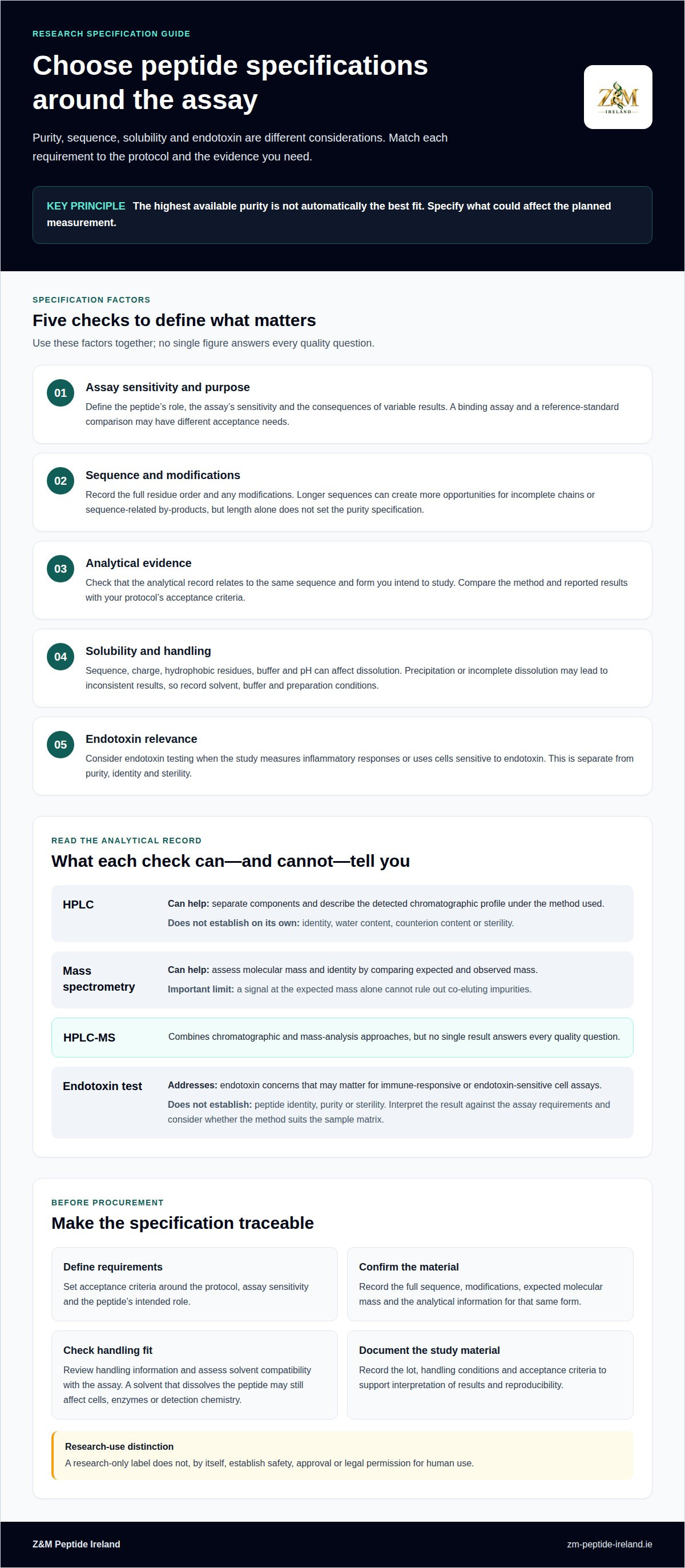
Choose purity according to the experiment, not a headline percentage. A cell-based binding assay may respond differently to impurities than a reference-standard comparison. The appropriate specification depends on assay sensitivity, the peptide’s role and the consequences of variable results. For peptide quality control, define these requirements before ordering. The right threshold is the one that supports the intended measurement.
Check what the reported purity measures. High-performance liquid chromatography (HPLC) separates components, while mass spectrometry (MS) helps assess molecular mass and identity. HPLC-MS combines these analytical approaches, but no single result answers every quality question. A chromatographic purity figure describes the detected profile under that method. On its own, it does not establish identity, water content, counterion content or sterility.
Review the analytical record for the sequence name, expected molecular mass, observed mass and chromatographic result. Compare the stated method with your experiment’s acceptance criteria. For example, a peptide used as an assay reference needs evidence relevant to identity and composition. A signal at the expected mass alone cannot rule out co-eluting impurities. Synthesis can also produce deletion sequences or other by-products.
For Irish laboratories, assess procurement and experimental use according to the compound’s identity and intended purpose. Distinguish laboratory research from any proposed human use. A research-only label does not, by itself, establish legal permission.
A peptide labelled for research should not be assumed suitable for human consumption in Ireland. The label does not establish permission to market or use the peptide for that purpose.
Misidentification, impurities, degradation or poor solubility can affect laboratory studies. These factors may alter assay signals and reduce reproducibility. Record the lot, handling conditions and acceptance criteria so you can interpret results in relation to the material used.
Before procurement, match the specification to the protocol, identify the analytical evidence supporting each requirement, and document acceptance limits. This makes the purity decision traceable and useful when reviewing results later.
Peptide sequence length and purity specifications
Sequence length informs analytical planning, but it does not determine a suitable purity specification on its own. The IUPAC Gold Book defines peptides through amino-acid units joined by peptide bonds; it does not set a universal length boundary for assessing research quality. Record the full sequence and intended experimental role, then define acceptance criteria for that specific material.
Longer sequences create more opportunities for incomplete chains or sequence-related by-products during synthesis. The practical question is whether those components could affect the planned measurement. For example, a binding assay may be sensitive to a sequence variant that changes interaction with the target, while a screening experiment may have different acceptance needs. Choose a specification based on the protocol’s purpose and the potential effect of impurities on interpretation.
Make sequence records unambiguous. Include the residue order, any modifications and the expected molecular identity. For a modified peptide, such as one with a terminal alteration, the unmodified sequence alone may not describe the requested compound. Ensure the analytical information relates to the same form and sequence, not merely a similar name or unmodified analogue.
- Transcribe the sequence: compare residue order with the experimental design.
- Record modifications: identify any changes that affect the material being studied.
- Define assay sensitivity: decide which sequence-related impurities could alter the result.
- Set acceptance criteria: specify the evidence needed for the peptide’s role.
Use the resulting specification consistently in procurement records and study documentation. If the same peptide supports different experiments, document why their acceptance criteria differ. This clarifies the relationship between sequence and study without treating chain length as a stand-alone measure of quality. It also gives the laboratory a reproducible basis for assessing future batches against the same experimental requirements.
Peptide solubility and endotoxin testing
Solubility affects whether a peptide reaches the assay at its intended concentration. Sequence, charge, hydrophobic residues, buffer and pH all influence dissolution. A hydrophobic sequence may behave differently from a charged one in the same aqueous buffer. Precipitation or incomplete dissolution can produce inconsistent results, even when the weighed amount is accurate. Record the solvent, buffer and preparation conditions for each experiment.
Choose a solvent based on the protocol and the peptide’s properties. Do not assume that water or a standard laboratory buffer will dissolve every sequence. Review the product’s handling information, then assess compatibility with the assay. A solvent that dissolves the peptide may still affect cells, enzymes or detection chemistry. Include a solvent-only control when the experimental design requires one.
Endotoxin testing addresses a different concern. Endotoxins, including lipopolysaccharides from Gram-negative bacteria, can influence immune-responsive cell assays. Consider testing when a study measures inflammatory responses or uses cells sensitive to endotoxin. An endotoxin result does not establish peptide identity, purity or sterility. Interpret it against the assay’s requirements, and consider whether the test method suits the sample matrix.
For storage and reconstitution, follow the compound’s handling information and your laboratory’s risk assessment. Use suitable protective equipment, minimise contamination and record preparation conditions. Do not assume one storage temperature or solvent suits every sequence.
- Before dissolution: confirm the sequence and intended assay conditions.
- During preparation: document solvent, buffer, pH and visible dissolution behaviour.
- For endotoxin-sensitive work: determine whether testing is relevant to the assay endpoint.
- For interpretation: distinguish endotoxin results from identity and purity evidence.
These steps help distinguish a solubility problem from an assay response. For example, a change in cell signal may reflect solvent effects, endotoxin or peptide activity. Controls and clear preparation records help identify which factor influences the result.
What purity levels and certificates of analysis should buyers look for?
No single purity figure suits every peptide or assay. Set an acceptance criterion according to the experiment’s purpose, sensitivity and the material’s role. For exploratory screening, the key requirement may differ from that for a reference material used in quantitative comparison. A higher stated percentage alone cannot show whether a peptide is suitable. Read the method and result together, then assess them against the protocol.
A certificate of analysis (CoA) is useful when it identifies the material and reports relevant analytical results. Check that the peptide name and sequence match the purchase specification. Without this connection, a generic document cannot establish that its results describe the batch received.
Review the analytical method, reported result and units. For example, a chromatographic purity result should identify the test method and correspond to the stated sample. Confirm that identity testing is addressed rather than inferring identity from a purity figure. The document’s date and issuing laboratory details can support traceability, but the certificate title alone does not prove every quality attribute.
- Match identity: compare the name, sequence and material form with your order record.
- Interpret results: note the method, units and which quality attribute each result addresses.
Record the acceptance decision with the study file, including why you selected that specification. If a result falls outside the protocol’s criteria, document how the material was handled in the experiment. This links the procurement record, analytical evidence and findings without treating a purity figure as a complete quality assessment.
For laboratory procurement, review peptide procurement options alongside the analytical requirements of your study.
Z&M Peptide Ireland: Research Peptides
Z&M Peptide Ireland supplies research peptides for laboratory and research purposes. It is a relevant procurement option when your study requires a research-grade compound and you have defined the sequence, purity criteria and handling requirements. Match the compound to your protocol, then assess its analytical documentation against the experiment’s acceptance criteria. This keeps procurement decisions aligned with the work rather than relying on a purity figure alone.
Research peptides are intended for research use, not human or veterinary consumption. A research-only label does not establish safety, approval or legal permission for other uses. Laboratories should apply their study protocols and institutional requirements when assessing suitability.
For research peptide procurement, visit zm-peptide-ireland.ie.
Make your next procurement decision traceable
Before your next research order, turn the study’s needs into a written acceptance plan. Specify the required sequence, the analytical evidence relevant to your question and the handling conditions your laboratory will record. This gives colleagues a consistent basis for assessing peptide compounds for research and links procurement decisions to experimental records. It also makes later reviews more useful: differences in outcomes can be considered alongside the material and protocol used.
Keep the specification proportionate to the experiment. A clear rationale is more useful than choosing a headline purity figure without considering what the assay can detect. If the work changes, revisit the criteria instead of carrying an old specification forward automatically. Assign responsibility for recording the decision and retain the supporting documentation with the study file. This creates a practical reference for repeat work and internal review.
For your next procurement step, contact Z&M Peptide Ireland to explore research peptide options for laboratory use. A documented decision gives your team a clear starting point and supports more consistent research workflows.
Z&M Peptide Ireland and Research Peptides
Z&M Peptide Ireland offers research peptides for readers exploring peptide compounds for research.
Once you’ve identified the research peptides relevant to your work, explore Z&M Peptide Ireland’s research peptide range.
Frequently Asked Questions
What are peptide compounds used for in scientific research?
Researchers use peptides to investigate molecular interactions and biological processes in controlled experiments. For example, a designed peptide can act as a probe in a binding assay, helping compare how sequence changes affect interaction with a target. Peptides also support studies of cell signalling and protein function. Findings from cell or animal experiments should be interpreted within that model, not treated as evidence of human effects.
Which research peptides are commonly studied and what are their properties?
Examples include oxytocin, a 9-amino-acid peptide, and ziconotide, a 25-amino-acid peptide isolated from the sea snail Conus magus. These examples differ in sequence length and composition, properties that influence molecular mass, folding and experimental handling. Researchers select a compound according to the biological question and model. A peptide’s research context does not establish a clinical use or outcome.
How can researchers verify the identity, purity, and quality of a research peptide?
Compare the material label and analytical records with the exact sequence required by the protocol. Check that the reported molecular mass is consistent with that sequence, and review any available fragmentation data for sequence-level support. Link the record to the batch received, then retain it with the experiment’s notes. For stronger interpretation, use independent evidence for identity and purity rather than treating one measurement as conclusive.
How can researchers compare reputable peptide suppliers serving Ireland?
Use consistent procurement criteria: clear compound identification, relevant analytical documentation, traceability between documentation and supplied material, and transparent research-use terms. Assess whether the information supports your protocol’s requirements, including sequence and handling needs. Keep the evaluation tied to documented evidence and institutional procurement procedures. A research-use description is not proof of safety, regulatory approval or permission for human consumption.
What Irish and EU rules apply to buying, importing, and using research peptides?
Assess procurement and experimental use according to the peptide’s identity and intended purpose, distinguishing laboratory research from proposed human use. A research-only label does not itself establish legal permission in Ireland.
