
Research Peptide Catalogue Prices, Specifications and Availability
A catalogue price alone cannot show whether a peptide suits your research workflow. Compare a research peptide catalogue by category, product specifications, availability and intended research use, then consider price alongside those details. Prices depend on the order and are provided after a quote request. Relevant factors include the product, quantity and research requirements.
Choosing a peptide for laboratory work takes more than matching a name or headline price. A research-only label does not prove safety, approval or legal permission. Clear comparisons help procurement teams assess whether a catalogue entry fits their study requirements and documentation needs.
This guide explains how to review catalogue categories, interpret specifications and assess biologically active peptides in context. It also covers how availability and research use shape purchasing decisions, helping you compare options more precisely.
Key Takeaways
- Use catalogue categories and filters to narrow options to peptides relevant to your study design.
- Compare product specifications carefully, including molecular details and the documentation provided for each listing.
- Assess availability alongside intended research use, so procurement decisions fit the study’s practical requirements.
- Interpret biological activity in its research context and distinguish laboratory or animal findings from evidence in humans.
Table of Contents
Peptide catalogue categories and filters
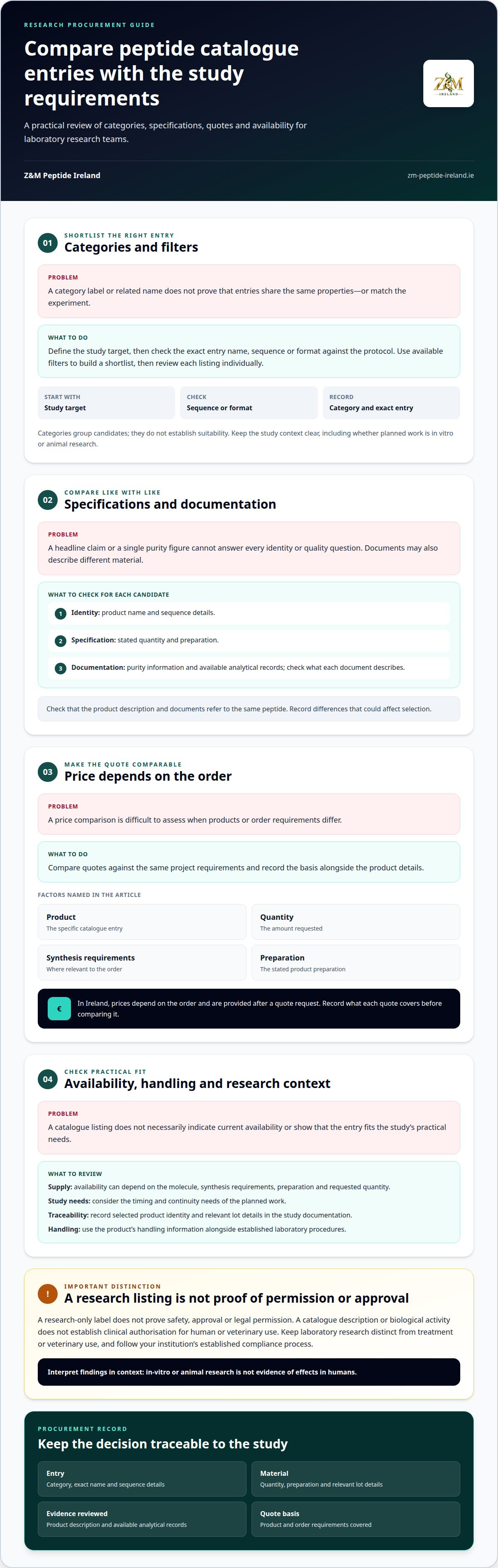
Categories and filters help laboratory teams organise catalogue entries before comparing individual products. Use them to screen options, then assess each candidate against the study protocol and required material.
Peptide categories
Start with the catalogue’s category labels, such as a named peptide family or a sequence-defined entry. Treat these as ways to group candidates, not proof that entries share the same properties. If a study requires a specific sequence, separate entries with related names and compare their identifiers. Record the category and exact entry name in your procurement notes.
Research applications
Relate each category to the research question rather than assuming a label determines an application. If a team is investigating a defined target, it can shortlist entries that match the protocol, then check each product description for relevant identifying details. Keep the study context precise: note whether the planned work is in vitro or animal research, and do not treat either context as evidence of effects in humans.
Catalogue filters
Use the filters on the catalogue page to narrow results, but do not assume every supplier offers the same options. Start with a category or named target, then apply relevant filters for sequence, format or product specification where available. Review each remaining entry individually. A filter creates a shortlist; it does not establish that a candidate matches the experiment.
A practical screening sequence is to define the target, identify the required sequence or format, then compare matching entries. Save the selected listing details alongside the protocol version. If the research question changes, repeat the search using the updated target criteria. This keeps catalogue browsing organised and gives scientific and procurement teams a consistent record of why an entry was considered.
Peptide product specifications and prices
Compare catalogue entries with the requirements in your study plan. Check the product name, sequence, stated quantity and preparation, then review documentation for the specific entry. A price comparison is useful only when the products and order requirements are comparable.
For identity and quality-control review, look for a precise product identifier and sequence, along with any stated purity information and analytical documentation. Check what each document describes and whether it relates to the material being assessed. A single purity figure does not answer every question about identity or quality. Record the information consistently for your research and procurement teams.
Compare suppliers by reviewing the same details for each candidate, rather than relying on a headline claim. Check that the product description and accompanying documentation refer to the same peptide. Record any differences that could affect your study selection. A research-only label does not prove safety, approval or legal permission.
Use a comparison record for each option:
- Identity: product name and sequence details.
- Specification: stated quantity and preparation.
- Documentation: purity information and available analytical records.
- Price basis: the product and order requirements covered by the quote.
To assess supplier legitimacy, compare the business identity in its procurement materials with the details on product records. Check that names and identifiers are consistent across the relevant documents. Treat this information as a record to review, not as a substitute for your organisation’s procurement procedures.
In Ireland, prices depend on the order and are provided after a quote request. Relevant factors include the peptide, quantity, synthesis requirements and preparation. Compare quotes against the same project requirements, as differences in these factors can make prices difficult to assess side by side. Record each quote’s basis alongside the product details to keep the purchasing decision traceable to the study requirements.
Catalogue peptide availability and research uses
A catalogue listing presents an option, but does not necessarily indicate current availability. Supply can depend on the molecule, synthesis requirements, preparation and requested quantity. Match these details to the study before treating an entry as suitable for procurement. Availability should also meet the timing and continuity needs of the planned work.
In Ireland, a research-only label or catalogue description does not establish that buying, importing or using a peptide is legally permitted. An entry alone cannot determine the applicable Irish or EU requirements, which depend on the specific product and intended use. Keep procurement decisions within your institution’s established compliance process.
A research-use listing does not establish approval for human or veterinary use in Ireland. Catalogue descriptions and biological activity are not evidence of clinical authorisation. Keep laboratory research separate from treatment or veterinary use, and do not interpret a product listing as permission for either.
Availability can affect how a study is organised. For example, if an experiment has several stages, record the selected product identity and relevant lot details in the study documentation. This helps the team track which material was used at each stage and assess whether a supply change could affect comparisons.
Handling and storage risks depend on the compound and its preparation. Degradation, contamination or an identity error can compromise experimental interpretation. Use the product’s handling information alongside the laboratory’s established procedures. A research-only label does not establish sterility or suitability for a particular application.
Before procurement, use this sequence:
- Match the listed molecule to the study question and protocol.
- Review preparation and handling information against laboratory procedures.
- Record product identity and relevant lot details for traceability.
- Assess the intended research use through institutional compliance procedures.
This process distinguishes catalogue visibility from practical suitability. A peptide may seem relevant by name yet differ from the material or preparation required for the experiment. For Irish research teams, the key is to align the product and study purpose with institutional review before procurement proceeds.
Which peptides are commonly listed in research peptide catalogues?
Catalogue entries can span named peptide families, individual sequences and research libraries. Examples already relevant to comparison include Peptide YY, amyloid beta and GP-12-01 library peptides. These names describe different kinds of entries, so researchers should first identify whether they need a specific molecule, a sequence variant or a library for screening.
For a named peptide, check that the catalogue entry matches the molecule in the study plan. For instance, distinguish Peptide YY from entries with similar names or related biological descriptions. Record the exact product name and sequence where provided. This helps prevent a broad family label from standing in for the specific material required by the protocol.
Amyloid beta listings require attention to variant naming. Aβ1-40 and Aβ1-42 are distinct identifiers, and the chosen form should match the research question. Compare the full entry rather than relying on an abbreviated label. For a study examining differences between variants, document each identifier separately in procurement records and experimental notes.
Library entries need a different review. GP-12-01 library peptides represent a grouped set rather than one individually named target. Consider whether the study requires screening across a library or evaluating a defined sequence. The distinction affects how researchers interpret the catalogue description and plan comparisons.
Use this short selection sequence for any named entry:
- Match the catalogue name to the target in the research plan.
- Check sequence or variant identifiers against the intended comparison.
- Separate single-peptide entries from library formats.
- Record the selected name consistently in procurement and study documentation.
This approach makes catalogue names useful starting points, not substitutes for study-specific selection. To review research peptide options against your project requirements, browse research peptide options.
The most common human amyloid beta isoforms are Aβ1-40 and Aβ1-42. This distinction can guide catalogue checks when a study requires a particular isoform.
Z&M Peptide Ireland: Research Peptides
Z&M Peptide Ireland supplies research peptides for laboratory and research purposes. For Irish research teams comparing catalogue entries, its research peptide supply is a relevant next step when a peptide matches the study’s defined target and procurement requirements.
Before selecting an entry, match its identity and intended research use to your protocol. Keep the product’s research-only status separate from questions of safety, approval or legal permission. The comparison criteria above can help organise your review, from peptide category and sequence to specifications and documentation.
Researchers seeking peptides for laboratory work can review the available research peptide catalogue at Z&M Peptide Ireland. For further information, visit zm-peptide-ireland.ie.
Make your next procurement decision with clarity
Before the next study begins, turn your comparison into a concise procurement record. Note the research question, selected material, reasons for the selection and documents supporting the decision. This creates a clear handover between scientific review and purchasing, while keeping the rationale accessible for future work.
A research peptide catalogue is most useful when you assess each entry against a defined project, rather than browse an isolated list. Revisit your selection if the protocol or material requirements change, and keep the record aligned with the current study plan. This supports continuity across research and procurement teams without treating catalogue wording as a substitute for project-specific criteria.
For a focused next step, contact Z&M Peptide Ireland with your research requirements. A clear brief can frame the procurement conversation. Your next decision can be clear and well grounded.
Z&M Peptide Ireland and Research Peptides
Z&M Peptide Ireland supplies Research Peptides for readers exploring a research peptide catalogue.
When you are ready to move from reviewing catalogue options to considering research peptides, explore the catalogue at Z&M Peptide Ireland.
Frequently Asked Questions
What is a research peptide catalogue?
A research peptide catalogue is an organised listing of peptide compounds intended for laboratory research. It lets researchers browse options and compare product descriptions for a defined study. For example, a procurement team can use a catalogue to shortlist entries before reviewing their sequence, preparation and supporting documentation. The catalogue is a starting point for selection, not proof that a peptide suits every experiment.
Which suppliers ship research peptides to Ireland?
Z&M Peptide Ireland supplies research peptides through an online procurement platform serving Ireland. Its products are intended exclusively for laboratory and research purposes. For procurement, match a product to the planned research use and review the relevant listing and order information. A research-only description does not establish safety, approval or legal permission for human or veterinary use.
What are typical research peptide prices in Ireland and Europe?
There is no single typical price for research peptides across Ireland and Europe. Price depends on the specific compound and order requirements, and is provided after a quote request. For a meaningful budget comparison, define the peptide and project requirements first, then compare quotes on the same basis. This avoids treating different products or order specifications as directly comparable.
What health, handling, storage, and contamination risks are associated with research peptides?
A research-only label does not establish safety or sterility. Handling and storage risks depend on the compound and its preparation; degradation, contamination or identity errors can compromise experimental interpretation. Follow the product’s handling information and your laboratory’s established procedures.
