
Research-Grade Peptide Services for Development and Commercial Use
A peptide’s suitability for research depends on its specification, not just its label. There is no single specification for all research-grade peptides: the intended application, sequence, synthesis scale, required quantity and relevant analytical criteria all shape the choice. Defining these requirements helps match the material to the planned work.
Researchers and procurement teams need to know what a peptide is intended for and how to interpret its stated specifications. This guide explains peptide applications, synthesis scales and quantities, biologically active peptides, and the information used to describe research-grade material.
It also shows how these factors relate to project requirements, helping you assess a peptide specification before procurement. The focus is on practical distinctions that support informed planning, rather than treating any one scale or specification as suitable for every application.
Key Takeaways
- Match synthesis scale and requested quantity to the planned work, allowing for the material needed at each stage of a project.
- Assess biologically active peptides in the context of their intended research application and the evidence required to interpret results.
- Read specifications as a set of quality indicators, including the analytical information relevant to your research requirements.
- Distinguish research materials from pharmaceutical products by their intended use and applicable quality expectations before procurement.
Table of Contents
Peptide synthesis scale and quantities
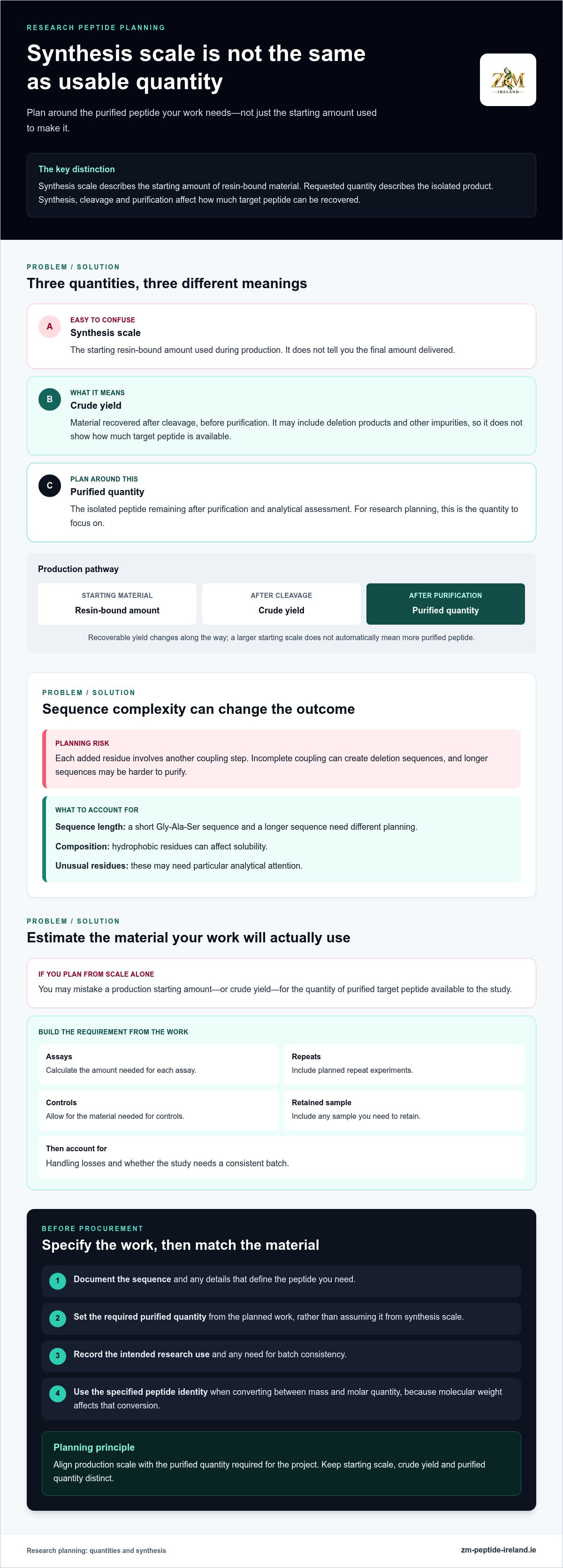
Synthesis scale describes the starting amount used to produce a peptide, not the quantity ultimately delivered. It commonly refers to the amount of resin-bound starting material, while the requested quantity refers to the isolated product. The two differ because synthesis, cleavage and purification affect the recoverable yield.
A short Gly-Ala-Ser sequence and a longer sequence, for example, require different planning. Each added residue involves another coupling step, and incomplete coupling can create deletion sequences. Longer sequences may therefore be harder to purify. Composition matters too: hydrophobic residues can affect solubility, while unusual residues may need particular analytical attention.
Plan the required quantity around the work, not the synthesis scale. Calculate the amount needed for each assay, repeat, control and retained sample, then account for handling losses and whether the study needs a consistent batch. A screening project may use less material than a programme involving repeated experiments or method development.
Keep three quantities distinct:
- Synthesis scale: the starting resin-bound amount used during production.
- Crude yield: material recovered after cleavage, before purification.
- Purified quantity: isolated peptide remaining after purification and analytical assessment.
For research planning, focus on the purified quantity. Crude yield does not show how much target peptide is available, as it may include deletion products and other impurities. Molecular weight also affects the conversion from mass to molar quantity, so use the specified peptide identity when calculating assay requirements.
Before procurement, document the sequence, required quantity, intended research use and any need for batch consistency. A project comparing results across experiments, for instance, may prioritise obtaining enough material from one synthesis. Clear specifications help align production scale with usable quantity and prevent the assumption that a larger starting scale automatically means more purified peptide.
Biologically active peptides
A peptide is biologically active when its structure produces a measurable effect in a biological system. That effect depends on its sequence, folding, modifications and experimental conditions. Insulin, for example, binds a receptor involved in glucose regulation. Changing the sequence can alter binding, stability or the measured response. A peptide’s name alone does not establish its function in a particular assay.
Research may investigate activity through a defined mechanism. One peptide may bind a receptor, while another inhibits an enzyme or interacts with a membrane. Antimicrobial peptides, for example, are studied for their interactions with microbial membranes. These are research mechanisms, not evidence of clinical suitability or treatment effects. The key question is how the molecule behaves in the specific experimental model.
Interpret results in context. A signal in a cell-based assay may reflect the target interaction, but it can also be affected by solubility, degradation, aggregation or assay design. Researchers can structure an assessment around:
- Target: identify the receptor, enzyme or other biological component under study.
- Model: record whether testing uses purified components, cells or another system.
- Controls: include suitable comparison conditions to distinguish peptide-related effects.
- Readout: define how the response will be measured, such as binding or enzyme activity.
Sequence details matter as well. A terminal modification, such as amidation, can change a peptide’s properties and affect its behaviour in an experiment. Match the specified molecular form to the protocol rather than relying on a similar name or sequence. For research-grade peptides, analytical identity and purity information describe the material, but biological activity still depends on the test conditions.
Plan the assay before selecting material. Define the target, model, controls and measured response, then review whether the peptide specification supports that design. For projects requiring research materials, explore the research peptide options relevant to laboratory work.
Research-grade peptide specifications
Assess a supplier by matching the product label to a defined sequence and documented analytical results. Compare lot-specific records with the stated identity and purity, and resolve discrepancies before using the material.
Specification details
A useful specification identifies the amino-acid sequence and any modifications, such as terminal amidation. Where applicable, it should also distinguish the target peptide from its salt form. These details matter because materials with similar names may differ chemically. Check the stated molecular mass against the specified sequence, then review evidence such as mass spectrometry for identity and HPLC for a purity profile. A chromatogram provides context beyond a single purity value by showing separated components. Check the lot identifier and ensure the documents refer to the material supplied, not a generic example. These steps help establish what the specification actually describes.
Research and pharmaceutical grades
The distinction centres on intended use and the quality framework applied to production. Research-grade material is supplied for laboratory investigation, such as testing a peptide’s interaction with a receptor. The label alone does not establish that it is suitable for administration to people or animals. Pharmaceutical-grade materials are intended for medicinal use and are subject to manufacturing and quality requirements appropriate to that purpose. A research certificate describing identity and purity does not establish pharmaceutical status. Match the grade to the project, and do not treat a research specification as evidence of clinical suitability.
Supplier and product checks
For a practical authenticity check, compare the product name, sequence, modification, lot identifier and analytical report across the label and accompanying documents. A mismatch between the stated molecular mass and sequence, or a report without a matching lot reference, should be resolved before the material enters an experiment. Assess whether the supplier provides product-specific documentation, clear intended-use information and consistent naming. Keep purchase records and lot documentation with experimental records to support traceability if results need review or an experiment needs repeating. These checks reduce the risk of using mislabelled material and make supplier claims easier to assess.
How do research-grade peptides differ from pharmaceutical-grade peptides?
The key distinction is intended use and the quality controls supporting it. A research label describes material for laboratory investigation; it does not establish suitability as a medicine or for administration to people.
For example, a peptide used to study receptor binding may be assessed for sequence identity and analytical purity. A medicinal product requires a broader framework covering its intended clinical use, manufacturing controls and consistency. A certificate reporting identity or purity is useful, but does not by itself demonstrate pharmaceutical status. Understand the label “pharmaceutical grade” in the context of the product’s intended purpose and supporting documentation.
Compare the material with your project’s requirements. Check the specified sequence, modifications, analytical results and lot documentation, then consider whether those records support the planned laboratory work. A research specification may suit an in-vitro assay, while a medicinal application requires standards designed for that purpose. These categories are not interchangeable, even when the peptide sequence is identical.
- Intended use: distinguish laboratory investigation from medicinal use.
- Documentation: match analytical records to the product and its lot.
- Quality framework: assess whether the controls address the material’s actual purpose.
- Claims: don’t treat a grade label or purity result as proof of clinical suitability.
For Irish research teams, procurement decisions should reflect the project’s defined use and institutional procedures. A research-grade designation does not establish authorisation for therapeutic use. Likewise, biological activity in an experimental model does not demonstrate a peptide’s safety or effectiveness as a medicine. Keep these distinctions clear in protocols, purchasing records and interpretation of results.
If your work requires laboratory materials, browse research peptides for research use and assess each specification against your experimental requirements.
Z&M Peptide Ireland: Research Peptides
Z&M Peptide Ireland supplies research peptides for Ireland’s scientific community. Its Research Peptides are intended for laboratory and research purposes, making them relevant when a laboratory or research project needs peptide materials for non-clinical investigation. They are not a substitute for medicines or medical advice.
Before procurement, define the peptide sequence, intended experimental use and required quantity. Apply the specification criteria discussed above to assess whether the material aligns with your study design. This makes the purchasing decision more precise and helps distinguish research materials from products intended for pharmaceutical use.
For laboratory and research requirements, visit Z&M Peptide Ireland to explore its Research Peptides.
Make peptide procurement part of research planning
Build procurement decisions into project planning rather than leaving them until the final purchasing stage. Recording why a particular material suits the study helps researchers, procurement teams and collaborators work from the same assumptions. It also gives future project reviews a documented basis for understanding material selection.
When choosing research-grade peptides, keep the intended laboratory use central to the decision. Distinguish research requirements from medicinal purposes, and ensure the purchasing rationale reflects the work the material is meant to support. This helps maintain clarity as projects develop or move between teams.
Z&M Peptide Ireland offers Research Peptides for laboratory and research purposes. If your project is moving towards procurement, take the next step by contacting Z&M Peptide Ireland. Set out your research requirements clearly and continue planning with a defined purpose.
Z&M Peptide Ireland and Research Peptides
Z&M Peptide Ireland offers Research Peptides as a next step for readers exploring research-grade peptides.
If your research requires peptide materials, explore the Research Peptides available from Z&M Peptide Ireland.
Frequently Asked Questions
What are research-grade peptides, and what are they used for?
Research-grade peptides are materials intended for laboratory and scientific investigation. Researchers may use a defined sequence to examine a target interaction, compare assay conditions or develop an analytical method. For example, a laboratory could investigate whether a peptide binds a particular receptor in a cell-based model. The designation describes research use; it does not establish suitability as a medicine or for administration.
How can peptide purity, identity, and quality be independently verified?
Independent verification means testing a representative sample at a laboratory separate from the supplier. Mass spectrometry can assess whether the measured molecular mass matches the expected sequence, while chromatographic analysis can help evaluate the sample’s composition. For a clearer interpretation, compare the results with the stated peptide form and lot records. An independent result should identify the sample tested and the analytical methods used.
What certificates and lab tests should peptide suppliers provide?
Review a product-specific certificate of analysis that identifies the peptide and links the results to its lot. Supporting records may include mass spectrometry data for identity and HPLC chromatograms showing the purity profile. Check that the sequence, modifications and reported results correspond to the material ordered. A generic certificate without a clear product or lot match provides less practical evidence for assessing a particular sample.
What are typical prices for research peptides in Ireland and the EU?
There is no single typical price across Ireland and the EU. Cost depends on the peptide sequence, requested quantity, modifications, synthesis complexity and purification requirements. A short, unmodified sequence and a longer, modified sequence involve different production considerations. When comparing quotations, match the specifications, including quantity and analytical documentation, so you are comparing similar materials rather than different orders.
