
Preventing Peptide Contamination: Sources and Risks
Preventing peptide contamination means controlling the introduction of unwanted microbes, endotoxins, particles or chemical impurities into a sample. In research, contamination can compromise sample integrity and make experimental results harder to interpret or reproduce. It can occur during sourcing, handling, concentration, lyophilisation and storage, not just during laboratory preparation.
Supplier documentation and manufacturing controls help inform procurement decisions, while aseptic handling and appropriate storage protect material after receipt. Compounding pharmacies operate in a distinct context: products prepared for clinical use are not automatically suitable for laboratory research. This article explains common contamination pathways, how concentration and lyophilisation can affect risk, and which quality and handling controls matter to Irish research teams. It also distinguishes purity measurements from evidence about other contaminants, helping procurement and laboratory decisions reflect what the analytical documentation actually shows.
Key Takeaways
- Assess supplier documentation in context: a purity result alone does not establish the absence of endotoxins or other contaminants.
- Trace contamination risks across the research workflow, including airborne microbes, surface residues and handling.
- Understand how concentration and lyophilisation can create opportunities for contamination if process controls are inadequate.
- Use suitable synthesis, purification and storage controls to protect sample integrity and support reproducible research.
Table of Contents
Risks from unregulated suppliers and compounding pharmacies
In Ireland and the EU, applicable requirements depend on a peptide’s classification and intended use. Medicinal-product manufacture is subject to applicable EU good manufacturing practice requirements. A research-only label does not establish safety, approval or legal permission. When assessing supplier claims, distinguish medicinal products from research reagents.
Supplier risks include incorrect identity or concentration, impurities, and microbial or toxin contamination. Testing of three products sold online as retatrutide found actual peptide content ranging from around half to almost double the labelled amount. This illustrates why a label alone cannot show that the amino acid chains, concentration or quality controls meet an experiment’s requirements.
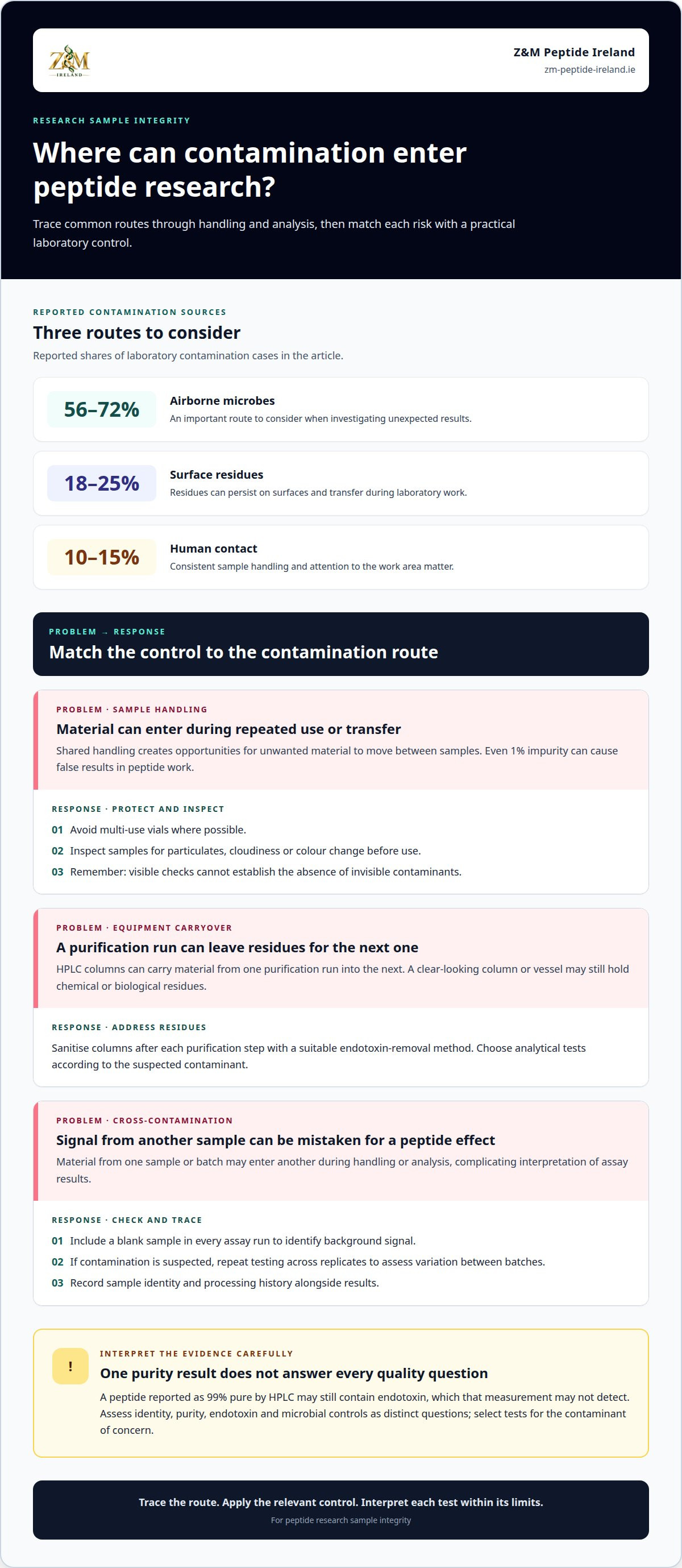
Purity results also have limits. A peptide reported as 99% pure by HPLC may still contain endotoxin, which that measurement may not detect. The European Pharmacopoeia 1997 limit for intravenous endotoxin exposure is 5 EU/kg body weight an hour. During purification, contaminated water, equipment or solvents can introduce endotoxin or bacteria, even when the target peptide appears chemically pure.
Compounding pharmacies prepare products in a different context from suppliers of research reagents. A pharmacy’s involvement does not, by itself, establish that a product is suitable for laboratory work or that its actual contents match a research specification. Unapproved or contaminated products pose particular risks if injected: non-sterile material can increase the risk of infection, tissue damage, allergic reactions and other health complications.
Evidence also needs careful interpretation. In-vitro findings or short-term observations cannot establish long-term effects in humans. Crude peptide preparations containing 5-10% impurities produced measurably different biological responses from highly purified peptide in a functional tissue-organ bath assay. For research procurement, assess identity, purity, endotoxin and microbial controls as distinct quality questions, rather than treating one result as proof of overall suitability.
Common contamination sources in peptide research
Contamination can originate in raw materials, synthesis reagents, shared equipment or sample handling. Mapping these sources to individual workflow stages helps a laboratory investigate unexpected results without assuming that one purity measurement covers every risk. Identify where unwanted material could enter, then determine what evidence could reveal its effect on an assay.
Prevention during synthesis and storage
Preventing peptide contamination during synthesis and storage means protecting the sample from introduced material and degradation at each stage. Even 1% impurity can cause false results in peptide work, so acceptance criteria should reflect the assay’s sensitivity. Avoid multi-use vials where possible, and inspect each sample for particulates, cloudiness or colour change before use. These checks can identify visible changes, but they cannot establish the absence of invisible contaminants.
Laboratory equipment and decontamination
Equipment controls should address residues that routine visual inspection may miss. For example, HPLC columns can carry material from one purification run into the next. Sanitise columns after each purification step with a suitable endotoxin-removal method. A clear-looking column or vessel may still contain chemical or biological residues. Select analytical tests according to the suspected contaminant: a purity result does not answer every question about sample quality.
Preventing cross-contamination between samples
Cross-contamination occurs when material from one sample or batch enters another during handling or analysis. If contamination is suspected, repeat testing across replicates to assess whether results vary between batches. Include a blank sample in every assay run to identify background signal that could be mistaken for a peptide-related effect. Record sample identity and processing history alongside results, so an anomalous signal can be traced to a relevant handling or analytical step.
Airborne microbes account for 56-72% of laboratory contamination cases, making airborne exposure an important source to consider alongside materials and equipment. Surface residues account for 18-25% of laboratory contamination cases, so surfaces are another potential route for unwanted material to persist or transfer.
Human contact contributes to 10-15% of laboratory contamination cases. Taken together, these sources reinforce the value of consistent sample handling and attention to the surrounding work area when investigating unexpected assay signals.
Contamination during concentration and lyophilization
Concentration and lyophilisation can expose a peptide preparation to contamination after synthesis and purification. Every transfer between vessels creates another opportunity for microbes, particles or residues to enter. As water is removed and peptide concentration rises, contaminants already present may also become more concentrated. Aseptic preparation and controlled equipment handling matter throughout the process, not just during initial amino acid synthesis.
Concentration may involve filtration, evaporation or other process steps, depending on the manufacturing method. Each introduces specific control points: filters can be contaminated or handled incorrectly, while shared tubing and vessels can carry residues between batches. Filtration alone does not establish that water or the finished peptide is free from endotoxin. Any specific water-purification process should be supported by relevant validation documentation.
Lyophilization removes water by freezing and drying the preparation under controlled conditions. Equipment integrity and closure controls matter during the process. Open containers, poorly managed loading or repeated handling can introduce particles or microbes. Equipment scale varies; a particular lyophilizer size should not be treated as a universal requirement for every research laboratory.
Specific figures for filtration, drying time, equipment capacity or contamination rates require a traceable source and should not be treated as general benchmarks. For example, values of 0.2 μm, more than 12 hours, 294 litres and 15-20% should not be used as general claims without supporting evidence. Process controls need to cover loading, drying, unloading and final closure. A cleanroom environment, sanitised contact surfaces and protected transfers may reduce opportunities for contamination, but do not replace appropriate analytical assessment. For a research sample, microbial contamination, endotoxin, residual solvents and peptide purity are distinct concerns, with potentially different effects on experimental results. Clinical use also has separate requirements and should not be inferred from a research preparation’s handling process.
How can peptide contamination be prevented during synthesis, purification, and storage?
Prevention relies on controlling contamination at each processing stage and maintaining suitable storage conditions. A 30-amino-acid peptide made with 99% coupling efficiency at each step has about 74% full-length product before purification. That example shows why synthesis quality and purification both matter: coupling efficiency alone does not establish the final sample’s composition.
Use aseptic procedures, including appropriate personal protective equipment and work in a biosafety cabinet, to reduce contamination rates to below 3%. Peptide purification and lyophilisation can take place in a Class 100,000 cleanroom, equivalent to ISO Class 8. Final bottling and packaging can use a Class 10,000 cleanroom, equivalent to ISO Class 7. These controls address different stages rather than substituting for analytical checks.
During purification, sanitise HPLC columns after each step with a suitable endotoxin-removal method to help limit carryover between runs. Before use, validate water systems through design, installation, operational and performance qualification. Routine monitoring of purified water should cover conductivity, total organic carbon, bioburden and endotoxin. One measurement alone cannot assess every contamination route.
Storage conditions should reflect the peptide’s composition and product instructions. Keep lyophilised peptides at −20°C and away from bright light. Peptides containing Cys, Met or Trp residues are prone to oxidation, so anaerobic storage helps maintain stability. Residues such as Asp, Glu, Lys, Arg or His can absorb moisture; a tightly capped vial in a desiccator helps limit exposure.
Repeated freeze-thaw cycles can degrade peptides. Aliquot material for each experimental set to reduce repeated opening and air exposure. Avoid storing peptides in solution where possible, as solutions are susceptible to bacterial degradation. Let a vial reach room temperature before opening, weigh the required quantity promptly, then reseal it tightly. These steps help preserve sample integrity between experiments.
Z&M Peptide Ireland: Research Peptides
Before considering Z&M Peptide Ireland for research peptide procurement, verify current product and business information directly. Research teams should define their experimental requirements and assess any peptide material against the analytical criteria for their laboratory workflows. A research-only designation does not establish suitability for clinical use, sterility, regulatory approval or legal permission. Assess material within the laboratory’s own controls for handling, storage and sample evaluation.
For current information about research peptide procurement, contact Z&M Peptide Ireland.
Put contamination controls into the next research plan
Make procurement part of experimental design. Before selecting material, define the analytical evidence the assay requires, how sample identity will be tracked, and which handling controls apply from receipt through use. This gives the research team a practical basis for aligning procurement with the planned work and makes deviations easier to record and investigate.
A consistent approach to preventing peptide contamination should reflect the assay, rather than rely on a generic checklist. Record relevant acceptance criteria alongside the protocol, then apply them consistently across experimental runs. When results differ, clear records help the team assess whether changes in material, handling or method may have contributed. Update procurement requirements as research methods develop.
For research peptide procurement aligned with your planned work, contact Z&M Peptide Ireland. A clear process gives each study a stronger foundation.
Peptide Contamination: Documentation Checks
Before using a peptide in laboratory work, check that its label and accompanying documentation identify the material and batch. Record any discrepancies for follow-up.
Keep the relevant documentation with your research records, and follow your laboratory’s procedures for handling and storing materials. A research-only label does not establish safety or legal approval.
Frequently Asked Questions
What Is Peptide Contamination?
Peptide contamination is the presence of unwanted material in a sample that can alter its composition or interfere with an assay. It may be biological, such as microbial material; chemical, such as residual synthesis reagents; or physical, such as fibres or particulates. For example, an unexpected signal in a control may indicate contamination, but needs interpretation alongside the assay design and sample history.
What are the main sources of contamination in peptide synthesis and handling?
Contamination can enter at different points in a workflow: starting materials may carry unwanted residues, synthesis equipment may retain carryover, and transfers can introduce material from containers or the surrounding workspace. For example, using a shared weighing spatula without suitable cleaning can transfer traces between powders. Keep a record of sample processing and transfers to help locate the source of an unexpected result and guide a targeted investigation.
