
Peptides for Scientific Research: Formats and Sample Content
A peptide’s value in research depends on more than its name. When selecting peptides for scientific research, check the sequence, synthesis format, modifications and sample composition. “Research-grade” describes intended laboratory use; it is not evidence of a therapeutic effect.
Comparing peptides means looking closely at what the material contains and how it is specified. This guide explains synthesis formats and modifications, how to assess sample composition, how blends differ from single peptides, and what to consider when choosing research-grade options for a laboratory project.
Product descriptions can help you assess a sample, but they are not scientific results. Focus on details relevant to the project: the sequence, format and composition. Keep those specifications separate from conclusions that require experimental evidence.
Key Takeaways
- Specify the sequence, format and intended modifications clearly to align a custom peptide with the research protocol.
- Assess sample composition by looking beyond the peptide name to the details that affect how the material is interpreted in a study.
- Compare research blends by their stated components and purpose, rather than assuming a blend is interchangeable with a single peptide.
- Distinguish research-grade status from evidence of therapeutic benefit when evaluating options for laboratory work.
Table of Contents
Custom peptide synthesis formats and modifications
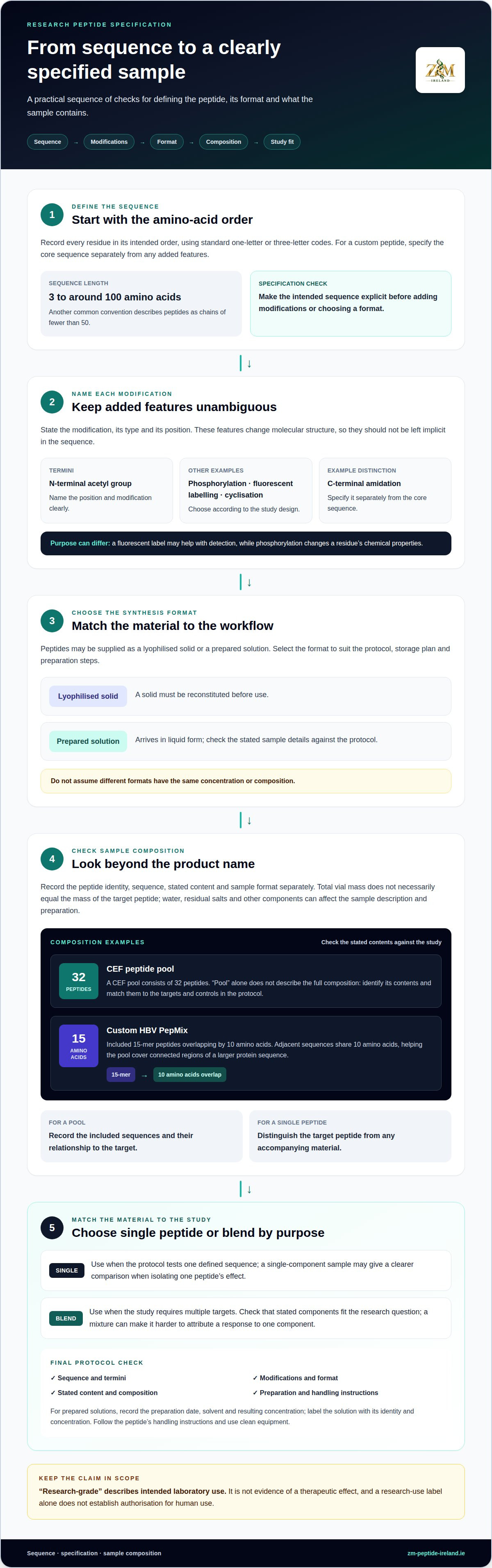
Custom peptide synthesis begins with a defined amino-acid sequence. For peptides for scientific research, provide the residues in order, using standard one-letter or three-letter codes, then identify any required modifications. Peptides can range from three amino acids to around 100 amino acids; another common convention describes them as chains of fewer than 50. The intended sequence length helps frame the specification.
Custom peptide synthesis can support projects requiring a sequence that is not available as a standard catalogue item. Specify the core sequence separately from any added features. For example, state whether the peptide needs an N-terminal acetyl group or C-terminal amidation. These modifications change the molecular structure, so do not leave them implicit in the sequence.
Format is another practical choice. Peptides may be supplied as a lyophilised solid or a prepared solution, depending on the project’s workflow and handling needs. A solid must be reconstituted, while a solution arrives in liquid form. Match the format to the protocol, storage plan and preparation steps. Do not assume that formats have the same concentration or composition.
- Sequence: record every amino acid in the intended order.
- Modification: name its position and type, such as N-terminal acetylation.
- Format: state whether the project requires solid material or solution.
- Application: describe the assay or laboratory workflow the specification must support.
Other modifications include phosphorylation, fluorescent labelling and cyclisation. Each has a different experimental purpose, so choose according to the study design. A fluorescent label may help with detection, while phosphorylation changes a residue’s chemical properties. Name each modification clearly to distinguish the requested peptide from its unmodified sequence.
Before ordering peptides for scientific research, compare the final specification with the protocol, field by field. Confirm the sequence, termini, modifications and format separately. This helps prevent a sequence-only description from missing a requirement for custom peptide synthesis.
Peptide content and sample composition
A sample label should distinguish the target peptide from other material supplied with it. Record the peptide identity, sequence, stated content and sample format separately. A vial’s total mass, for example, does not necessarily equal the mass of the target peptide. Water, residual salts and other components can affect how the sample is described and prepared.
Peptide pools combine multiple sequences for a defined research use. A CEF peptide pool consists of 32 peptides. This example shows why “pool” is not a complete composition description: the number of peptides and their identities determine what the sample contains. For an experiment, match the pool’s stated contents to the targets and controls in the protocol.
A custom HBV PepMix included 15-mer peptides overlapping by 10 amino acids. This arrangement uses peptides of 15 amino acids, with adjacent sequences sharing 10. The overlap allows the pool to cover connected regions of a larger protein sequence. In practical terms, the named target and overlap design help researchers interpret which regions the sample represents.
- Identity: compare the stated peptide name and sequence with the study design.
- Pool composition: identify each included sequence and its relationship to the target.
- Content: distinguish target peptide content from total sample mass.
- Preparation: follow the protocol’s chosen method for dissolving and handling the sample.
These details matter when comparing experimental results. For a pool, record its components rather than only its name. If the protocol uses one peptide, distinguish it from any accompanying material. Consistent records of sample composition help clarify results and separate experimental differences from changes in the material used.
Peptide products and blends for laboratory research
Choose a single peptide when the protocol tests one defined sequence, or a blend when it requires multiple targets. A pool is useful only if its stated components fit the research question. For example, a panel for examining several targets serves a different purpose from a single-peptide control. Record the product identity and intended role before comparing options.
In Ireland, requirements for buying, importing and using research peptides depend on the compound’s classification, intended use and supply route. A research-use label alone does not establish authorisation for human use.
There is no single typical price for research peptides across Ireland and Europe. Cost can depend on sequence length, modifications, sample format and whether the order is for a single peptide or a blend. Compare the full specification, not just the product name, when assessing value.
Storage and reconstitution depend on the specific peptide and its handling instructions. In the laboratory, follow those instructions, use clean equipment and record the preparation date, solvent and resulting concentration. Label each prepared solution with its identity and concentration so it is not confused with the original sample.
Blends need careful experimental planning. A mixture can simplify testing several targets, but may make it harder to attribute a response to one component. Record the blend’s stated composition alongside the protocol and choose controls that suit the research question. If the experiment needs to isolate one peptide’s effect, a single-component sample may give a clearer comparison.
- Match the format: select a single peptide or blend based on the study design.
- Review composition: connect each stated component to the targets being investigated.
- Document handling: record preparation details and follow the instructions supplied for the sample.
- Separate research from human use: intended laboratory use does not establish suitability for people.
For procurement in Ireland, first define the experimental purpose, required composition and handling workflow. These details help identify a suitable product format for the laboratory project. A blend, a single peptide and a product intended for human use are not interchangeable.
Research-grade peptides
Research-grade peptides for scientific research are intended for laboratory investigation, not established treatment. This distinction matters: peptides discovered by Stanford researcher Katrin Svensson, including BRP, had been tested only in mice, not in humans.
Distinguishing research-grade peptides
Assess the stated intended use, product identity and available analytical documentation together. A research-use label describes purpose; it does not establish suitability for people or demonstrate a therapeutic effect. Compare the named peptide and its sequence with the study protocol, then review information about identity, purity and sample composition.
Marketing language is not experimental evidence. Keep claims about human benefits separate from laboratory specifications and published findings. Some peptides studied in animals have been associated with cancer, organ damage or neurotoxicity after use over weeks or months. When assessing peptides for scientific research, distinguish preclinical findings from established human outcomes.
Peptides in scientific studies
Research peptides are compounds used in laboratory studies to investigate biological questions. Researchers may study how a sequence interacts with a target, compare modified and unmodified forms, or test a peptide in a defined assay. The purpose depends on the protocol, target and experimental model, not on the product label alone.
For example, a study might use a peptide to examine a protein interaction or compare responses under different experimental conditions. Results describe the system tested; they do not, by themselves, establish effects in people. When interpreting findings from peptides for scientific research, record the research question, model and sample identity together.
A practical review can follow three steps: match product identity to the protocol, separate laboratory specifications from therapeutic claims, and record the model behind the evidence. This distinction is especially relevant for compounds discussed in human-use contexts, including BPC-157, which was purportedly discovered in human gastric juice in the 1990s. Discovery context alone does not establish clinical evidence.
For laboratory procurement, review research peptide options against your study’s defined requirements.
Z&M Peptide Ireland: Research Peptides
Z&M Peptide Ireland supplies research peptides for laboratory and scientific use. Researchers sourcing compounds for a defined project can explore its research-grade products. Align selection with the study protocol, including peptide identity and intended experimental purpose. These products are intended exclusively for research, not as evidence of human suitability or therapeutic effect.
Before placing an order, identify the research peptide required and ensure its intended use fits the laboratory work. This keeps product sourcing distinct from medical decisions and claims about human use.
Visit Z&M Peptide Ireland online to view its research peptides.
Make sourcing part of study planning
For peptides for scientific research, make sourcing part of study planning rather than a last-minute task. A consistent internal process links procurement decisions to the research question, keeps records aligned throughout the project and supports clearer review as work progresses.
Before a study begins, agree how sourcing decisions will be recorded, who will maintain the records and where the documentation will be kept. This provides a practical reference if protocols evolve or responsibilities change. It also helps distinguish adjustments to the experimental design from procurement changes, while keeping scientific judgement central.
A repeatable record can support continuity across future projects. Review it alongside the protocol when requirements change, so decisions remain traceable and relevant to the work. For the next step in sourcing, contact Z&M Peptide Ireland.
A considered process gives your team a clear foundation for the next study.
Z&M Peptide Ireland and Research Peptides
Z&M Peptide Ireland offers research peptides for readers exploring peptides for scientific research.
If you are looking for research peptides for a project, explore the range at Z&M Peptide Ireland.
Frequently Asked Questions
Peptides are buzzing: But what does the science say?
Evidence varies by peptide and research model, so discussion or early findings do not establish human benefit. Some peptides have been studied only in animals. Reported animal-study findings include cancer, organ damage and neurotoxicity after use over weeks or months. For any claim, examine the compound, experimental model, duration and measured outcome. A result in one model does not automatically apply to another.
What are the risks of unapproved peptides?
Key concerns include uncertain effects in humans and adverse findings in some animal studies. Reported outcomes include cancer, organ damage and neurotoxicity after exposure over weeks or months. Product identity and composition also matter: a label alone does not demonstrate what a sample contains. Keep investigational use separate from claims about human treatment, and interpret evidence in the context of the specific compound and study model.
What purity does my peptide need to be?
Set the required purity according to the assay and the effect impurities could have on results. A sensitive analytical method may require tighter control than an experiment in which trace contaminants do not affect interpretation. Define acceptable limits in the protocol, then align them with the method’s detection capability and the sample’s intended use. Identity and purity are separate checks, not interchangeable measures.
What, exactly, are peptides?
Peptides are molecules made from amino acids joined in a particular sequence. Length descriptions vary: peptides are often described as having fewer than 50 amino acids, while the broader range extends from three to around 100. Proteins are generally longer, from a few hundred to over 1,000 amino acids. Their sequence and chemical structure help determine how researchers classify and investigate them.
Which peptides are commonly used in laboratory research, and what does each do?
Examples discussed in scientific research include insulin, BPC-157 and BRP, but their research status and evidence differ. Insulin is among peptide therapeutics used in contexts including diabetes. BPC-157 and BRP are discussed in preclinical research; BRP-related findings described in the literature include mouse testing. To understand a peptide’s role, assess the specific study question, model and measured outcome rather than relying on its name.
How can researchers assess peptide purity, identity and quality?
Use complementary analytical evidence rather than relying on a product label alone. High-performance liquid chromatography (HPLC) separates sample components and helps assess purity; mass spectrometry provides evidence about molecular mass and identity. Compare both results with the expected sequence and sample description. For example, investigate any mismatch between the expected mass and the measured result before using the material in an experiment.
