
Peptides for Laboratory Research: Legal Use and Purity in Ireland
A research designation describes intended purpose, not permission for human or animal consumption. In Ireland, peptides for laboratory research are supplied for scientific investigation and laboratory applications, so assess procurement in that context. Whether a particular use is appropriate depends on its research purpose and the controls governing the work.
That distinction matters when assessing a peptide’s legal status, purity and suitability for a laboratory protocol. This article explains how research use differs from consumption, what analytical information can tell you about identity and purity, and how chemical modifications relate to research applications.
It also outlines how peptides are studied in laboratory settings, helping you match a compound’s documented characteristics to your research requirements.
Key Takeaways
- Match a peptide’s documented identity and intended research application to the requirements of your laboratory protocol.
- Learn how HPLC purity data and mass spectrometry results help assess a compound’s analytical profile.
- Consider how chemical modifications, such as DAC, can affect the properties being investigated.
- Understand which Irish and EU compliance considerations to account for when procuring research compounds.
Table of Contents
What Are Research Peptides?
Peptides are chains of amino acids that can influence cellular processes and participate in signal transduction. They typically contain between 2 and 50 amino acids. In scientific studies, researchers select a peptide for its structure and the mechanisms under investigation, rather than for consumption.
A research peptide catalogue groups compounds by name and intended laboratory application. Examples include semaglutide, studied as a GLP-1 receptor agonist, and ipamorelin, investigated for effects on growth hormone release. These names describe research subjects, not recommendations for human or animal use. A peptide supplier’s catalogue is most useful when each entry lets researchers distinguish the compound and assess whether it fits a defined protocol.
Review product specifications as a set. Confirm the peptide’s identity, sequence or other structural description, presentation and available documentation. A certificate of analysis can link a specific batch to its analytical results. These details matter because different sequences or modifications can affect a compound’s behaviour in a study. Matching the material closely to the protocol supports clearer interpretation.
Consider catalogue prices alongside the listed quantity and product specification. A lower price alone does not establish better value if the material, presentation or documentation differs. Compare like with like, and calculate the amount required by the laboratory protocol. No single price applies to every peptide or research requirement.
Storage and handling affect a peptide after procurement. Keep lyophilised material at -20°C or colder, protected from direct light and moisture. Frozen vials should reach room temperature before opening; this reduces condensation forming inside the vial. Reconstitute only according to the relevant laboratory protocol, then divide solutions into smaller aliquots where appropriate. Avoid repeated freeze-thaw cycles; peptide solutions may be stored at -20°C when necessary.
For peptides for laboratory research, use the catalogue as a starting point: match the named compound and its documentation to the study question, then follow the laboratory’s approved handling protocol.
Peptide purity and chemical modifications
Purity data and structural changes help researchers assess whether a peptide suits a protocol. Interpret both in light of the study’s requirements, not as evidence of therapeutic suitability.
Purity and Experimental Reliability
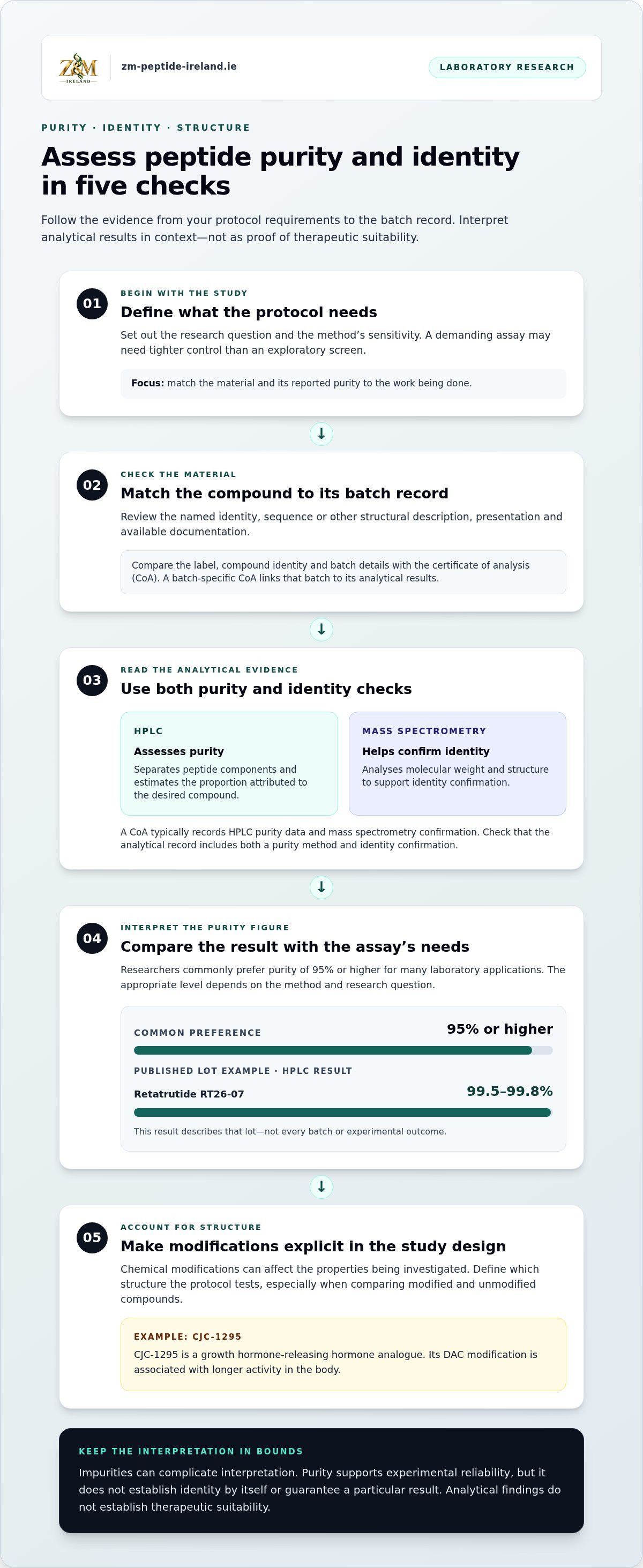
Purity describes the proportion of the desired compound in a sample. For many laboratory applications, researchers commonly prefer purity of 95% or higher. HPLC separates peptide components and estimates the proportion of the target compound. For example, the published Retatrutide RT26-07 lot record reports HPLC results of 99.5-99.8%. Such results describe that lot, not every batch or experimental outcome.
Impurities can complicate interpretation if they affect observed responses or introduce variables. Match the reported purity to the method’s sensitivity and the research question. A demanding assay may require tighter control than an exploratory screen. Purity can support experimental reliability, but it does not establish identity by itself or guarantee a particular result.
Quality Control and Certificates of Analysis
A certificate of analysis typically records HPLC purity data and mass spectrometry confirmation. HPLC assesses the proportion attributed to the desired compound; mass spectrometry helps confirm identity by analysing molecular weight and structure. This makes the analytical record more useful for quality control and research documentation.
When assessing a supplier, review batch-specific purity data, certificate detail, shipping information and the clarity of customer support. Consider whether the stated handling and delivery arrangements suit your laboratory’s procedures.
To reduce the risk of counterfeit or mislabelled material, compare the label, compound identity and batch details with the certificate of analysis. Check that the analytical results include both a purity method and identity confirmation, rather than relying on a general quality claim.
Chemical modifications also matter. CJC-1295 is a growth hormone-releasing hormone analogue; its DAC modification is associated with longer activity in the body. Researchers should account for that distinction when comparing study designs. An advanced protocol investigating modified and unmodified compounds needs to define which structure it tests. Research findings do not establish therapeutic use or suitability.
Peptide applications in laboratory research
Research applications depend on the question, model and measured outcome. BPC-157, TB-500 and ipamorelin illustrate distinct research areas, not interchangeable compounds. Their names alone cannot determine whether a peptide fits a specific protocol. Researchers should connect the proposed mechanism to a measurable endpoint before selecting material for testing.
BPC-157 is studied for potential tissue repair across gastrointestinal, muscle, tendon, ligament and nervous system injury research. A useful analysis defines the tissue model and outcome being observed, then records the conditions consistently. This helps distinguish what a particular experiment measures from broader claims about repair. Findings from laboratory studies do not establish suitability for human or animal consumption.
TB-500 is described as a peptide naturally found in almost all human and animal cells, and is studied in tissue repair and regeneration. Its research context differs from BPC-157’s. A study comparing these topics should specify its model and endpoints rather than treating both names as evidence of identical mechanisms. The protein or cellular process under investigation should remain explicit.
Ipamorelin is a selective growth hormone-releasing peptide researched for its effects on growth hormone release. It is relevant to studies examining a defined signalling response. Researchers can structure an analysis around that response and distinguish it from unrelated questions, such as tissue repair. A clear hypothesis helps align compound selection with the experiment.
For each peptide, define the model, intended observation and comparison before testing begins. Record the compound identity and batch details alongside protocol conditions. Mass spectrometry can help confirm molecular identity, while independent analysis may provide an additional evidential check. These steps support consistent interpretation; they do not show that results will transfer between models or studies.
The practical takeaway is to choose by research question, not popularity. BPC-157, TB-500 and ipamorelin represent different lines of investigation. Treat each as a laboratory research material, and interpret results within the model and measurements used.
What Irish and EU rules apply to buying, importing and using research peptides?
In Ireland, a “research use” label describes intended use; it does not, by itself, establish a product’s legal status. Relevant considerations include the compound, its presentation, intended use and route of supply. Buying, importing and using are separate steps, so assess each in relation to the specific material and planned work.
Before ordering, record the compound name, stated purpose and destination laboratory. Compare the product description with the proposed protocol, and keep procurement records with the relevant batch documentation. A research designation does not make a peptide suitable for human or animal use. Research peptides are intended for scientific investigation, not human or animal consumption.
For an import into Ireland, identify the dispatch location and the shipment’s contents. These details can affect which import and transport requirements apply. A shipment from within the EU may follow a different route from one entering from outside it. An online listing does not settle the classification or paperwork for every compound, so assess the requirements for the particular shipment before ordering.
Laboratory use also depends on the activity being carried out. A defined research protocol, suitable handling procedures and clear records help distinguish laboratory work from other uses. Document the compound’s purpose, receipt and use alongside the study records. A research-only description does not remove responsibilities arising from the laboratory’s work or the material’s classification.
For a practical procurement decision, establish the intended research use, confirm the compound identity, and record its origin and destination. Then assess any requirements attached to that specific use and shipment. This avoids treating all peptides or supply routes as equivalent. To source materials designated for laboratory work, explore Research Peptides as part of your procurement process.
Z&M Peptide Ireland: Research Peptides
Z&M Peptide Ireland supplies high-purity research peptides for laboratory and scientific work. It is a relevant option when your research question and protocol are defined and you need research-grade compounds for that work. The peptides are intended exclusively for laboratory and research purposes, not human or animal consumption.
Before procurement, match the compound to the study objective and consider its identity, analytical requirements and handling needs. This keeps purchasing decisions connected to the actual laboratory application rather than separating catalogue selection from experimental planning.
For research peptides intended for laboratory use, visit zm-peptide-ireland.ie to explore the range.
Plan your next procurement step
Before ordering, turn the study objective into a concise procurement record. Set out the research question, the compound’s role in the protocol and the documentation your laboratory needs to retain. This gives you a clear basis for reviewing suitability and aligning the purchase with the work.
For peptides for laboratory research, keep the intended laboratory use clear throughout procurement and handling. Research materials are not a substitute for medical advice or products intended for consumption. Z&M Peptide Ireland supplies research peptides for laboratory and research purposes.
Use your protocol and procurement requirements to guide the next step. Contact Z&M Peptide Ireland to discuss Research Peptides for your laboratory work.
Z&M Peptide Ireland and Research Peptides
Z&M Peptide Ireland supplies research peptides for laboratory research. Once you have identified the compounds relevant to your research needs, explore the range.
Consider Z&M Peptide Ireland when you are ready to source research peptides for laboratory work.
Frequently Asked Questions
What Does Peptide Purity Mean?
Peptide purity is the proportion of a tested sample attributed to the intended peptide. The remaining material may include related peptide products or other impurities. Purity is not the same as identity or concentration: a sample can have high reported purity while still requiring separate evidence that it is the named compound and contains the intended amount. Interpret each measure separately.
What are research peptides and what are they used for in laboratory studies?
Research peptides are compounds prepared for scientific investigation, not for human or animal consumption. Laboratory studies use them to examine defined biological questions, such as how a signalling pathway responds to a compound. Let the research purpose determine the model, controls and measurements. For example, a study of a cellular response needs a different design from one examining peptide stability.
Which peptides are commonly used for laboratory research in Ireland?
Examples discussed in laboratory research include BPC-157, TB-500, ipamorelin, semaglutide and CJC-1295. These compounds relate to different research questions, so the name alone does not establish suitability for a particular study. Researchers should select according to the protocol’s hypothesis and model, and distinguish laboratory investigation from therapeutic use or consumption.
How can researchers assess peptide purity, identity and quality?
Review the batch-specific certificate of analysis alongside the product label and study records. Check that the certificate identifies the compound and batch, reports a purity method such as HPLC, and includes identity evidence such as mass spectrometry. Keep these records linked to the experiment. This creates a traceable basis for interpreting results and comparing material across separate runs.
What are typical prices for research peptides from suppliers serving Ireland?
There is no single typical price for research peptides. The amount required, peptide structure, chemical modifications, product presentation and analytical documentation can all affect the cost. Compare products only when their specifications and quantities match the protocol. For budgeting, calculate the material requirement from the study design and account for any shipment-related charges shown at purchase.
What information should researchers include when ordering peptides for laboratory use?
Specify the exact compound name and any required modification, then state the quantity and presentation needed for the approved protocol. Include the laboratory’s delivery details and identify documentation needed for research records, such as batch-linked analytical results. A clear order reduces ambiguity between similarly named compounds and helps the receiving team connect the material to the planned study.
