
Peptide Product Specifications for Research Buyers
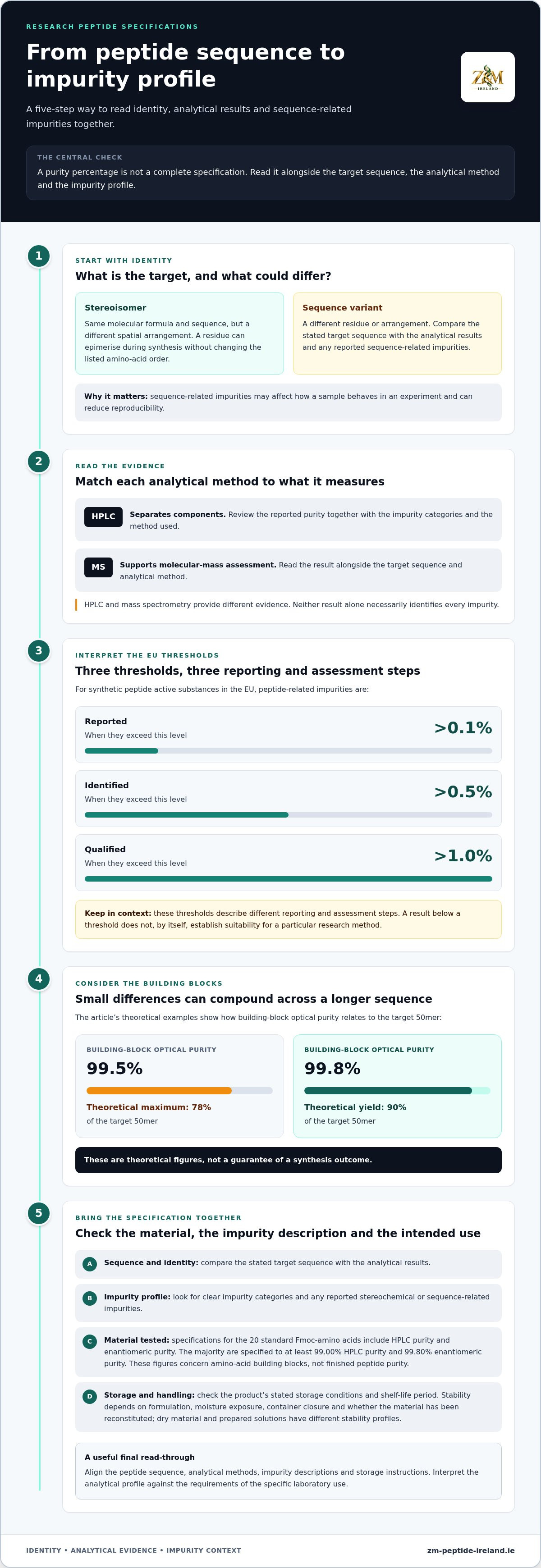
A purity percentage alone is not a complete set of peptide product specifications. For synthetic peptide active substances in the EU, peptide-related impurities are reported when they exceed 0.1%, identified when they exceed 0.5%, and qualified when they exceed 1.0%. These thresholds provide context for interpreting analytical data, rather than a substitute for checking what a particular specification measures.
Research buyers need to assess how purity, identity and sequence-related impurities are documented, as well as the practical requirements of an order. This guide explains how analytical characterisation informs peptide product specifications and what product size, pricing and sterilisation options mean when planning a research purchase.
You’ll learn how to distinguish a useful analytical profile from a headline purity figure, how sequence-related impurities and stereoisomers affect interpretation, and what to consider when matching product size and handling format to a project. This gives you a clearer basis for reviewing research peptide specifications in Ireland and selecting products for laboratory use.
Key Takeaways
- Learn how stereoisomers and sequence-related impurities can affect how a peptide’s purity profile is interpreted.
- Identify the analytical details that help make a specification more informative than a purity figure alone.
- Compare product sizes and pricing in the context of your research requirements, without relying on assumptions about typical costs.
- Understand how peptide grades relate to research applications and what to consider when reviewing sterilisation options.
Table of Contents
Stereoisomers and sequence-related impurities
A stereoisomer has the same molecular formula and sequence as the target peptide but a different spatial arrangement. During synthesis, a residue can epimerise, changing its configuration without changing the listed amino-acid order. This creates a sequence-related impurity that may affect how a sample behaves in an experiment. By contrast, a sequence variant contains a different residue or arrangement. HPLC can help separate components, while mass spectrometry can support molecular-mass assessment. Neither result alone necessarily identifies every impurity.
For synthetic peptide active substances in the EU, peptide-related impurities are reported when they exceed 0.1%, identified when they exceed 0.5%, and qualified when they exceed 1.0%. These thresholds describe different reporting and assessment steps. A result below a threshold does not, by itself, establish that a sample is suitable for a particular research method. Review the impurity profile alongside the analytical method, sequence, and intended laboratory use.
Building-block optical purity also matters, particularly as peptide chains grow. Building blocks with 99.5% optical purity can theoretically produce a maximum of 78% of the target 50mer. At 99.8% optical purity, the theoretical yield is 90% of the target 50mer. These examples illustrate how small differences at individual residues may compound across a longer sequence. They are theoretical figures, not a guarantee of a synthesis outcome. For a sequence review, compare the stated target sequence with analytical results and any reported stereochemical or sequence-related impurities.
Impurities can alter measured composition and reduce experimental reproducibility. Incorrect labelling can lead researchers to use the wrong sequence or quantity, while unverified products make identity and traceability harder to assess. For human medicinal products in the EU, the European Union's EMA guideline cites Directive 2001/83/EC, as amended, as a relevant legal framework. For veterinary medicinal products in the EU, the European Union's EMA guideline cites Regulation (EU) 2019/6, as amended, as a relevant legal framework. These frameworks concern medicinal products, while research buyers should assess peptide identity and impurity data against their specific laboratory requirements.
Characterisation and specifications
A useful specification connects the peptide’s identity to measurable quality attributes. The EMA guideline addresses manufacturing, characterisation, specifications and analytical control for synthetic peptides. Read the sequence and molecular-mass result alongside the method used, rather than treating a single HPLC purity value as a complete profile. HPLC separates components, while mass spectrometry supports assessment of molecular mass. Together, these methods provide different evidence and should be interpreted for the compound being examined.
Review how the specification describes impurities. In the EU, limits for peptide-related impurities in synthetic peptide active substances should be based on European Pharmacopoeia general monograph 2034, “Substances for Pharmaceutical Use”. A parameter described only as “high molecular weight impurities” is not acceptable for synthetic peptides under the EU guideline. Clear identification of the measured impurity category makes results more meaningful than a broad label. USP peptide resources also reference General Chapter <1106.1>.
Starting materials can influence the analytical profile. Specifications for the 20 standard Fmoc-amino acids include HPLC purity and enantiomeric purity. The majority are specified to at least 99.00% HPLC purity and 99.80% enantiomeric purity. Those figures concern amino-acid building blocks, not finished peptide purity. Keep the distinction clear when comparing raw-material data with a final peptide’s HPLC or MS results. The analytical method and the material tested must match the claim being assessed.
Storage conditions and shelf life depend on the formulation, exposure to moisture, container closure and whether the material has been reconstituted. Follow the storage conditions and shelf-life period stated for the specific product: dry material and prepared solutions have different stability profiles. Low acetate and ethyl acetate content helps make capped peptide formation negligible and supports long-term product storage. This can be relevant when reviewing analytical data and handling requirements.
For a practical review, align the peptide sequence, analytical methods, impurity descriptions and storage instructions before comparing specifications. Researchers sourcing materials for laboratory work can explore research peptides as a next step when these requirements define the purchase.
Peptide product sizes and prices
Suppliers may offer different pack sizes, so compare the amount of material rather than the pack label alone. A vial’s net peptide content, salt or counterion form, and purity basis affect how much material is available for a research protocol. Check whether the stated quantity refers to peptide content or total material, then compare equivalent amounts across listings.
Research peptide prices vary with sequence length, synthesis complexity, purification requirements, analytical work and pack quantity. A short, straightforward sequence is not directly comparable on price alone with a longer sequence requiring additional purification. Compare the stated specification, analytical characterisation, quantity and supplied format. In Ireland, assess the total quoted amount in euros and distinguish the product price from any separately stated delivery charge or tax.
Choose a product size based on the planned experiments and handling requirements. A smaller quantity may suit initial method development, while a larger pack may fit repeated experiments using the same sequence. Consider expected consumption, storage conditions and repeated handling. For example, compare what you need for a single assay with the quantity required for a complete study, rather than choosing solely by the lowest unit cost.
In the EU, the EMA guideline on synthetic peptide development and manufacture cites Directive 2001/83/EC, as amended, for human medicinal products and Regulation (EU) 2019/6, as amended, for veterinary medicinal products. The guideline comes into effect on 1 June 2026. These are medicinal-product frameworks; research-use labelling does not itself establish that a product is authorised for human or veterinary use.
For a consistent comparison, record each option’s sequence, stated quantity, purity method, analytical evidence, format and quoted price in euros. Then assess whether the specifications match the experimental purpose and required batch size. A listing with only a purity figure does not provide the same basis for comparison as one that also states the quantity and analytical methods. A simple comparison table makes differences clear without treating the lowest price as the best value.
Compare equivalent peptide content and matching specifications, including sequence, salt or counterion form, purity basis, analytical evidence and supplied format. Consider the quoted price in euros alongside pack quantity and any separate delivery charge or tax. Synthesis and purification requirements can also affect the price.
What are common peptide product grades and what applications are they suitable for?
“Research grade” is a common commercial description, but the label alone does not define purity, identity testing or permitted use. Match the stated grade to the experiment by reviewing its acceptance criteria, analytical methods and intended application. For example, a peptide for HPLC method development may need a documented purity profile, while exploratory laboratory work may prioritise sequence identity and a suitable quantity.
“Analytical grade” generally signals suitability for analytical work, but its practical value depends on the supporting evidence. For an HPLC assay, review chromatographic purity, method details and whether the report identifies the tested material. For mass spectrometry, check that the result supports the expected molecular mass. A grade name does not replace these specific results.
“GMP grade” refers to a different assurance context from a general research-use label. High purity or an HPLC trace alone does not establish GMP status. Medicinal-product applications involve requirements beyond an analytical result, including manufacturing controls and regulatory status. A research peptide should not be treated as suitable for human or veterinary use merely because its listing uses a high-grade descriptor.
Use a clear selection process. First, define the experiment, such as assay development, method validation or exploratory laboratory research. Next, identify the evidence needed: sequence confirmation, an HPLC profile, a mass spectrometry result or other relevant testing. Then compare the data with the method’s acceptance criteria. For instance, a chromatographic purity figure describes detected components under that method; it does not automatically establish suitability for every application.
For purchasing research materials, select a grade based on the experiment and the documentation needed to interpret its results. The 20 standard Fmoc-amino acids described in product specifications illustrate why the tested material matters: building-block quality and finished-peptide quality refer to different stages. Review research peptide products in light of the specific analytical requirements for your laboratory work.
Z&M Peptide Ireland: Research Peptides
Z&M Peptide Ireland supplies high-purity Research Peptides exclusively for laboratory and research purposes. It is a relevant next step for Irish researchers seeking research-grade peptide materials and a clear understanding of the analytical criteria that guide selection.
Before choosing a peptide, define the research application and identify the information that matters, such as sequence identity, purity assessment or analytical characterisation. These criteria help you assess product specifications against your laboratory’s needs, rather than relying on a grade label alone. Research peptides are not a substitute for medicinal products or medical consultation.
For laboratory research, visit Z&M Peptide Ireland’s research peptide range or contact Z&M Peptide Ireland.
Put your research requirements into practice
Before ordering, turn your experimental plan into a concise purchasing checklist. Record the target sequence, the analytical evidence your method requires, the quantity needed and laboratory handling considerations. This gives your team a consistent basis for assessing peptide product specifications rather than relying on a single headline value.
Keep the checklist with your project records. If the method changes, the identity evidence, impurity profile or material quantity needed may change too. A documented rationale helps colleagues understand the selection and makes future procurement comparisons more consistent.
Z&M Peptide Ireland supplies Research Peptides for laboratory and research purposes. If your criteria are ready, review the available research peptide products against your project requirements and choose a suitable next step.
Contact Z&M Peptide Ireland to discuss your research requirements. A clear specification and considered selection process provide a practical starting point for your next project.
Z&M Peptide Ireland and Research Peptides
Z&M Peptide Ireland supplies Research Peptides. Once you know which product specifications matter, explore the products available for your research.
Explore Z&M Peptide Ireland’s Research Peptides when you are ready to move from comparing specifications to reviewing products for your research.
Frequently Asked Questions
What specifications are listed on peptide product labels and datasheets?
Peptide product specifications can include the sequence, molecular mass, quantity, chemical form, purity result, storage instructions and analytical methods. A datasheet may also identify a batch or lot and provide chromatograms or mass spectra. Use these details to match the material to a protocol. For instance, confirm whether the listed quantity refers to peptide content or total material, particularly when counterions are present.
What purity and assay standards are used for peptide products?
Purity and assay describe different measurements. HPLC purity usually reports the relative area of detected peaks under a stated chromatographic method; assay measures the amount or content of peptide in a sample. Check the method, calculation basis and acceptance criteria before comparing results. Purity percentages are not necessarily equivalent when methods or reporting conventions differ. Select criteria that align with the experiment’s analytical purpose.
How are peptide identity, sequence, and molecular weight verified?
Mass spectrometry compares a sample’s measured mass with the expected molecular mass, supporting an identity assessment. Sequence verification requires evidence about the order of amino-acid residues, not mass alone, since different sequences can share a mass. Review the method and result together. For example, a mass match can support the proposed peptide identity, while sequence-specific analysis provides additional evidence about residue order.
What analytical methods and certificates of analysis are available for peptides?
Analytical packages may use HPLC or related chromatography to assess component separation, and mass spectrometry to examine molecular mass. When supplied, a certificate of analysis is most useful if it identifies the tested batch, methods, results and acceptance criteria. Compare its batch identifier with the material received. A generic method description without sample-specific results provides less information for interpreting a particular research batch.
What peptide product specifications are required for research, diagnostic, or pharmaceutical use?
Requirements depend on the intended use and applicable regulatory framework. Research materials should be assessed against the experiment’s identity, purity and handling needs; diagnostic and medicinal applications have distinct validation and regulatory considerations. For human medicinal products in the EU, the EMA guideline cites Directive 2001/83/EC, as amended, as a relevant framework, according to the European Union. Research-use designation alone does not establish suitability for diagnostic or medicinal use.
