
Peptide Basics: How They Work and What to Consider
A research-grade label describes intended use, not proof of safety, approval or legal permission. A peptide is a short chain of amino acids that can interact with proteins and other molecules, including in cell-signalling processes. Its biological activity depends on its structure and the molecules it interacts with.
The terminology can be difficult to interpret, especially when “compounded” and “research-grade” appear together. They refer to different contexts, and neither label alone establishes that a product is suitable for human use.
This introduction explains how peptides differ from anabolic steroids, what compounded and research-grade mean, and why possible side effects and evidence need careful interpretation. It also distinguishes laboratory and animal findings from evidence in people. For Irish research teams, these distinctions help clarify a product’s intended use and the limits of what can be concluded from it.
Key Takeaways
- Distinguish short amino-acid chains from larger protein structures, and assess them separately from anabolic steroids.
- Interpret reported side effects alongside product status; unapproved products carry unresolved safety concerns.
- Separate compounded preparations from research-grade materials by their intended context, and do not treat laboratory or animal findings as evidence of benefit in people.
- Match material selection to the research purpose, and keep laboratory use distinct from human-use assumptions.
Table of Contents
What are peptides and how do they work?
A peptide is a chain of amino acids, the building blocks of proteins. Its sequence and structure influence how it interacts with other molecules. The European Bioinformatics Institute’s protein resources explain how amino-acid sequences relate to protein structure, useful context when interpreting molecular research.
Peptides, Proteins and Steroids
Peptides are generally shorter chains of amino acids than proteins, while anabolic steroids belong to a different chemical class. These structural differences affect how compounds interact with biological targets. Testosterone, for example, is a steroid hormone; insulin is a peptide hormone. The European Medicines Agency’s medicine information can help researchers identify active substances in authorised medicines, but a shared biological purpose does not make compounds chemically equivalent.
Peptides and Protein Interactions
Short amino-acid chains can interact with proteins and other macromolecules, influencing biological processes such as cell signalling and immune activity. The outcome depends on the sequence, target and experimental conditions. Recording these details helps laboratory teams distinguish a measured interaction from a broader claim about a compound’s effects.
Peptides, Amino Acids and Collagen
An amino acid is a single molecular unit; a peptide is a chain of amino acids, while collagen is a structural protein. Collagen in oral supplements can be broken down into short chains, commonly called collagen peptides. These terms describe different structures, not interchangeable materials. Accurate naming in research records clarifies whether an experiment concerns individual units, short chains or intact collagen.
In Ireland, a research-only label does not establish safety, approval or legal permission for human use. The Health Products Regulatory Authority provides information on medicines in Ireland, but a product’s status and intended use remain important.
Peptide medicines include insulin for diabetes and GLP-1 medicines used for diabetes and obesity. Their medical use does not establish that other compounds have the same effects or status.
What are some side effects of peptides?
Possible effects depend on the compound, formulation and available evidence. For unapproved products, uncertainty about composition can make risks harder to assess.
Risks of Unapproved Peptides
The US Food and Drug Administration (FDA) warns that unregulated peptides may contain impurities. This is a product-quality concern, not proof that every product is contaminated. Uncertain composition can complicate safety assessments and the interpretation of laboratory results. A label alone cannot establish which active substance is present or whether the contents match the description.
Some users report gastrointestinal problems, headache, fatigue or irritation at an injection site. These reports do not show that every compound causes those effects. Responses can depend on the molecule and formulation. Without reliable evidence for the specific product, reported effects cannot provide a complete safety profile.
Supplement Side Effects and Safety
A supplement label does not show, by itself, that a product has been assessed for safety before sale. Evidence may also differ according to the compound, formulation and intended use. Researchers should distinguish the product under study from others with similar names, since their composition may differ.
Contamination or incorrect composition can affect experimental findings as well as safety. An unexpected ingredient, for example, may alter a measured response, making it difficult to attribute the result to the intended compound. The FDA’s warning about possible impurities in unregulated products underscores why product identity matters, but it is not an Irish regulatory determination.
In Ireland, the cost of supplements and prescription medicines depends on the product. For medicines, prescription and dispensing arrangements also matter. There is no single price across these different categories.
Differences between peptides and anabolic steroids
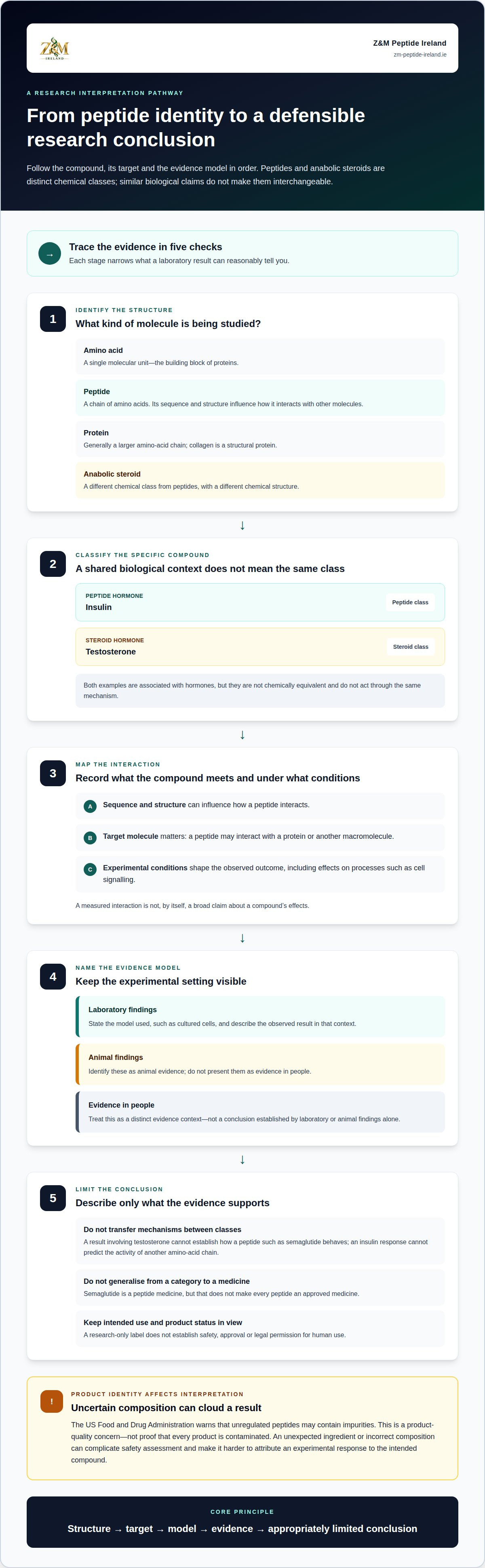
Peptides and anabolic steroids are chemically distinct classes of compounds. Peptides consist of amino-acid chains, while anabolic steroids are typically synthetic versions of naturally occurring male hormones, such as testosterone. This distinction matters in research: similar claims about muscle or hormone effects do not make the substances equivalent or interchangeable.
Their structures help explain the difference. A peptide’s amino-acid sequence can affect how it binds to a target molecule, such as a receptor. Anabolic steroids have a different chemical structure and interact with hormone pathways. Insulin, for example, is a peptide hormone, whereas testosterone is a steroid hormone. Their association with hormones does not mean they act through the same mechanism.
Medical use depends on the individual compound and its evidence, not its broad category. Semaglutide is a peptide medicine, but that does not make every peptide an approved medicine. Likewise, the term “anabolic steroid” does not establish approval or a particular clinical use. In Ireland, the intended use and status of the specific product remain relevant.
For laboratory teams, this distinction shapes how to interpret results. A change observed after exposure to a peptide cannot automatically be attributed to the same mechanism as a steroid response. Researchers need to identify the tested compound, its molecular target and the model used, such as cultured cells or an animal study. These details help separate a demonstrated effect from a broad marketing claim.
Classifying a compound by structure is only the first step. Next, examine its target, experimental conditions and evidence. A hormone-related result involving testosterone cannot establish how semaglutide behaves, just as an insulin response cannot predict the activity of another amino-acid chain. Clear terminology supports accurate comparisons in medical and laboratory science.
Compounded and research-grade peptides
“Compounded” describes a preparation made by combining or adapting ingredients into a formulation. “Research-grade” describes material intended for laboratory investigation. One term concerns preparation; the other concerns intended use. Neither label establishes that a material is suitable for clinical use or authorised as a medicine in Ireland.
This distinction matters when interpreting product descriptions and study records. A compound used in a research protocol is not automatically equivalent to a preparation for clinical use, even if both have the same name. Formulation, intended purpose and supporting evidence need to be considered separately. A label alone cannot demonstrate equivalence.
For laboratory procurement, documentation should connect the material to the planned experiment. Useful details include its stated identity, formulation and the analytical methods used to characterise it. These records help researchers interpret results and identify what was tested, but they do not establish suitability for human use. The Health Products Regulatory Authority (HPRA) provides information on medicines authorised in Ireland, a separate context from laboratory research materials.
Evidence also needs careful classification. The European Medicines Agency’s clinical-trial framework distinguishes non-clinical research from clinical investigation in people. Results from cell or animal models can inform a research question, but they do not establish clinical benefit. Claims about recovery, growth hormone, immune activity, weight or blood sugar therefore need evidence suited to the specific claim and population.
For laboratory procurement in Ireland, explore Research Peptides for research purposes. Keep the experimental objective and intended use clear in procurement and study records. This separation supports accurate interpretation without treating a research designation as evidence of clinical status or suitability.
Z&M Peptide Ireland: Research Peptides
Z&M Peptide Ireland supplies Research Peptides for laboratory and research purposes. This is relevant when an Irish research team needs peptide compounds for a defined laboratory study, rather than for clinical use. Keep the research setting clear throughout procurement and use.
A research-grade or research-only description does not establish safety, approval or legal permission for human use. Nor does it replace a study-specific assessment of identity, composition and suitability. Keep product claims separate from evidence generated in laboratory or animal studies, and do not infer human effects from those findings.
If your laboratory work requires Research Peptides, contact Z&M Peptide Ireland to discuss your research requirements.
Set a clear direction for your next research project
Before selecting materials, define the experimental question and the result your protocol is designed to measure. A clear endpoint keeps procurement decisions aligned with the work, whether the study examines molecular activity, cell signalling or another laboratory process. Record the model, controls and analytical method alongside the research question. This gives you a practical basis for interpreting results and documenting how the material was used.
For a peptide project, make the intended research application clear in procurement records and study documentation. Clear records support consistency between the planned experiment and its eventual interpretation, particularly when evidence comes from different models or methods. They also help distinguish a laboratory study’s purpose from claims about clinical use.
When you are ready to progress a laboratory requirement, contact Z&M Peptide Ireland to discuss the next step. A well-defined research question gives your project a sound foundation.
Z&M Peptide Ireland and Research Peptides
Z&M Peptide Ireland offers Research Peptides for laboratory and research purposes. If you need peptides for a defined research project, explore the company’s research peptide supply.
Consider Z&M Peptide Ireland when your laboratory requires Research Peptides.
Frequently Asked Questions
Are peptides steroids?
No. Steroids and peptides have different chemical structures and mechanisms, so evidence about one class does not establish effects in the other. For a research comparison, identify the exact compound and experimental model, then assess the outcome measured. This avoids treating a hormone-related finding as proof that two substances act in the same way.
What are the risks of unapproved peptides?
Unapproved products may have uncertain composition, impurities or effects that have not been adequately assessed in people. A product label alone cannot establish its contents. In procurement records, link the material’s identity and analytical evidence to the experimental protocol. This traceability is especially relevant when results depend on a compound’s identity or concentration.
Are peptides safe?
Safety depends on the specific substance, formulation, quality and intended context. Evidence from a cell experiment or animal model does not establish safety in people. A finding in cultured cells, for example, should be interpreted as evidence about that experimental system, not as a conclusion about clinical use. A research-only label is not proof of safety or approval.
Is stacking peptides dangerous?
Combining unregulated products can increase the possibility of interactions, side effects and other health complications. It can also make experimental results harder to interpret because each compound’s contribution is less clear. In laboratory studies, isolating variables can support clearer attribution. A combined outcome does not establish that every component is effective or safe on its own.
Peptides are buzzing: But what does the science say?
Evidence varies by compound and study design. A peptide may show biological activity in a laboratory model, but that alone does not demonstrate benefit in people. Assess the molecule studied, the model, the controls and the outcome. These details help distinguish an early research signal from evidence supporting a clinical claim.
Peptides, what's behind the hype?
Public attention can grow when proposed mechanisms or early findings are presented as established outcomes. Claims about recovery, weight or immune effects may go beyond what a study measured. Compare each claim with the type of evidence and the outcome tested. This helps separate a plausible research question from a demonstrated clinical result.
