
Net Peptide Content and the Effects of Moisture and Salts
A net peptide content calculation estimates how much of a weighed sample is peptide material rather than moisture, counterions and other non-peptidic mass. It is distinct from peptide purity: purity compares the target peptide with peptide-related impurities, while net content also includes peptidic impurities. A sample can therefore be reported as 100% pure yet have net peptide content below 100%.
The mass weighed from a vial does not necessarily equal the peptide mass available for a research calculation. Moisture and salts can contribute to the sample weight, and standard analytical HPLC does not detect these components. This article explains how they affect interpretation, what quantitative assays can establish, and how a theoretical estimate differs from a measured result. It also shows why purity and net content must be considered separately when calculating peptide concentration from a weighed sample.
Key Takeaways
- Separate the estimated amount of peptide material from the proportion of target peptide when interpreting analytical results.
- Account for moisture and counterions when translating a weighed powder mass into an estimated peptide mass.
- Use a quantitative assay, such as amino acid analysis, when a measured content value is needed; treat theoretical estimates as calculations, not assay results.
- For concentration calculations, apply net content and purity alongside molecular weight so the estimate reflects the desired sequence rather than gross sample mass alone.
Table of Contents
What Is Net Peptide Content?
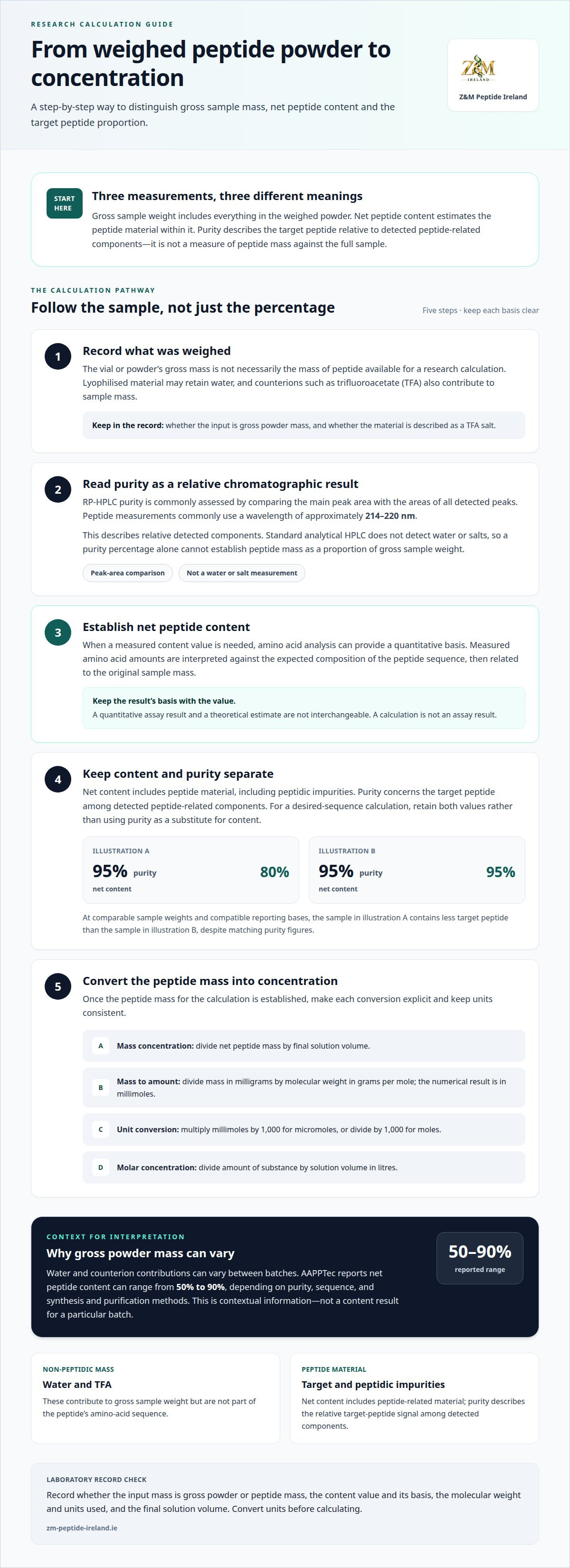
Net peptide content is the amount of peptide material in a weighed sample. It differs from gross sample weight, which includes every component present, and from peptide purity, which describes the relative amount of the target peptide among detected peptide-related components. Net content includes peptidic impurities, so it does not state what proportion belongs to the desired sequence.
In reverse-phase high-performance liquid chromatography (RP-HPLC), peptide purity is commonly assessed by comparing the main peak area with the areas of all detected peaks. Peptide measurements commonly use a wavelength of approximately 214-220 nm. This comparison describes relative detected components, not the amount of water or salts in the powder. Consequently, a chromatographic purity percentage cannot alone establish peptide mass as a proportion of gross sample weight.
The distinction affects interpretation of reported results. A sample with 95% purity and 80% content contains less target peptide than one with 95% purity and 95% content, assuming comparable sample weights and compatible reporting bases. The purity figures match, but the content values differ. For calculations, retain both values rather than using purity as a substitute for net content.
In Ireland and the EU, the appropriate testing approach depends on the research purpose and applicable quality system. A single HPLC purity result does not establish universal suitability. Interpret each result according to what the method measures, rather than treating one percentage as a complete description of the sample.
A clean HPLC trace can show a dominant detected peak, but it does not by itself prove the peak’s identity or determine the sample’s water or counterion content. These are separate analytical questions. A purity result describes relative chromatographic signal, while a content assay addresses peptide material relative to the full sample. Keeping these distinctions clear helps laboratories select the relevant result for a research calculation and describe it accurately in records.
Moisture and counterions in lyophilized peptides
Lyophilised peptide powder can retain bound water, so the vial’s gross weight may include moisture as well as peptide material. The amount depends partly on the peptide’s properties and lyophilisation conditions. Weighing a portion therefore does not establish the mass of peptide available for a research calculation. This matters when preparing samples from powder.
Counterions also contribute to sample mass. Peptides purified by preparative RP-HPLC are usually supplied as trifluoroacetate (TFA) salts. TFA balances positively charged sites, including protonated amino groups and arginine side chains. It is associated with the peptide but is not part of its amino-acid sequence. Weighing a TFA salt therefore includes both peptide and counterion mass.
Water and counterion contributions can vary between batches. AAPPTec reports that net peptide content can range from 50% to 90%, depending on purity, sequence, and synthesis and purification methods. These factors mean that gross weight alone cannot establish an equivalent peptide mass across different samples. The reported range is contextual, not a substitute for a content result for a particular batch.
For interpretation, distinguish non-peptidic mass from peptide-related impurities. Water and TFA are non-peptidic components; peptide impurities remain peptide material. This matters because content and purity describe different features of a sample. A chromatographic purity result does not quantify how much of the weighed mass comes from water or TFA.
In laboratory records, preserve the stated sample form and the basis of any content value. Note whether the material is a TFA salt when comparing batch data or translating powder mass into an estimated peptide amount. This makes assumptions clear to colleagues and helps prevent gross powder weight from being treated as an equivalent peptide mass across samples.
Quantitative assays and peptide concentration
Amino acid analysis can provide a quantitative basis for estimating net peptide content. The measured amino acid amounts are interpreted against the expected composition of the peptide sequence. This is useful when a research calculation needs an estimate of peptide material in the weighed sample, rather than a relative chromatographic purity result. The sequence provides the reference for interpreting the assay output.
To calculate content using amino acid analysis, relate the measured amino acid quantities to the residues expected from the sequence, then express the resulting peptide mass relative to the original sample mass. The reported result depends on the assay output and calculation basis. Record that basis alongside the result so subsequent calculations use a content value, not an unrelated purity percentage.
For a concentration by mass, divide the net peptide mass by the final solution volume, keeping the mass and volume units consistent. To convert peptide mass into amount of substance, divide mass in milligrams by molecular weight in grams per mole; the numerical result is in millimoles. Multiply millimoles by 1,000 for micromoles, or divide by 1,000 for moles. For molar concentration, divide the amount of substance by solution volume in litres.
Make each conversion step explicit in laboratory records. Note whether the input mass represents gross powder or peptide mass, then record the molecular weight and units used. This makes the calculation traceable when values move between a preparation record and an analysis worksheet. Convert units before calculating, rather than mixing milligrams with grams or microlitres with litres.
Amino acid analysis and concentration calculations answer related but distinct questions: the assay estimates peptide content, while concentration expresses an amount relative to solution volume. Choose the result that fits the research calculation. This distinction supports consistent interpretation across records and prevents sample mass, content percentage and solution concentration from being treated as interchangeable.
Theoretical net peptide content calculation
A theoretical estimate predicts the desired sequence from synthesis assumptions; it does not measure the sample. Its value is in showing how small starting-material impurities can compound across a sequence.
Calculating Content from Purity and Sample Weight
Peptide purity and sample weight alone cannot establish net peptide content. Purity describes detected peptide-related components, while net content accounts for peptide material relative to non-peptidic mass. To estimate the mass of the target sequence, multiply gross sample weight by the net-content fraction and the purity fraction. If only purity is available, moisture and salts remain unaccounted for, so the result is not a net-content measurement.
Theoretical synthesis estimates also depend on starting-material purity and assumptions about impurity reactivity. For a 10-amino-acid peptide, 95% starting-material purity gives an estimated desired-product yield of 60%, assuming impurities have the same reactivity. At 99% starting-material purity, the estimated yield is 90%; at 99.5%, it is 95%. These are synthesis estimates, not assay results.
Using a Certificate of Analysis
To calculate content from a certificate of analysis (CoA), multiply the gross sample weight by the reported net peptide content fraction. A CoA showing purity alone does not provide enough information to calculate net peptide content, because HPLC purity does not quantify water or salts. Keep the certificate’s reported measurement type distinct from any theoretical estimate.
To estimate the desired sequence, apply the purity fraction as well, provided the reported content and purity refer to compatible sample results. Record the units and reported basis before calculating. This prevents a percentage from being mistaken for a mass value, or a synthesis yield from being treated as measured content.
Common Calculation Errors
Common errors include treating HPLC purity as net content, using gross sample weight as peptide mass, and presenting a theoretical synthesis yield as an assay result. Each confuses a different quantity. A net peptide content calculation requires a content value or a clearly identified theoretical method; purity alone cannot account for moisture and salts.
Another common error is applying purity twice or mixing percentages with decimals. Convert percentages to fractions before multiplication, and apply each factor only once. Keep molecular weight and mass units consistent when converting to amount of substance. These checks make the calculation interpretable and help reduce avoidable discrepancies between reported sample weight and estimated target peptide.
Z&M Peptide Ireland: Research Peptides
For research teams in Ireland procuring research peptides, check current site information to confirm whether Z&M Peptide Ireland supplies them and what specifications are stated. The analytical distinctions in this article can inform procurement decisions, but a theoretical content estimate is not a substitute for a measured assay or documentation relevant to a specific sample. Use the information available for each research peptide to assess its suitability for your project.
For procurement enquiries about available products, contact Z&M Peptide Ireland.
Set a clear basis for your next research decision
Before using a content value in a research plan, define what the calculation needs to support. A net peptide content calculation can inform sample planning, but its usefulness depends on matching the figure to the research question. Recording the basis for each calculation also helps colleagues distinguish an analytical result from an estimate.
For procurement, this framework can help clarify which information matters to your work and how it relates to planned analysis. Check current product and documentation details directly with Z&M Peptide Ireland before making a decision. A clearly defined analytical basis can help your team proceed with greater confidence.
Z&M Peptide Ireland and Research Peptides
Z&M Peptide Ireland supplies Research Peptides for laboratory and research purposes. Once you have completed the net peptide content calculation and understand what the result represents, explore the research peptides available for your work.
Turn to Z&M Peptide Ireland when you are ready to move from calculation guidance to considering Research Peptides.
Frequently Asked Questions
What is gross peptide weight?
Gross peptide weight is the total mass recorded when supplied powder is weighed. It describes the sample as weighed, not the mass of a particular peptide sequence. In a research record, label this value as gross sample mass and keep it separate from any assay-derived content figure. This prevents the powder’s total mass from being mistaken for the amount of target peptide.
What does net peptide content mean?
Net peptide content is the proportion of a sample’s mass attributable to peptide material, including peptidic impurities. It does not identify how much of that material is the desired sequence. Interpret a content figure alongside sequence identity and purity data, since each addresses a different analytical question. A content value alone cannot establish that the sample contains the intended peptide.
What is the formula for net peptide content?
Express net peptide content as: net peptide content (%) = net peptide mass ÷ gross sample mass × 100. Use a measured content value for the numerator when the calculation is intended to represent assay-based content. If estimating the desired-sequence mass, apply the purity fraction separately to net peptide mass. Do not substitute an HPLC purity percentage for the content value, because the measurements represent different quantities.
How do water content and counterions affect net peptide content calculations?
Water and counterions increase the mass of the weighed material without increasing peptide-sequence mass. The calculation therefore needs a content value that accounts for these non-peptidic components. A reported powder mass alone cannot establish peptide mass if the sample contains retained water or counterions. Their contribution can vary with sequence, purification history and lyophilisation conditions.
How is net peptide content used to determine peptide dose or concentration?
For research concentration calculations, use the net peptide mass as the mass input, then divide by the final solution volume to obtain a mass-per-volume concentration. For molar concentration, also use the peptide’s molecular weight, and apply purity when estimating the desired sequence specifically. These are laboratory calculation principles, not human or veterinary dosing instructions; any experimental use must follow the applicable research protocol.
