
Lyophilised Peptide Storage: A Reference for Temperature, Light and Handling
For longer-term storage, Thermo Fisher Scientific’s peptide handling guidance recommends keeping lyophilised peptides at −20 °C or colder. Room-temperature stability varies with the peptide and storage conditions, so use the supplier’s instructions for the specific material.
Moisture can affect dry peptides during handling. Let a cold vial reach room temperature in a desiccator before opening to help prevent condensation from forming on its contents.
This guide covers protection from light and moisture, handling before reconstitution, transport and long-term storage. It explains how aliquoting can reduce repeated exposure to ambient conditions and why storage requirements change after reconstitution. These distinctions help research teams across Ireland apply consistent procedures.
Key Takeaways
- Before opening a chilled vial, let it reach room temperature in a desiccator to limit moisture exposure.
- For longer-term storage, keep dry peptides tightly sealed at −20 °C and away from heat, light and moisture.
- Aliquoting can reduce repeated freeze-thaw cycles and exposure to ambient conditions.
- During handling and transport, keep containers closed and protect them from light, heat and humidity.
Table of Contents
How should peptides be handled?
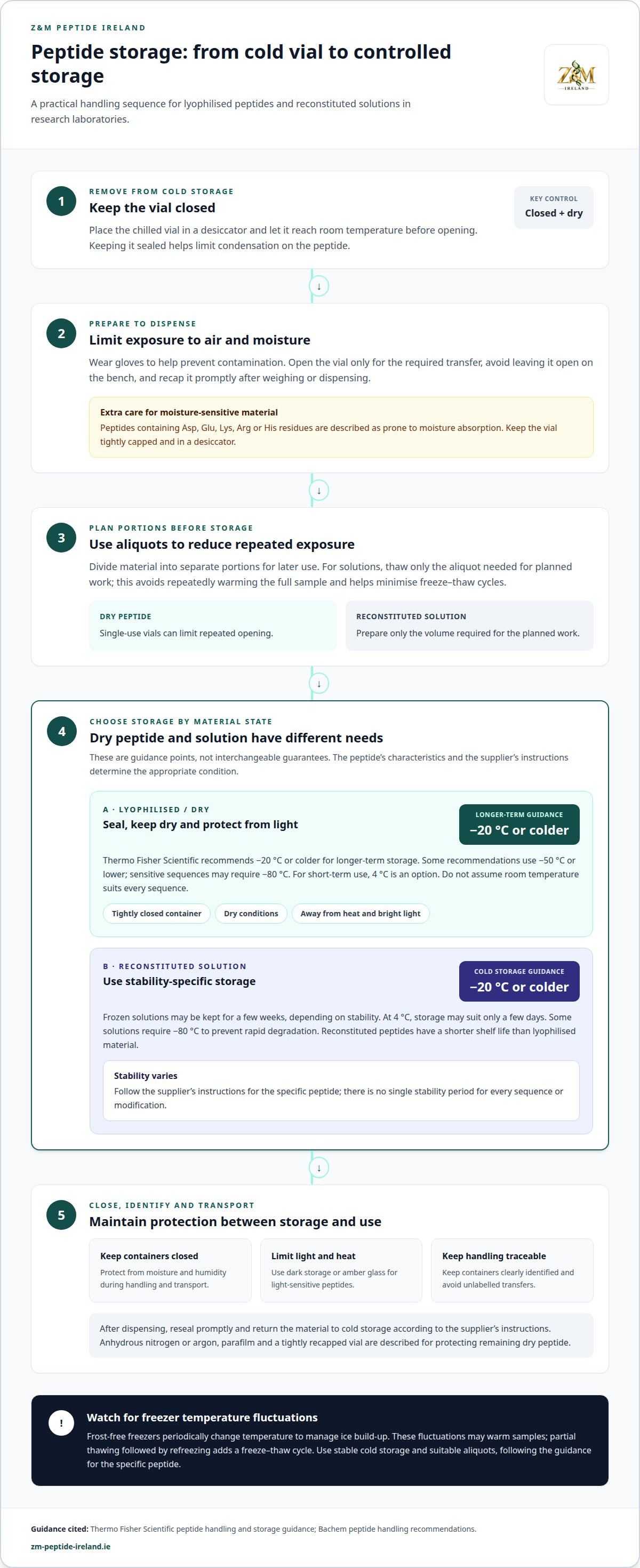
When removing a peptide from cold storage, leave the vial closed while it reaches room temperature in a desiccator. For reconstituted material, the appropriate storage temperature and usable duration depend on the peptide’s stability in solution.
Freeze-thaw cycle avoidance
A freeze-thaw cycle occurs when a frozen peptide sample warms and is then frozen again. Thermo Fisher Scientific’s peptide handling guidance advises minimising repeated freeze-thaw cycles, particularly for solutions. Divide solution into aliquots before freezing, then thaw only the amount needed for planned work. This avoids repeatedly warming the full sample and limits unnecessary exposure to air during use.
Handling peptides during removal from storage
Cold-vial handling means warming a sealed container in a controlled way before its contents meet room air. Keep the vial closed as it reaches room temperature in a desiccator to reduce condensation on the peptide. Wear gloves to help prevent contamination. After dispensing, reseal the vial, preferably under dry inert gas, and return it to cold storage according to the supplier’s handling instructions.
Aliquoting means dividing peptide material into separate portions for later use. Thermo Fisher Scientific’s peptide storage guidance describes aliquoting as a practical way to reduce repeated exposure during use. For dry peptide, single-use vials limit repeated opening. After dispensing, gently purge remaining contents with anhydrous nitrogen or argon, recap, seal with parafilm and store at −20 °C.
Reconstituted peptides have a shorter shelf life than lyophilised material. Store solutions at −20 °C or colder, according to their stability; frozen solutions may be kept for a few weeks. At 4 °C, storage may suit only a few days, depending on stability. Some solutions require −80 °C to prevent rapid degradation. Prepare only the volume required for the planned work.
A frost-free freezer periodically changes temperature to manage ice build-up. These fluctuations may warm samples, and partial thawing followed by refreezing adds a freeze-thaw cycle. Use stable cold storage and suitable aliquots to reduce this risk, following the storage guidance for the specific peptide.
Storage temperature and light protection for lyophilised peptides
Good storage control limits temperature changes and exposure to moisture and light. Thermo Fisher Scientific’s peptide handling guidance recommends cold storage for longer-term stability; the specific sequence and supplier instructions should guide the final choice.
Temperature, humidity and light control
Stable, dry and dark conditions help limit degradation. Bachem’s peptide handling recommendations emphasise protecting peptide material from moisture and following product-specific storage guidance. Keep containers tightly closed and away from bright light and heat. Amber glass or dark storage can reduce light exposure for light-sensitive peptides. A desiccator or desiccant helps limit humidity around the sealed vial.
Room-temperature and frozen storage
Room-temperature storage keeps a sealed, dry peptide outside refrigerated or frozen conditions. Thermo Fisher Scientific’s peptide storage guidance treats storage conditions as dependent on the peptide and its intended use, so room temperature should not be assumed suitable for every sequence. For short-term use, 4 °C is a storage option; for longer-term storage, −20 °C is a common recommendation. Follow the specific supplier’s instructions.
Long-term storage temperature
Long-term storage keeps dry peptide under cold, dry conditions to preserve its stability. Thermo Fisher Scientific recommends −20 °C or colder for longer-term storage. Some storage recommendations use −50 °C or lower, while sensitive sequences may require −80 °C. These are not interchangeable guarantees: peptide characteristics and supplier guidance determine the appropriate condition. Keep the container sealed and desiccated during storage.
There is no single stability period that applies to every sequence or modification. Room-temperature stability may range from days to weeks or weeks to months under protected conditions; 4 °C is generally for short-term use, while −20 °C is a common long-term reference. Once dissolved in sterile buffers, peptide solutions need separate storage conditions and generally have shorter shelf lives.
Pre-reconstitution handling and transport
Pre-reconstitution handling includes opening, dispensing and moving lyophilised peptide before adding a solvent. Moisture control is essential, particularly for hygroscopic samples and sequences containing certain amino acid residues.
Handling hygroscopic samples
Hygroscopic samples absorb moisture from the surrounding air. Peptides containing Asp, Glu, Lys, Arg or His residues are prone to moisture absorption, so keep them tightly capped in a desiccator. Before dispensing, let the closed vial reach room temperature inside the desiccator. This limits exposure to humid air when opening the container and helps protect the dry material.
After weighing, close the vial promptly and return it to dry storage. A peptide’s amino acid composition can affect its sensitivity to moisture, so follow the storage guidance for that specific peptide. Avoid leaving an open vial on the bench while preparing other materials.
Laboratory handling and safety
Careful laboratory handling means opening and dispensing peptide material using clean procedures. Wear gloves to help prevent contamination, and keep the vial sealed until it has reached room temperature in a desiccator. Open it only for the required transfer, then recap it tightly. This minimises the peptide’s exposure to air and moisture.
Follow the laboratory’s applicable handling guidelines for the compound and planned research procedure. Keep the container clearly identified during weighing, and avoid transferring material between unlabelled vessels. These steps support traceable handling; a research-only label is not proof of safety.
Moisture-protective packaging
Moisture-protective packaging keeps the vial sealed and dry during storage or transport. Use a tightly capped container, maintaining dry conditions with a desiccator or desiccant where appropriate. For longer storage, a sealed, desiccated container helps limit moisture exposure. Protect the vial from humidity when moving it between storage and the work area.
Before reconstitution, lyophilised peptides may be shipped at room temperature; dry ice can also maintain low temperatures and minimise humidity exposure during transport. Choose handling conditions that preserve the sealed, dry state, and follow the supplied storage guidance for the specific sequence. On receipt, leave the vial closed until it reaches room temperature in a desiccator.
Long-term storage of lyophilised peptides
Long-term storage means keeping dry peptide under conditions that preserve its stability over an extended period. For lyophilised material, control temperature, moisture, light and air exposure. Solvent storage requirements apply only after reconstitution.
A tightly sealed, desiccated container limits moisture, which can substantially reduce peptide stability. Store dry material in a desiccator or a container with desiccant, and minimise how long each vial stays open. Peptides containing Cys, Met or Trp residues are prone to oxidation, so anaerobic storage is important for maintaining stability.
For longer storage, keep lyophilised peptides in a closed container below −15 °C. A storage temperature of −20 °C is a common reference, while some recommendations prefer −50 °C or lower. Sensitive sequences may require −80 °C. The sequence and its stability characteristics determine which cold-storage condition is appropriate.
Most lyophilised peptides can remain stable for several years under recommended conditions. This is not a universal expiry period: sequence sensitivity, moisture exposure and temperature stability all affect how well a particular sample is preserved. Keep the supplier’s storage guidance with the sample record so handling decisions remain specific to the peptide.
Aliquoting dry material into single-use vials reduces repeated exposure to ambient conditions. Choose portions that match planned research use, then keep each unused vial sealed and dry. This limits moisture contact during repeated access, without requiring you to open the full sample each time.
Freeze-thaw cycles are chiefly a concern after a peptide has been dissolved. Reconstituted solutions have shorter shelf lives than dry peptides and need storage conditions suited to their stability in solution. Do not assume that the dry peptide’s long-term storage conditions or period also apply to solutions made with solvents or buffers.
Z&M Peptide Ireland: Research Peptides
Z&M Peptide Ireland supplies research peptides for laboratory and research purposes. Once you have established your storage requirements and handling procedures, source compounds that fit your research procurement needs. Keep peptide-specific storage instructions with the material, as sequence and stability can affect suitable conditions. A research-only designation is not evidence of safety, approval or legal permission; assess each compound within the applicable laboratory and regulatory framework. For research peptide procurement, contact Z&M Peptide Ireland to discuss your requirements.
Make storage procedures part of your research workflow
Make handling decisions part of a consistent sample record. Document the peptide identifier, applicable storage conditions, access events and any reconstitution details alongside the relevant research work. This gives colleagues a clear reference and supports consistent handling when samples move between staff or storage locations.
Effective lyophilised peptide storage involves more than choosing a freezer. It requires a clear procedure applied consistently, so each sample’s history remains understandable during later research. A concise record helps your team maintain those decisions as workflows change.
For research peptide procurement, contact Z&M Peptide Ireland to discuss your requirements. A clear procurement conversation can help you take the next step with your research plans.
Z&M Peptide Ireland and Research Peptides
Z&M Peptide Ireland supplies research peptides for readers considering their next step after learning about lyophilised peptide storage.
When you’re ready to explore research peptides, Z&M Peptide Ireland is a natural place to continue.
Frequently Asked Questions
How should I store peptides?
Store dry peptides and peptide solutions according to their different stability requirements. Lyophilised material is generally kept sealed, dry and cold, while solutions need freezing and have a shorter shelf life. In the laboratory inventory, record whether each sample is dry or reconstituted, along with its storage conditions. This distinction helps prevent applying a dry-powder storage period to a solution.
How should lyophilised peptides be stored before reconstitution?
Keep lyophilised peptides in a tightly closed, dry container, protected from light and heat. For longer storage, −20 °C is a common reference; some sequences may require colder conditions. Retain the supplier’s instructions with the sample record, and keep the vial closed during storage. Before opening, allow a cold container to reach room temperature in a desiccator.
What temperature and humidity are best for lyophilised peptide storage?
For longer-term storage, −20 °C is a common temperature, with some recommendations favouring −50 °C or lower. Dry peptides should be kept at 4 °C or colder and protected from moisture; a desiccated container helps limit humidity exposure. Peptide sequence and storage duration affect the suitable conditions, so use the instructions for the specific material rather than treating one temperature as universal.
Should lyophilised peptides be stored with desiccant and protected from light?
Yes. A desiccator or container with desiccant helps limit moisture, which can reduce long-term stability. Protect vials from direct light because some peptides are light-sensitive; an amber vial or dark storage area can reduce exposure. Keep the container closed between uses. These steps are especially relevant for samples held for longer periods or sequences vulnerable to moisture-related degradation.
Can lyophilised peptides be frozen and thawed repeatedly?
Avoid repeated freeze-thaw cycles, especially after dissolving the peptide. Divide reconstituted solution into aliquots so you thaw only the portion needed, rather than repeatedly warming the full volume. For dry peptide, single-use vials can limit repeated opening and exposure to ambient conditions. Return unused material to suitable storage promptly after dispensing.
