
Laboratory Peptide Supplier Testing for Research Teams
A general quality statement cannot establish what is in a particular vial. For Irish research teams, assess a laboratory peptide supplier through lot-specific documentation that links the material supplied to analytical results, such as HPLC purity and identity data, endotoxin and heavy-metal testing, and clear supplier credentials.
Expect evidence relevant to the exact lot, rather than broad assurances that are difficult to assess. This guide explains what to look for in a certificate of analysis, how to interpret the scope of HPLC results, and what endotoxin and heavy-metal reports can tell you. It also outlines practical ways to assess supplier transparency and research-focused standards, helping you base procurement decisions on documentation that supports your laboratory’s requirements.
Key Takeaways
- Assess whether a certificate of analysis identifies the specific lot supplied and makes its test results traceable.
- Read HPLC findings alongside identity data; a purity result alone does not establish every aspect of a peptide’s quality.
- Consider how endotoxin and heavy-metal testing relate to your research requirements, and whether the documentation explains the tests performed.
- Evaluate supplier transparency and consistency, and clarify which charges are included in an Irish order before comparing total procurement costs.
Table of Contents
Lot-specific independent testing and certificates of analysis
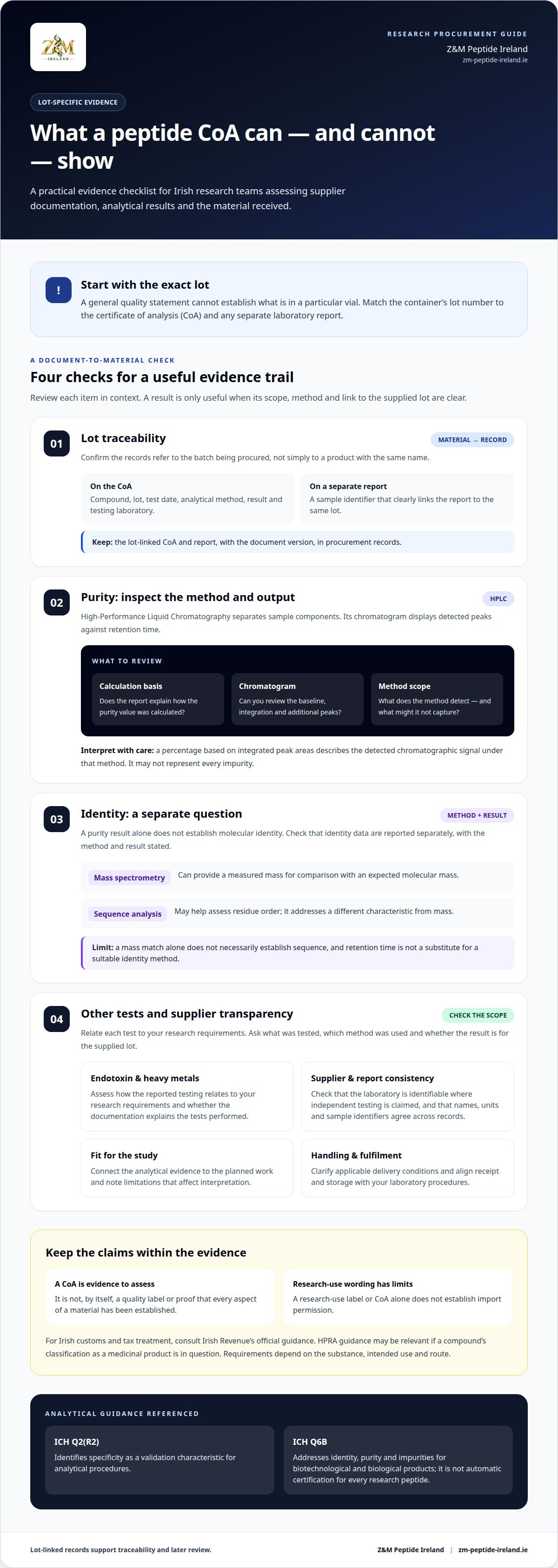
Start with the lot number on the container and trace it to the certificate of analysis (CoA). A generic product specification cannot show that the tested sample came from the batch you are procuring. The document should identify the compound, lot, test date, analytical method, result and testing laboratory. If a separate report is provided, its sample identifier should clearly link to the same lot. Together, these details create a usable record for grant documentation and later review.
Assess the CoA as evidence, not as a quality label. A purity result needs its method and reporting basis to be meaningful; an unsupported percentage does not show which impurities were measured or how the result was calculated. Look for the chromatogram or a clear summary of the analytical output, alongside the named method. HPLC is widely used to assess peptide purity and consistency, but a purity result alone does not establish identity. Identity data should be reported separately, with the method and result stated.
Independent testing is more informative when the laboratory is identifiable and the report matches the supplied lot. Check that the document distinguishes results from specifications, and that units, sample identifiers and compound names are consistent across the CoA and any laboratory report. For example, a report for one lot is not evidence for a later lot, even if the product name is unchanged. Record the document version with your procurement files to keep the audit trail linked to the material received.
In Ireland, Irish Revenue’s official guidance is relevant to customs and tax treatment. HPRA guidance may be relevant if a compound’s classification as a medicinal product is in question. Applicable requirements depend on the substance, intended use and route; a research-use label or CoA alone does not establish import permission.
- Match the container’s lot identifier to each analytical document.
- Assess purity and identity as distinct results, with methods stated.
- Retain the lot-linked CoA and report in procurement records.
HPLC purity and identity testing
High-Performance Liquid Chromatography separates sample components as they pass through a column. The chromatogram displays detected peaks against retention time. HPLC can assess peptide purity and consistency, but a prominent main peak alone does not establish molecular identity. The European Medicines Agency’s ICH Q2(R2) guideline identifies specificity as a validation characteristic for analytical procedures, underscoring the need to understand what a method detects.
Interpret a purity value in the context of its calculation. A percentage based on integrated peak areas describes the detected chromatographic signal under that method. It may not represent every impurity, including compounds the detector does not adequately capture. Review the chromatogram’s baseline, integration and additional peaks. ICH Q6B addresses identity, purity and impurities for biotechnological and biological products; its scope should not be treated as automatic certification for every research peptide.
Identity requires evidence suited to the claim. Mass spectrometry can provide a measured mass for comparison with an expected molecular mass, while sequence analysis may help assess residue order. These methods address different characteristics. A mass match alone does not necessarily establish sequence, and retention time is not a substitute for a suitable identity method. The report should state the method and result so you can assess the claim against your research requirements.
For a grant-supported study, connect analytical evidence to the planned work. A cell-signalling experiment may require a different impurity assessment from an analytical method-development project. Record why the method and reported result are relevant to the protocol, and note any limitations that affect interpretation.
- Purity: identify the calculation basis and review the chromatogram.
- Identity: assess whether the method supports the specific identity claim.
- Study fit: explain how the evidence relates to the protocol.
Evaluating peptide suppliers
For grant procurement, assess each supplier against your research needs, documentation, communication and fulfilment. A useful comparison records how each criterion affects reproducibility and accountability.
Synthesis, Custom Sequences and Bulk Orders
Suppliers specialising in peptide synthesis may offer standard compounds, custom sequences or bulk orders. Capabilities vary, so define the required sequence, scale and specification before assessing suitability.
For a custom sequence, document the requested sequence and acceptance criteria in the project record. For bulk procurement, consider whether supply consistency and lot documentation support the study plan. Do not assume that a supplier offering catalogue research peptides also provides synthesis or custom work.
Shipping, Cold-Chain and Storage Options
Delivery options to Ireland vary by supplier and compound. Establish which shipping conditions apply to the material and whether temperature control is used in transit. Cold-chain handling matters when the compound’s stability requirements call for it; do not assume it is necessary for every peptide.
Before ordering, align the delivery plan with your laboratory’s receiving and storage procedures. For example, if a shipment is temperature-sensitive, arrange suitable receipt and storage, and document any handling instructions supplied with the material. Packaging and transit conditions affect whether the compound arrives ready for the intended research workflow.
Risks of Unverified Suppliers
An unverified source can create uncertainty about a research peptide’s identity, composition or handling history. A mismatch between the label and the material, for example, could undermine an experiment’s interpretation or make results difficult to reproduce.
Procurement risks also include incomplete records, unclear product descriptions and inconsistent fulfilment. These gaps can complicate grant audits and delay work if the material does not meet the protocol’s requirements. Treat research-only wording as a description of intended use, not proof of safety, approval or legal permission. Record the rationale for supplier selection and retain purchase documentation.
Are peptide prices quoted with Irish VAT, customs duties, and shipping included?
For an Irish research budget, distinguish the peptide price from the delivered order total. A displayed product amount does not, by itself, establish whether VAT, delivery or import-related charges are included. The total depends on the transaction and shipping route, so record each cost component separately rather than assuming one quoted figure covers everything.
A peptide price depends on the compound, order quantity, shipping route and handling requirements; the final amount is provided after a quote request. For procurement records, use a written quotation that identifies the product amount and states how VAT and delivery are treated. If the order involves cross-border transport, establish whether any customs-related charge applies to that transaction. Do not infer the answer from the supplier’s location alone.
Separate the charges before comparing quotations. For example, one quotation may show the product amount and delivery separately, while another presents a combined total. These formats are not directly comparable until you identify the same cost categories. Assess VAT treatment and any customs charges against the specific transaction and route, using applicable Irish and EU requirements rather than assuming a rate.
- Product: record the compound and quoted quantity.
- VAT: note whether the quotation says it is included or additional.
- Delivery: identify whether transport is included and the stated destination.
- Import charges: account for any applicable customs-related costs separately.
For a grant application, retain the quotation and final invoice together. This links the approved budget to the amount charged and records any difference in delivery or tax treatment. If a quotation does not separate these components, its total is not a reliable like-for-like comparison. A clear cost breakdown supports purchasing approval and helps explain expenditure during grant reporting.
Z&M Peptide Ireland: Research Peptides
Z&M Peptide Ireland supplies Research Peptides for laboratory and research purposes. For Irish research teams, it can be a relevant procurement route when a project requires research compounds and the team is assessing supplier documentation, analytical evidence and purchasing records against grant requirements.
Before placing an order, align the compound and procurement details with your study protocol, approved budget and laboratory procedures. Keep the supplier’s product information and transaction documents with the project records so purchasing decisions remain traceable. Research-only designation does not establish safety, approval or legal permission; assess the material in the context of the intended work and applicable requirements.
For research peptide procurement, contact Z&M Peptide Ireland to discuss your requirements.
Make supplier qualification part of procurement planning
Supplier qualification can become a repeatable part of grant procurement, rather than a decision made anew for each order. Define the evidence your project needs, how procurement decisions will be recorded, and who is responsible for approving exceptions. This gives research and finance teams a shared basis for evaluating a laboratory peptide supplier before a purchase becomes time-critical.
Build that process around the study’s requirements. A procurement record can link the research purpose, selected material, supplier documentation and budget approval in one clear account. This supports consistent decisions across project stages and helps colleagues follow the rationale when purchasing responsibilities change.
For your next research procurement, contact Z&M Peptide Ireland to discuss your requirements. A defined process and a clear project rationale provide a practical foundation for moving forward with confidence.
Z&M Peptide Ireland: Research Peptides
Z&M Peptide Ireland supplies Research Peptides for readers considering a laboratory peptide supplier.
If Research Peptides are what you need, contact Z&M Peptide Ireland to discuss your procurement requirements.
Frequently Asked Questions
Which laboratory peptide suppliers ship to Ireland?
Z&M Peptide Ireland supplies Research Peptides for research purposes in Ireland. For a grant-funded project, plan purchasing around the project’s required start date and the order terms, rather than assuming a particular transit period. Include laboratory receiving arrangements in your planning, since access and handling capacity can affect when a delivery can be accepted and incorporated into the work schedule.
How can I verify a peptide supplier's identity, quality, and reputation?
Use your institution’s vendor approval process and consider its purchasing history. For example, procurement or finance records may show whether previous orders were completed as expected and how discrepancies were resolved. Treat that experience as one input, not a substitute for assessing suitability for the present project. Record the approval rationale and any unresolved concerns so the research team can make a transparent, consistent decision.
What purity levels and analytical certificates should a laboratory peptide supplier provide?
No single numerical purity level is appropriate for every research application. Define an acceptance threshold based on the assay’s requirements and justify it in the grant documentation as a project-specific criterion, not a general market standard. Consider whether the study’s downstream analysis is sensitive to impurities or material variation. This approach links the required specification to experimental design and helps reviewers understand why you selected that threshold.
How do laboratory peptide suppliers compare on product range, testing, delivery, and customer support?
Use a two-stage comparison: first identify requirements essential to the funded study, then assess preferences that may distinguish otherwise suitable options. For example, a required compound or delivery arrangement can be a pass-or-fail condition, while ease of resolving procurement queries can inform the final decision. Document the trade-offs and rationale so colleagues reviewing grant expenditure can follow the selection.
