
Laboratory peptide compliance for labels, records and guidance
A research-use-only label sets a boundary, but it is not a complete compliance record. In Ireland, laboratory peptide compliance depends on linking the label and batch documents to clear records of receipt, storage, research use and disposal. A certificate of analysis supports traceability, but does not by itself show that a peptide is safe, approved or legally suitable for every purpose.
For research laboratories and procurement teams, the practical task is to maintain a reliable record from delivery through the end of a project. Document the product identity, batch details, intended research use and any concerns about the material to preserve that chain of custody.
This article explains how certificates of analysis and batch records work together, what research-use-only labelling means, and why therapeutic claims require care. It also outlines how teams in Ireland can interpret relevant regulatory and technical guidance without treating rules from other jurisdictions as Irish requirements.
Key Takeaways
- Keep batch records and certificates of analysis linked to the material they describe, so each delivery remains traceable through its research use.
- Treat research-use-only labelling as an intended-use boundary, not evidence of safety, approval or permission for human or animal administration.
- Separate a peptide with questionable labelling, appearance or paperwork from normal use while the concern is recorded and handled under site procedures.
- Distinguish Irish and EU requirements from frameworks for other jurisdictions, and consider Research Peptides only for laboratory and research purposes.
Table of Contents
Certificates of Analysis and batch documentation
Keep certificates of analysis, batch records, delivery checks and project-level material records together. These documents connect each peptide delivery to its batch and intended laboratory research use.
Certificates and HPLC records
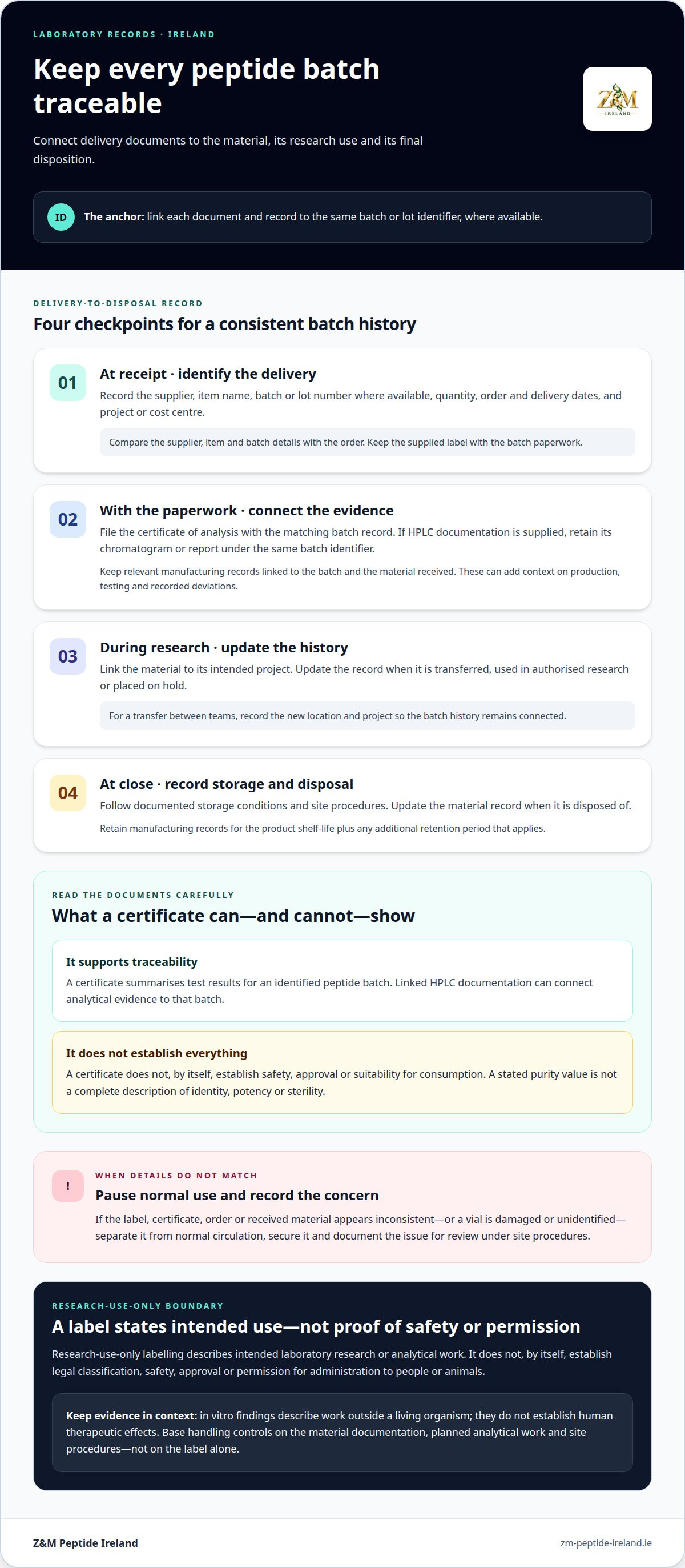
A certificate of analysis summarises test results for an identified peptide batch. If HPLC documentation accompanies it, retain the chromatogram or report with the same batch identifier. This links the analytical evidence to the material received, rather than leaving the certificate unattached. Procurement teams can compare the supplier, item and batch details with the order. Record discrepancies promptly, such as a different item name or missing batch reference. A certificate supports assessment of identity and purity, but does not establish safety, approval or suitability for consumption.
Manufacturing records and batch traceability
Manufacturing records document how a batch was produced, tested and managed. Where GMP documentation applies, relevant records include batch information, test results and deviations from established procedures. They give procurement and research teams context beyond the analytical summary in a certificate. Link each record to its batch identifier and the material received. If a delivery does not match the order, document the discrepancy and keep the related paperwork together. This creates a traceable record for review without treating supplier claims as independent verification.
Documentation integrity and retention
Documentation integrity means keeping records complete, attributable and connected to the material they describe. Log receipt details, supplier, item name, batch or lot number where available, quantity, order and delivery dates, and the project or cost centre. Update records when material is transferred, used in authorised research, placed on hold or disposed of. Preserve product labels with their batch documents. Retain manufacturing records for the product shelf-life plus additional retention periods. These steps help staff retrieve a consistent history when reviewing a batch, an order discrepancy or a research record.
Research-use-only labelling and restrictions on therapeutic claims
In Ireland, a research-use-only label describes the intended laboratory use; it does not, by itself, establish a peptide’s legal classification. Medicines and food supplements are distinct categories, and intended purpose and therapeutic claims can affect how a product is treated.
Before handling a peptide, the laboratory should document a task-specific risk assessment. Controls should address personnel, handling, storage, access and disposal under site procedures. Base the assessment on the material’s documentation and planned analytical testing, rather than assuming the label proves safety.
Research-use-only labelling indicates that material is intended exclusively for laboratory research or analytical work, not administration to people or animals. In vitro findings describe work conducted outside a living organism; they do not establish human therapeutic effects. Keep product descriptions factual, as claims about health benefits or medical applications can misrepresent the material’s research purpose.
Procurement staff should record the intended project and pause an order if an enquiry indicates human consumption, animal administration or therapeutic use. Escalating the issue under institutional procedures helps prevent material being acquired for a purpose inconsistent with its stated classification. A label cannot resolve that mismatch.
For traceability, link each received item’s supplier, name and batch or lot identifier, where available, to its project record. Keep the label and accompanying documents together. Update the record when personnel receive, transfer, use, hold or dispose of the material. For example, a transfer between research teams should record the new location and project, preserving the batch history for later review.
Laboratory product compliance responsibilities
Laboratory controls connect supplier documentation with decisions about receipt, use and storage. Procedures should address product identity, documentation and intended research classification.
In-process and final product testing
In-process testing monitors defined manufacturing stages, while final testing assesses the released material. For pharmaceutical peptides, release testing may assess identity, purity, potency and sterility; stability studies support shelf-life and storage conditions. These measures are not interchangeable with a research-use certificate. Procurement teams should distinguish pharmaceutical controls from evidence supplied for laboratory research and avoid treating one analytical result as proof of every quality attribute.
Product identity and purity specifications
Identity and purity testing assess different properties, so labels and certificates should specify which results they report. A stated purity value is an analytical claim, not a complete description of identity, potency or sterility. Independent assessment may be appropriate for the research protocol and institutional procedures. If the label, certificate and received material appear inconsistent, quarantine the product from use and record the concern for review. This prevents an unresolved identity question from carrying into an experiment.
Laboratory handling and product controls
Handling controls define how personnel label, store, access and dispose of each material. Keep the supplied label attached or retain it with the batch record, and follow documented storage conditions and site procedures. If a vial is damaged or unidentified, remove it from normal circulation, secure it and record the issue. Dispose of expired, surplus or damaged material under site procedures and applicable waste rules, not in general waste. These steps preserve a clear status for each item.
Supplier qualification and raw-material testing, including amino acids and reagents, are relevant to pharmaceutical manufacturing controls. For laboratory procurement, record the supplier and product classification, then assess the documents against the intended research use. A certificate reports results for the tests it covers; it does not establish suitability for every clinical or pharmaceutical application.
Regulatory and technical guidance for synthetic peptides
For laboratories in Ireland, applicable requirements depend on intended use, classification and supply-chain role. Non-compliant supply or use can disrupt research; legal consequences depend on the relevant rules and conduct.
Regional peptide regulatory frameworks
Regional frameworks differ, so rules for one market should not be treated as Irish requirements. In the EU, relevant frameworks include REACH and the Clinical Trials Regulation. REACH registration is required above 1 ton. The European Medicines Agency guideline EMA/CHMP/CVMP/QWP/387541/2023 addresses synthetic peptide development and manufacture. Intended use and whether work concerns research or clinical development affect which guidance applies.
Regulation in the UK and US
The UK framework is separate from Ireland’s EU context. The MHRA is the authority for the UK peptide regulatory framework, where classification depends on intended use; some peptides are prescription medicines, while others are unlicensed products. UK REACH is separate from EU REACH. The European Medicines Agency identifies the FDA in the United States and EMA in the EU as agencies that typically enforce GMP standards. These distinctions matter when interpreting overseas supply-chain records.
Regulatory updates and specialist advice
Regulatory updates can affect technical expectations for development and manufacture. For synthetic peptide development, the European Medicines Agency guideline identified above is a relevant reference. Specialist advice is particularly useful when a project moves towards clinical use, changes its intended purpose or involves a controlled substance. For Ireland, identify the product classification and research context before applying guidance written for another jurisdiction.
Checks before importing peptides
Before import, establish the peptide’s intended use, origin and classification within the supply chain. Check the relevant country’s controlled-substance schedule if the material has known or suspected abuse potential. Keep the decision and supporting documentation with procurement records. For Irish laboratory research procurement, Research Peptides are intended for research purposes.
Z&M Peptide Ireland: Research Peptides
Verify directly with Z&M Peptide Ireland whether it supplies Research Peptides and whether they are intended for laboratory and research purposes. This is a relevant procurement question when a project has a defined research scope and requires peptides intended for research. The offering does not replace a laboratory’s own classification, risk assessment or recordkeeping procedures.
For a research team in Ireland, align a proposed purchase with the approved project and institutional procurement process. Define the experimental purpose, responsible research group and internal authorisation before ordering. These decisions help keep procurement aligned with laboratory research, rather than therapeutic, veterinary or consumption-related purposes.
Keep the material’s role clear throughout the project. Confirm the supplier’s stated intended use; a research-use description does not establish safety, approval, legal permission or suitability for a particular procedure. Those determinations are separate from purchasing.
A defined project scope also helps institutional teams manage purchasing records. Associate the purchase with its project or cost centre, intended research purpose and internal authorisation. Once received, handle the material under established procedures for storage, access, use and disposal. This keeps procurement aligned with local governance and approved research activity.
This distinction matters when teams manage documentation, chain of custody and regulatory responsibilities. A product category informs the purchasing decision, while laboratory procedures govern receipt, handling and research records. If work is intended for human or animal administration, do not treat a research-only description as confirmation of suitability. Keep the procurement purpose aligned with laboratory research.
For procurement enquiries, contact Z&M Peptide Ireland.
Make compliance part of routine procurement
Make laboratory peptide compliance part of established procurement governance, rather than a task reserved for audits or exceptions. Assign responsibility for assessing intended use, recording decisions and escalating changes in project scope. A documented process gives procurement and research personnel a shared basis for managing materials throughout a project.
Review the process whenever a project changes direction, a supplier or material changes, or a new regulatory question arises. These review points help teams decide whether existing approvals and procedures still fit the work. Keep decisions connected to the institution’s research governance so operational records reflect why materials are obtained and used.
Record the material description, intended research use, supplier information and checks required by institutional procedures. Check the Z&M Peptide Ireland website for current supplier information, and verify any details relevant to procurement before recording them. A clear scope and consistent records help support considered research procurement.
Z&M Peptide Ireland and Laboratory Peptide Compliance
Before considering a supplier, document your laboratory’s compliance requirements and verify relevant product and business information directly with Z&M Peptide Ireland. Do not treat a research-only label as proof of safety, approval or legal permission.
Keep these checks central to material selection and use, and consult the applicable guidance for your research and jurisdiction.
Frequently Asked Questions
What does laboratory peptide compliance mean?
Laboratory peptide compliance means documenting control of a peptide’s procurement, classification and use within the institution’s research scope. For example, a project record should identify who authorised the work and how the material is assigned to that project. This goes beyond a label or analytical document: it connects procurement decisions to institutional governance and the research being conducted.
What Irish and EU laws regulate peptides used in laboratories?
No single framework classifies every peptide in the same way. In Ireland, applicable requirements depend on intended use and classification. The EU’s REACH framework and Clinical Trials Regulation are relevant legal frameworks, but their relevance depends on the material and activity. Consult the legislation itself for applicable provisions; a peptide used in non-clinical analytical work should not automatically be treated as a clinical-trial product.
What are the rules for importing peptides into Ireland for research use?
Before importing, establish the material’s identity, intended use, origin and classification. If it has known or suspected abuse potential, consult the official controlled-substance schedule for the relevant country as a primary source. Keep the decision and supporting supplier documents with institutional procurement records. A research-use-only label does not, by itself, establish legal permission to import or use a material in Ireland.
What quality standards and testing should laboratory peptides meet?
Quality criteria depend on intended use and classification. For pharmaceutical peptide release, testing should assess identity, purity, potency and sterility; stability studies support shelf-life and storage conditions. The European Medicines Agency guideline EMA/CHMP/CVMP/QWP/387541/2023 provides technical guidance on synthetic peptide development and manufacture. For research materials, define acceptance criteria against the experimental purpose; a purity result alone does not establish sterility or clinical suitability.
