
How to assess peptide dissolution and equilibrium solubility
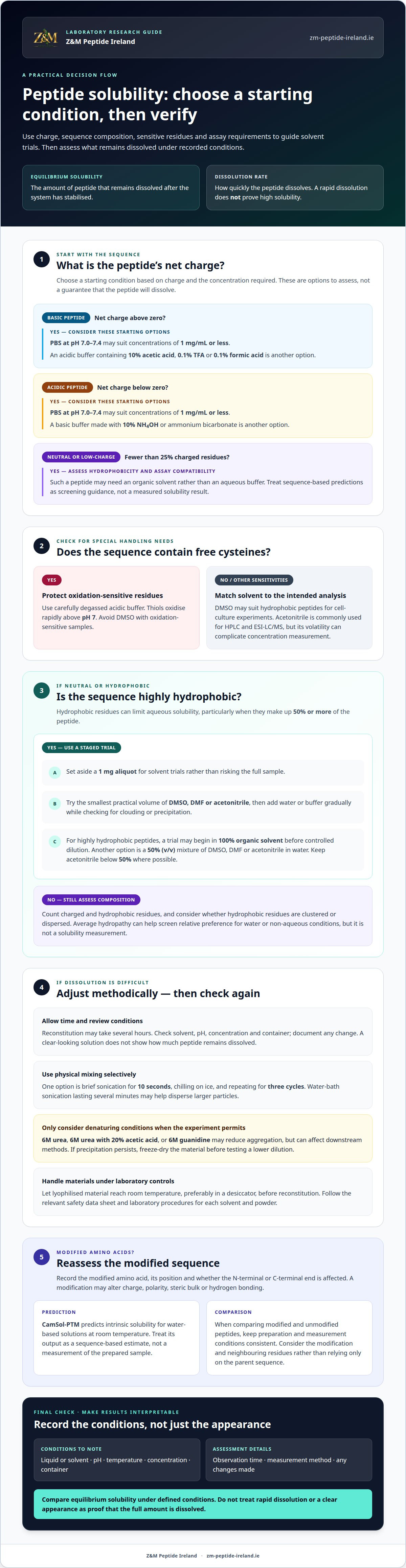
Equilibrium solubility is the amount of peptide that remains dissolved under defined conditions after the system has stabilised. Dissolution rate describes how quickly it dissolves. Effective peptide solubility protocols distinguish these measurements: rapid dissolution does not prove high solubility.
In laboratory work in Ireland, results depend on the conditions used, including the liquid, temperature, pH, concentration and container. Recording these conditions, along with the observation time and measurement method, makes comparisons more meaningful. A clear-looking solution may not contain the full amount of peptide in solution.
This guide explains how to assess equilibrium solubility, distinguish it from dissolution rate, and approach neutral, hydrophobic and modified peptides. It covers practical choices for solvents and buffer conditions, and explains why sequence modifications can affect predictions and experimental results. The aim is to make assessments more consistent and interpretable, not to assume one preparation method suits every peptide.
Key Takeaways
- Choose a starting solvent for acidic or basic peptides based on net charge and the concentration required for the experiment.
- For neutral or hydrophobic sequences, use a staged solubilisation approach and assess whether the solvent is compatible with the intended analysis.
- Account for modified amino acids when estimating solubility, then compare predictions with experimental observations.
- Keep sequence-based estimates separate from concentration calculations, and record the conditions used so results can be interpreted consistently.
Table of Contents
What is peptide solubility?
Solubility is the amount of peptide that remains dissolved under defined conditions; dissolution rate is how quickly it dissolves. Assess both in relation to the peptide sequence, solvent, pH, temperature, concentration and container.
Set the solution conditions
- Match solvent choice to charge. For basic peptides, PBS at pH 7.0-7.4 can suit concentrations of 1 mg/mL or less. For a basic peptide with net charge above zero, an acidic buffer containing 10% acetic acid, 0.1% TFA or 0.1% formic acid is another option. For acidic peptides at 1 mg/mL or less, PBS at pH 7.0-7.4 may be suitable; a peptide with net charge below zero can be tested in basic buffer made with 10% NH4OH or ammonium bicarbonate.
- Account for sensitive residues and intended use. Dissolve peptides containing free cysteines in carefully degassed acidic buffer, since thiols oxidise rapidly above pH 7. DMSO may suit hydrophobic peptides for cell-culture experiments, but avoid it with oxidation-sensitive samples. For HPLC and ESI-LC/MS, acetonitrile is commonly used; its volatility can complicate concentration measurement. In-vivo research requires a vehicle compatible with the experimental protocol, not an assumption based on clarity.
Troubleshoot precipitation or failed dissolution
- Test a small sample first. Hydrophobic residues can limit aqueous solubility, particularly in peptides containing 50% or more hydrophobic residues. For a highly hydrophobic sequence, try the smallest practical volume of an organic solvent before gradual dilution with water or buffer. Keep acetonitrile below 50% where possible.
- Allow time and assess the conditions. Reconstitution may take several hours. Check whether the solvent, pH, concentration or container could explain precipitation, then document any change. A clear solution does not establish how much peptide remains dissolved.
- Handle powder and solvents under laboratory controls. Let lyophilised material reach room temperature, preferably in a desiccator, before reconstitution. Follow the relevant safety data sheet and laboratory procedures for each solvent and powder; use oxygen-free solvent for oxidation-sensitive residues such as cysteine.
Solubilising neutral and hydrophobic peptides
- Review sequence composition before selecting a solvent. A peptide with fewer than 25% charged residues may need an organic solvent rather than an aqueous buffer. Count charged and hydrophobic residues, then consider their positions: clustered hydrophobic residues can affect behaviour differently from a dispersed pattern.
- Use a hydropathy index as a screening tool. Calculate or consult the sequence’s average hydropathy to predict its relative preference for water or non-aqueous conditions. Treat the value as a guide, not a measured solubility result. Sequence composition and experimental conditions still determine what the sample does.
- Start with a small test portion. Set aside a 1 mg aliquot for solvent trials instead of risking the full sample. For highly hydrophobic peptides, test the smallest practical volume of DMSO, DMF or acetonitrile, then add water or buffer gradually while observing for clouding or precipitation.
- Adjust the solvent strategy if the first trial fails. A highly hydrophobic peptide may first be dissolved in 100% organic solvent before controlled dilution. Another option is a 50% (v/v) mixture of DMSO, DMF or acetonitrile in water. Select the method compatible with the downstream assay and its solvent limits.
- Use physical mixing methods selectively. Sonicate briefly for 10 seconds, chill on ice, and repeat for three cycles. A water-bath sonication lasting several minutes may help disperse larger particles. Avoid assuming that faster disappearance means greater equilibrium solubility.
- Escalate only when the experiment permits it. Denaturing conditions such as 6M urea, 6M urea with 20% acetic acid, or 6M guanidine may reduce aggregation, but can affect downstream methods. If precipitation persists, freeze-dry the material before testing a lower dilution.
Solubility of peptides containing modified amino acids
- Record each modification before assessing the sequence. Note the modified amino acid, its position, and whether it affects the N-terminal or C-terminal end. A chemical change can alter charge, polarity, steric bulk, or hydrogen bonding. These effects may change how the peptide interacts with water compared with its unmodified sequence.
- Reassess the complete sequence. Consider how the modification affects net charge and hydrophobic character, including neighbouring residues. A change that adds a charged group may alter aqueous behaviour, whilst a hydrophobic modification may shift the balance towards non-aqueous conditions. Do not infer the modified peptide’s properties solely from its parent sequence.
- Use prediction tools within their defined scope. CamSol-PTM predicts intrinsic solubility for water-based solutions at room temperature. Treat its output as a sequence-based estimate, not a measurement of the prepared sample. Solvent composition, pH, concentration, temperature, and container can all affect the experimental result.
- Design a direct comparison. If comparing modified and unmodified peptides, keep preparation and measurement conditions consistent. Record the solvent, pH, concentration, temperature, observation time, and method. This makes it easier to distinguish a modification-related difference from variation introduced by the procedure.
- Keep handling and storage records specific. Document the modification, terminal position, preparation conditions, and storage history for each sample. A biological modification does not establish solution stability. Compare the sample’s behaviour after storage with its initial result using the same analytical conditions.
- Interpret predictions against the intended experiment. A water-based estimate at room temperature may not represent performance in a different buffer or assay. Use prediction to guide experimental design, then assess the peptide under the conditions relevant to the study. This supports a more defensible conclusion about whether it remains dissolved for the intended application.
How do you calculate peptide solubility from sequence, molecular weight and concentration?
- Use sequence analysis to estimate, not measure, solubility. Review charged and hydrophobic residues to predict how the peptide may interact with water. Histidine's charge state can depend on pH, so account for pH when estimating peptide charge. This sequence-based estimate does not establish the amount that will remain dissolved at equilibrium.
- Find the molecular weight for the exact peptide. Use the value for the complete sequence, including modifications and terminal changes. A modified peptide may have a different molecular weight from its unmodified counterpart, so use the matching value in any molar conversion.
- Calculate mass concentration from the amount and final volume. Divide peptide mass by the final solution volume, using compatible units. For example, dissolving 1 mg in a final volume of 2 mL gives 0.5 mg/mL. Use final volume, not simply the volume of solvent added.
- Convert mass concentration to molar concentration when needed. Convert mg/mL to g/L, then divide by molecular weight in g/mol. The result is mol/L. This calculation describes the nominal concentration added, not necessarily the concentration that remains dissolved.
- Separate the calculation from the experimental finding. A peptide solubility protocol should record sequence, molecular weight, solvent, pH, temperature, container, and concentration. Compare samples only when these conditions and the observation time are consistent. A sequence estimate and a concentration calculation answer different questions.
- Measure dissolved peptide to assess equilibrium solubility. Allow the sample to reach a stable state under defined conditions, then use a suitable analytical method to quantify peptide in solution. Account for precipitation and adsorption to the container, since either can make measured concentration lower than the nominal value. Report the method and any sample losses alongside the result.
Z&M Peptide Ireland: Research Peptides
Before sourcing research peptides, confirm whether Z&M Peptide Ireland currently lists the peptide you need. Check the current site information and request relevant product documentation before making procurement decisions.
Use the solubility considerations above to plan solvent screening and record the conditions required for your study. Product selection and experimental preparation are separate decisions: solubility depends on the peptide and the conditions used. A research-only designation does not establish safety, approval or legal permission for a particular use.
To verify whether Z&M Peptide Ireland currently offers a relevant research peptide, consult its current product information.
Carry your solubility findings into the next experiment
Before scaling a preparation, define what the experiment requires from the dissolved peptide. An analytical method may require a solvent compatible with detection, while a biological assay may depend on conditions that preserve its readout. Use preliminary findings to refine the procedure for the planned application, rather than assuming one preparation will suit every downstream method.
Turn the selected conditions into a concise preparation record. Include the peptide identifier, solvent system, preparation steps and criterion used to assess the result. This gives colleagues a practical reference for repeating the work or investigating differences between runs. Keep the record specific to the experiment, and revise it if the method or sample changes.
For procurement planning, align the material specification with the study requirements and the relevant Research Peptides information. A clear record of the intended research context can help maintain continuity between sourcing and experimental planning. Apply that same precision to the next stage of your work.
Z&M Peptide Ireland and Research Peptides
After reviewing peptide solubility protocols, check current product and documentation details with Z&M Peptide Ireland before deciding whether an item is suitable for your research.
For procurement, verify the specification and analytical documents relevant to your laboratory’s requirements rather than relying on a research-only label.
Frequently Asked Questions
What does equilibrium solubility mean?
Equilibrium solubility is the amount of peptide that remains dissolved under defined conditions after the system has stabilised. It differs from both the amount initially added and the speed of dissolution. To assess it, define the solvent, pH, temperature, concentration, vessel and observation endpoint, then quantify the dissolved fraction using a suitable method. A clear sample alone does not establish equilibrium or account for peptide adsorbed to surfaces.
What are standard lab protocols for dissolving peptides in water, PBS and organic solvents?
There is no single solvent sequence suitable for every peptide. For an initial screen, use separate small sample portions and compare water or aqueous buffer with an organic solvent where sequence properties indicate limited water solubility. PBS at pH 7.0-7.4 may suit basic or acidic peptides when 1 mg/mL or less is adequate. Record the solvent composition and final volume, and ensure the chosen system suits the downstream assay.
How should peptide pH be adjusted to improve solubility without damaging the peptide?
Adjust pH cautiously and use weak bases when raising it, since strong bases can promote racemisation or side reactions. For a basic peptide, an acidic solution may be tested; for an acidic peptide, consider a basic solution. Use the smallest practical adjustment and record the final pH. Peptides with free cysteines require particular care because their thiols oxidise rapidly above pH 7.
How do you prepare peptide stock solutions and calculate concentrations in mg/mL and mM?
Calculate mass concentration by dividing peptide mass by final solution volume. For example, 1 mg brought to a final volume of 2 mL gives 0.5 mg/mL. To convert mg/mL to mM, use the peptide’s molecular weight: mg/mL is numerically equal to g/L; divide by molecular weight in g/mol, then multiply mol/L by 1,000. Use the molecular weight for the exact modified sequence.
What are recommended sonication, vortexing and warming steps for dissolving peptides?
Begin with gentle mixing, then use brief sonication if particles remain. One reported approach is three 10-second sonication periods, chilling the sample on ice between periods. Allow reconstitution time, as dissolution may take several hours. If warming is appropriate for the experiment, keep the solution below 40°C. Avoid treating faster dissolution as proof that a greater amount has reached equilibrium solubility.
How should peptide solutions be filtered, aliquoted, stored and freeze-thawed?
Before filtration, consider whether the membrane could retain peptide; assess recovery with a small portion if filtration is required by the method. Aliquoting can limit repeated handling of the main stock. Store solutions intended for storage below −20°C; frozen solutions may remain stable for several months, but long-term storage is not recommended, particularly for peptides containing Asn, Gln, Cys, Met or Trp. Record freeze-thaw history.
