
High-Purity Research Peptides for Laboratory Research in Ireland
A high-purity claim alone does not establish that a peptide is suitable for laboratory research. In Ireland, assess high-purity research peptides by their laboratory-only intended use and the evidence supporting their purity and identity. HPLC helps assess purity, while mass spectrometry can help verify molecular identity.
Purity is an important starting point, but it does not tell the whole story. Differences between production batches can affect laboratory results, so consider what a research-grade claim means and what it does not demonstrate when interpreting findings.
This article explains what a research peptide catalogue can include, how HPLC purity testing and mass spectrometry identity checks work, and what purity claims do and do not establish. It also covers analytical reports and factors laboratories can consider when selecting peptides, helping you assess product information more precisely.
Key Takeaways
- Keep intended use firmly within laboratory research, and account for batch differences when planning and interpreting experiments.
- Match catalogue selections to the study’s requirements rather than relying on a product name alone.
- Use HPLC results to assess purity and mass spectrometry to examine molecular identity; each provides different information.
- Read research-grade claims alongside analytical documentation, since a purity figure alone does not describe every aspect of a sample.
Table of Contents
Laboratory-only intended use and research limitations
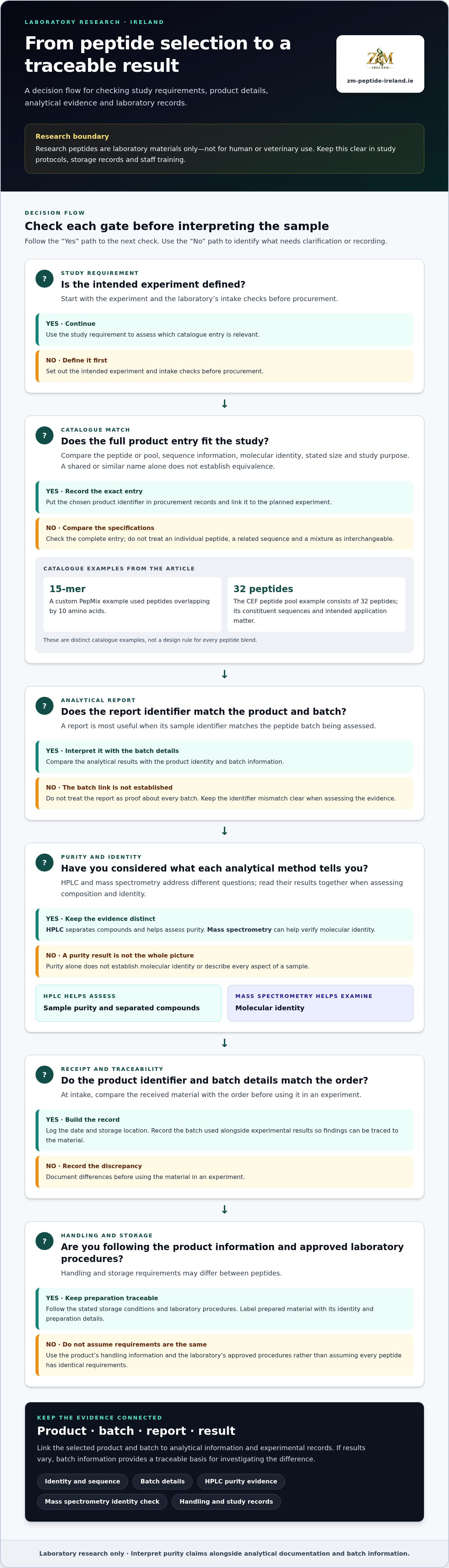
Before procurement, define the intended experiment and the laboratory’s intake checks. Record the material’s identity, batch details and handling requirements alongside related reagents and consumables.
Research peptides are laboratory materials, not instructions for human or veterinary use. Keep this boundary clear in study protocols, storage records and staff training.
Impurities and Laboratory Results
Peptide synthesis can leave unwanted compounds or incomplete sequences, which purification helps remove. Batch differences can affect laboratory outcomes even when reported purity levels appear acceptable. Low-level contaminants may alter a biological response and complicate interpretation. Record the batch used alongside each experimental result, then compare batch information if findings vary. This provides a traceable basis for investigating unexpected results.
Buying, Importing and Using Peptides
For Ireland and the EU, consider the compound’s classification, intended use and import route before procurement, as these determine which requirements apply. Keep purchase and intake records, and restrict use to laboratory research. On receipt, compare the product identifier and batch details with the order, then log the date and storage location. Record discrepancies before using the material in an experiment. Procurement records help link each reagent to its study and results.
For storage and reconstitution, follow the product’s handling information and the laboratory’s approved procedures. Label prepared material with its identity and preparation details, and use the specified storage conditions. Do not assume every peptide has the same requirements.
Safety Risks and Precautions
Research peptides and associated reagents may present handling risks through exposure, spills or incorrect disposal. Before work begins, review the available safety information and the laboratory’s risk assessment. Use the specified protective equipment, keep containers clearly identified, and follow local procedures for containment and waste. During reconstitution, use the approved laboratory method and avoid unlabelled solutions. These steps support controlled laboratory research; they do not make the material suitable for use outside research.
Research peptide catalogue and product categories
A research catalogue is most useful when each entry can be matched to a defined experimental requirement. Compare the peptide name, amino acid sequence, molecular identity and intended research context. A receptor study, for example, may require a particular sequence; a similar name alone does not establish equivalence.
Catalogue entries can describe individual peptides, related sequences or mixtures. Treat each as a distinct research material. A custom PepMix described by Dr Laura J Pallett used 15meric peptides overlapping by 10 amino acids. That example shows why sequence length and overlap matter when assessing a designed pool. It does not mean every peptide blend uses the same design.
Product variants may differ in sequence or other stated specifications. Compare the complete product entry rather than selecting by a shared peptide name. Record the chosen identifier in procurement documents and link it to the planned experiment. This helps prevent similarly named materials from being confused at laboratory intake.
Some research uses involve a peptide pool rather than one individual sequence. The CEF peptide pool described by Dr Laura J Pallett consists of 32 peptides. For a pool, its constituent sequences and intended application are central selection details. For an individual peptide, the sequence and molecular identity guide comparison. These are different catalogue formats, not interchangeable descriptions.
Treat product sizes and molecular formulas as specification details, not information to infer from a category label. Use the stated unit and formula when matching material to a protocol or recording inventory. A formula supports identification, while product size informs procurement planning; neither alone describes purity or confirms suitability for a particular experiment.
Before ordering, make a brief comparison record covering the peptide or pool, sequence information, molecular details, stated size and study purpose. This gives the laboratory a consistent way to distinguish related entries and document its selection. Do not assume that a blend, receptor-related peptide and individual sequence have the same research role.
HPLC purity testing and mass spectrometry identity checks
HPLC and mass spectrometry answer different analytical questions. Read their results together to assess sample composition and identity.
Third-Party HPLC Purity Results
Independent testing can provide evidence about purity, molecular identity, composition, stability and contaminants. A report is most useful when its sample identifier matches the peptide batch being assessed. Compare the reported results with the product identity and batch details, rather than treating them as proof about every batch. Third-party testing provides a separate analytical assessment, but results still need to be interpreted in light of the study’s requirements.
HPLC Purity Analysis
High-Performance Liquid Chromatography separates compounds within a peptide sample. The resulting separation helps identify impurities and calculate the proportion attributed to the intended product. Review the reported purity alongside the analytical information and batch identifier. HPLC can also support assessment of molecular consistency, contaminants, batch reliability and product stability. These measures help laboratories evaluate a sample, but purity alone does not establish molecular identity.
For practical comparison, match each HPLC report to its product and batch. Record the result with laboratory intake and study documents to help trace a sample if experimental findings differ across batches. Follow appropriate storage procedures, as storage conditions can affect stability. Interpret stability information in the context of how the material was handled.
HPLC-MS Identity Checks
Mass spectrometry examines ions produced from a sample and helps assess whether its measured molecular mass aligns with the expected peptide. HPLC-MS combines chromatographic separation with mass spectrometric analysis, so separated compounds can be examined alongside identity evidence. Review identity findings separately from the HPLC purity figure. Together, these methods provide complementary information; neither result replaces the other.
For procurement records, retain the analytical report with the product and batch details. Check that the report identifies the material assessed and distinguishes purity findings from identity findings. This makes the evidence easier to interpret during laboratory research and supports consistent comparisons between samples. Analytical documentation, third-party testing and appropriate storage information each address a different part of quality assessment.
Peptide purity and research-grade claims
A purity figure describes the proportion of a final sample attributed to the intended amino acid sequence rather than unwanted contaminants or by-products. It is useful evidence, but does not fully describe a peptide’s identity, stability or performance in a scientific experiment. Treat “research-grade” as a claim to assess through analytical documentation, not as a substitute for it.
Peptide synthesis can produce additional compounds and incomplete sequences. Purification removes impurities and improves consistency, but reported purity still needs context. A high percentage alone, for example, does not identify which impurities were detected or demonstrate that molecular identity was checked. Read the result alongside the batch identification and analytical method.
High-performance liquid chromatography separates compounds in a sample and helps calculate purity. Read a report for its stated result and the material or batch it describes. Mass spectrometry addresses a different question by checking molecular identity. These methods provide complementary evidence; a purity result is not an identity check.
Even low levels of contamination may alter biological responses and lead to misleading experimental outcomes. This matters when comparing results across batches or interpreting an unexpected response. Keep the product’s batch record with experimental notes so the material used can be traced during review. Stability and storage information can also help explain whether handling affected the sample.
Before purchasing, review available analytical reports, including Certificates of Analysis and independent laboratory reports. These documents form part of quality assurance and help assess specific product claims. Check that the report corresponds to the material under consideration, then weigh its purity, identity evidence and stated composition against the experiment’s requirements. No single label establishes every quality attribute.
For laboratory procurement, review research peptide options alongside the analytical information relevant to your study.
Z&M Peptide Ireland: Research Peptides
Z&M Peptide Ireland supplies Research Peptides for laboratory and research purposes through an online procurement platform serving Ireland’s scientific community. Explore the catalogue once your laboratory has defined the compound required, its intended research use and its intake process. Match the selected material to your study protocol, then record its identity in laboratory documentation. This connects purchasing decisions to experimental requirements rather than broad product labels alone.
Consider research-grade claims alongside the analytical criteria discussed above. Review available product information in the context of your study and established laboratory procedures. Research peptides are intended exclusively for laboratory and research purposes.
For research peptide procurement, contact Z&M Peptide Ireland.
Make your next procurement decision study-led
Before placing an order, turn the experimental question into a practical procurement brief. Specify the material required by your protocol, the analytical evidence relevant to the work and how the laboratory will document receipt. This links the purchasing decision to study design rather than treating it as a separate administrative step.
For studies requiring high-purity research peptides, define how the selected material will be evaluated in the experiment. A clear record of selection criteria supports consistent decisions as projects or batches change. Z&M Peptide Ireland supplies Research Peptides for laboratory research, offering a relevant next step once your requirements are defined.
Explore research peptide procurement with Z&M Peptide Ireland and take the next step with your laboratory’s requirements in view.
Z&M Peptide Ireland and Research Peptides
Z&M Peptide Ireland supplies Research Peptides for readers seeking high-purity research peptides for laboratory use.
Once you have clarified your research requirements, explore the Research Peptides offered by Z&M Peptide Ireland.
Frequently Asked Questions
How is peptide purity tested and reported, such as by HPLC and mass spectrometry?
HPLC and mass spectrometry provide complementary analytical evidence. To review a report, match its sample or batch identifier to the material label, then note which method supports each result. This helps prevent a purity result from being mistaken for identity evidence. Keep the report with the laboratory’s procurement record so the documentation remains traceable during later analysis.
What purity levels are typical for research-grade peptides?
No single purity level defines suitability for every research-grade peptide or experiment. The relevant acceptance criterion depends on the study design and the effect impurities could have on its measurements. Set the laboratory’s required specification before purchasing, then assess the stated result against it. A “research-grade” label alone does not establish that material meets a particular experimental threshold.
What factors affect the price of high-purity research peptides?
Price can depend on the requested peptide sequence, quantity, modifications, purification requirements and analytical work. These factors affect the material and production process, so different research peptides need not have comparable costs. For budget planning, define the required sequence and specification first, then compare the requested quantity and documentation needs with the study’s procurement criteria. There is no single market price for every peptide.
Which suppliers provide high-purity research peptides in Ireland or the EU?
In Ireland, Z&M Peptide Ireland is an online supplier of Research Peptides intended exclusively for laboratory and research purposes. Irish laboratories can consider its research peptide catalogue when sourcing material for a defined study. The supplier’s stated scope is Ireland; this does not establish EU-wide delivery. Keep procurement aligned with laboratory requirements and the material’s research-only intended use.
What documentation should accompany research peptides, such as a certificate of analysis?
A Certificate of Analysis or independent laboratory report can form part of quality assurance documentation. For useful laboratory records, associate the document with the product identifier and batch received, and retain it alongside purchase and intake records. This creates a traceable file for later review. Use the analytical information relevant to the study rather than treating the document’s title alone as evidence of every quality attribute.
How can buyers compare peptide suppliers, purity claims, and quality-control standards?
Use a comparison record to capture each material’s stated purity information, analytical documentation, batch identification and storage procedures. Assess whether the records address the intended experiment’s requirements. For example, distinguish purity results from identity evidence and record any differences in documentation between batches. This structured approach makes purchasing decisions easier to explain and supports consistent laboratory procurement.
