
GHK-Cu Peptide: Skin and Hair Effects and What Research Shows
For laboratory storage, the right conditions for GHK-Cu peptide depend on its physical form and the supplier’s stability data. Treat it as a research compound, not a cosmetic product, and use its documentation to determine the applicable storage limits.
First, distinguish the material as supplied from any prepared solution. Record the batch identifier and receipt date, then follow the stated handling and storage conditions. Do not assume the same conditions apply to both forms, or assign a shelf life without supporting stability data.
This article explains how to assess storage information, identify factors that may affect peptide stability, and interpret skin and hair research without confusing laboratory findings with evidence in people. It also outlines what procurement teams can record to support traceability and consistent laboratory handling.
Key Takeaways
- Understand how GHK binds copper and why this complex is studied separately from the peptide alone.
- Assess topical skin findings alongside the limited human evidence for hair growth and wound healing.
- Distinguish laboratory and animal results from effects demonstrated in people, and consider why formula matters when combining copper peptides with active ingredients.
- Interpret current findings cautiously: studies have limitations, and published human research has not established the safety and effectiveness of injectable use.
Table of Contents
So what makes a peptide a "copper" peptide?
A copper peptide is a peptide associated with a copper ion; GHK-Cu is one example. Distinguishing the complex from the peptide alone helps research teams define exactly which material a study examines.
Copper Binding and Peptide Structure
Copper binding describes the coordination of a copper ion by chemical groups within a peptide, forming a complex. In GHK-Cu, GHK refers to the peptide component, while Cu denotes copper. The binding environment is relevant to compound identity and behaviour in a formulation. For a laboratory comparison, record the material’s stated identity and form rather than treating all copper-containing peptides as interchangeable.
GHK-Cu and Copper Peptides
Copper peptides are a broader category; GHK-Cu names a particular peptide-copper complex. Cosmetic ingredient labels may use the name Copper tripeptide-1. For procurement and experimental records, compare the stated identity across the label, product documentation and study protocol. Consistent naming helps prevent confusion between the complex and other ingredients that also contain copper or peptides.
Copper peptides have been used in topical cosmetic creams and serums for decades. Research has explored possible links with collagen, elastin and skin remodelling, but these findings do not establish how every product performs. Formulation, concentration and other ingredients can all affect a topical product’s behaviour.
Layering depends on formulation. Avoid applying raw copper peptides directly with strong actives such as vitamin C or retinoids; compatibility depends on the finished formula. “Copper uglies” is an informal term for a possible unwanted skin response, not a defined measure of product quality or effectiveness.
There are no published human studies showing that injectable GHK-Cu is safe and effective, and it is not FDA-approved. FDA status is not Irish authorisation. To assess product quality in Ireland, compare the stated compound identity with the accompanying analytical documentation, including whether the records identify the same material and batch. A research-only label does not establish safety or approval.
How Does GHK-Cu Work On Skin and Hair?
Researchers study GHK-Cu using different models, from skin-cell experiments to topical studies in people. Each model can answer a different question, so the model matters when interpreting a result.
How GHK-Cu May Affect Skin and Hair
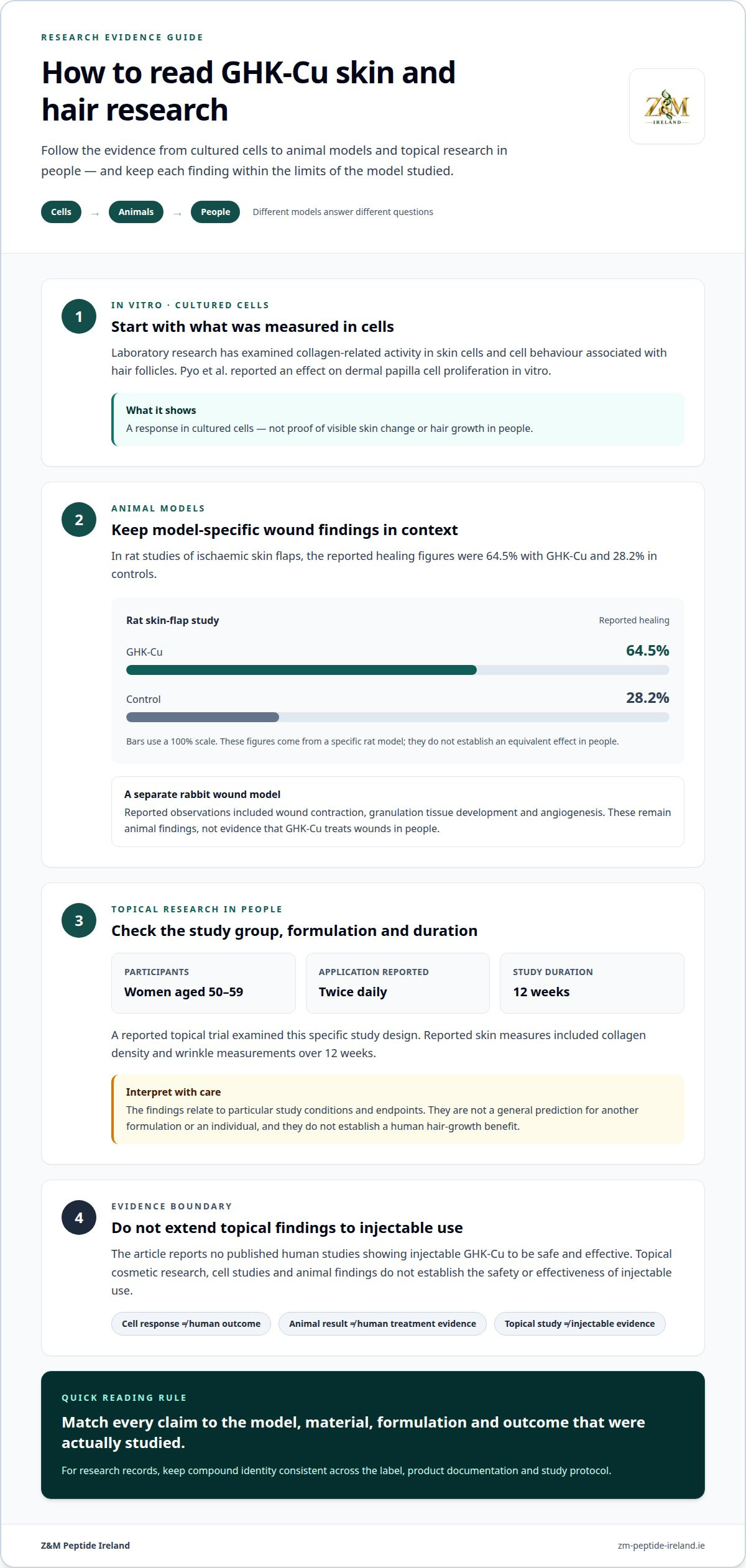
Laboratory research has examined whether GHK-Cu affects collagen-related activity in skin cells and cell behaviour associated with hair follicles. These are possible mechanisms, not proof of visible changes. When assessing a claim, distinguish a measured cellular response from a skin feature or hair growth in people. These outcomes are not equivalent evidence.
Research into Healing and Hair Growth
Wound-healing research includes animal models, while hair investigations include cell-based work. Pyo et al. reported effects on dermal papilla cell proliferation in vitro. That result concerns cultured cells, not hair growth in people. Animal wound findings likewise apply to the model studied. These research directions can guide further investigation, but they do not establish clinical effectiveness for human wounds or hair loss.
Cosmetic Uses for Ageing and Hair Loss
Topical GHK-Cu appears in cosmetic research focused mainly on skin appearance. One reported trial examined twice-daily topical use in women aged 50 to 59 over 12 weeks. This is a specific study design, not evidence that every formulation has the same effect. Cosmetic interest in hair loss should be assessed separately, since laboratory observations do not establish a human hair-growth benefit.
Reported Results and Timelines
Reported topical studies describe changes in skin measures, including collagen density and wrinkle measurements, over 12 weeks. These findings are tied to particular study conditions and endpoints. They should not be read as a general prediction for an individual or another product. For hair, the cited evidence here concerns cells rather than a human timeline for visible change.
Animal studies and possible effects beyond skin
Animal findings extend research beyond cosmetic skin effects, but remain distinct from evidence in people. Their value is in identifying biological questions for further study.
Findings from Animal Studies
In rat studies of ischemic skin flaps, GHK-Cu was associated with 64.5% healing, compared with 28.2% in controls. The result concerns a specific animal model and cannot establish an equivalent effect in people. Researchers can use such findings to examine repair processes under controlled conditions. They do not show that cosmetic use produces the same outcome or that effects beyond skin occur in humans.
Skin Remodelling and Wound Healing
Skin remodelling describes changes to tissue structure during repair, including processes involving collagen production. In rabbit dermal wounds, GHK-Cu was reported to support wound contraction, granulation tissue development and angiogenesis. These observations help researchers investigate possible effects on healing, but they are animal findings, not evidence that GHK-Cu treats wounds in people. Researchers can also study peptides as messengers by examining their sequences for biological signalling effects.
Antioxidant and Skin-Barrier Support
For everyday skincare, daily SPF and a supported skin barrier remain practical fundamentals. Cosmetic routines may include antioxidant ingredients, but that does not establish that GHK-Cu acts as an antioxidant in a person’s skin. Distinguish a proposed mechanism from a measured effect: collagen production in a study model, for example, is not the same as a visible outcome in human skin.
Routine context also matters when interpreting cosmetic claims. A topical peptide is one component of a formulation, while SPF and barrier care address different aspects of skin maintenance. Animal repair findings suggest a research direction, not a substitute for those fundamentals. Compare study models, measured outcomes and formulations to judge what each result can support.
Limitations of current research
GHK-Cu research spans cell experiments, animal models and topical studies in people, but each evidence type answers different questions. A finding in cultured tissue may identify a mechanism, but it cannot establish a medical benefit in people. Nor does the compound’s natural occurrence in human plasma prove that topical application produces the same effects. Claims should match the model and outcome actually studied.
Human trials described for GHK-Cu have generally been small and funded by the cosmetic industry. These features matter when interpreting reported changes: small studies may not represent a wider population, and industry funding makes independent replication valuable. When reading a study, identify the participants, comparator, formulation and measured endpoint. A wrinkle measurement, for example, is not evidence of wound healing or hair growth.
Animal results raise further questions rather than settle them. Rabbit wound-healing observations and rat skin-flap findings concern specific tissue models, not routine cosmetic use in people. Species, injuries and study conditions affect how directly findings translate. The same distinction applies to laboratory work on collagen or enzymes: a measured cellular process does not automatically mean a visible or functional outcome in human skin.
The clearest boundary concerns injection. No published human studies show that injecting GHK-Cu is safe and effective, leaving no human clinical evidence to establish its medical benefits or risks. Researchers should label each result by evidence type and avoid extending topical or animal findings to injectable use. Stronger conclusions require well-described methods, relevant human outcomes and independent replication.
Z&M Peptide Ireland: Research Peptides
Z&M Peptide Ireland supplies research peptides for laboratory and research purposes. For teams evaluating GHK-Cu, it is a relevant procurement option when the compound is needed for a defined research project, rather than personal or clinical use.
Before procurement, match the compound’s stated identity to the study protocol and the analytical criteria your laboratory requires. Keep cosmetic findings, animal results and human evidence distinct when defining the research question; they do not establish the same outcomes. A research-only designation also does not establish safety, approval or legal permission for human use.
For research peptide procurement, visit Z&M Peptide Ireland.
Set a clear direction for your next research step
A practical next step is to turn interest in GHK-Cu peptide into a defined research question. Specify the model, endpoint and comparison needed to make the result meaningful. This keeps experimental planning aligned with what the evidence can address, rather than extending findings beyond the study design.
For procurement, match compound identity and supporting documentation to your laboratory’s requirements before using a material in a study. This provides a clearer basis for evaluating results and recording the conditions under which they were obtained.
Z&M Peptide Ireland offers Research Peptides for laboratory and research purposes. Contact Z&M Peptide Ireland to take the next step with your research planning.
A well-defined question lays a strong foundation for careful, reproducible research.
Z&M Peptide Ireland and GHK-Cu Peptide Research
Z&M Peptide Ireland supplies research peptides. If GHK-Cu is needed for a research project, explore the range and select a compound that fits your laboratory’s research requirements.
Explore research peptides from Z&M Peptide Ireland when you are ready to consider GHK-Cu for your research.
Frequently Asked Questions
Is GHK-Cu Legal?
In Ireland, the legality of GHK-Cu cannot be reduced to a blanket yes or no for every product. Status depends on intended use, presentation and the rules applying to the product category. A research-only label does not establish approval, safety or legal permission for human use. Distinguish laboratory procurement from cosmetic or medicinal claims when assessing a specific product.
What Is GHK-Cu?
GHK-Cu is a copper-peptide complex used in research and cosmetic formulations. The name refers to GHK associated with copper, while “copper peptide” can describe other peptide-copper complexes. In laboratory records, distinguish the compound’s identity from its formulation and intended application. Similar wording on labels does not necessarily mean materials are interchangeable.
Who Should Consider Using GHK-Cu?
Researchers with a defined laboratory question are the appropriate audience for considering GHK-Cu as a research compound. A project might, for example, compare a specified formulation against a control using a preselected skin-related endpoint. This is not a personal-use recommendation or a substitute for medical care; available evidence does not establish GHK-Cu as a treatment.
Why is #ghkcu trending?
The hashtag #ghkcu groups social-media posts about the compound, including skincare, hair claims and research. Hashtag activity can make a topic easier to discover and recirculate, but it does not measure scientific consensus or demonstrate efficacy. To assess a post, identify whether it cites a human study, cell experiment or animal model, then compare the claim with the reported endpoint.
What are the evidence-based benefits of GHK-Cu for skin, hair growth and wound healing?
Evidence supports investigating topical skin effects, not treating GHK-Cu as an established therapy. Human cosmetic studies have reported changes in skin measures, while hair findings include cultured-cell work and wound-healing observations in animal models. These outcomes are not interchangeable: a cell response cannot demonstrate visible hair growth, and an animal wound result cannot establish efficacy for human wounds.
What clinical studies and human evidence support GHK-Cu peptide use?
Human evidence consists mainly of topical cosmetic research focused on skin, with less investigation of wound healing and hair. These studies offer preliminary findings, not proof that every formulation produces the same results. No published human studies establish injectable GHK-Cu as safe and effective. When reviewing a paper, note its participants, comparator, route of use and measured outcome before applying its conclusions.
